


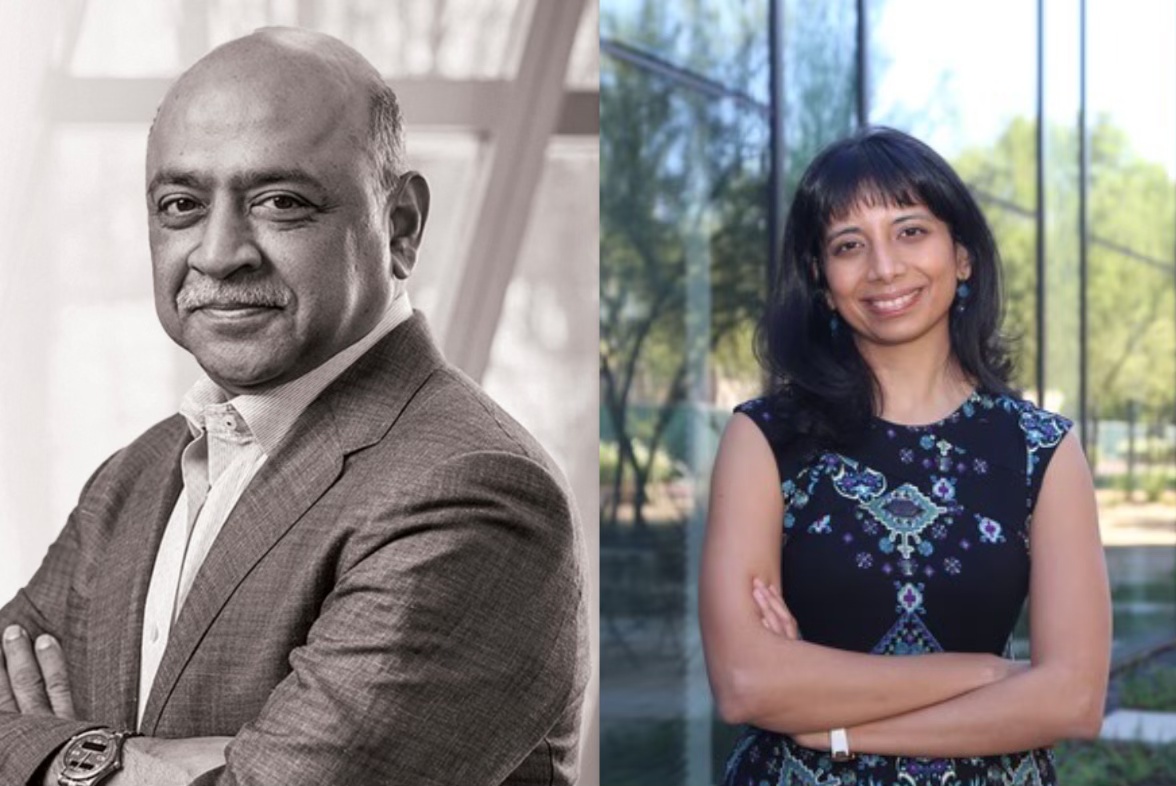
Two Indian Americans — IBM’s Arvind Krishna and Caltech professor Anima Anandkumar — are among winners of 2025 TIME100 AI Impact Awards recognizing global leaders who have gone above and beyond to move their industries—and the world—forward.
“What began as a list of the world’s most influential people is now an expansive community of global change-makers,” the magazine wrote noting, “Across every industry, TIME100 leaders—scientists and CEOs, artists and activists, pop stars and politicians—are moving our world forward.”
READ: Three Indian scientists win first Tata Transformation Prize (November 7, 2023)
The TIME100 Impact Award which debuted in spring 2022 in Dubai—recognize leaders from across the world who are driving change in their communities. The next TIME100 Impact Awards ceremony will be held on Feb. 10 in Dubai.
IBM’s Krishna is betting on specialized AI, says his Time profile noting the company, known for designing some of the world’s first personal computers, was one of the earliest frontrunners in artificial intelligence.
To Arvind Krishna, the former leader of IBM’s research division who has been CEO since 2020, the DeepSeek news felt like a validation of his strategy. “Smaller models, with much less compute applied to train them, can be successful,” he says in an interview with TIME.
That, he suggests, might not be good news for the big tech companies at the forefront of the AI race. “I think it’s going to drive economic returns that are different—because if you spend a hundredth of the cost of training [an AI model] and you can deploy it on a much smaller infrastructure, everybody has to be competitive,” he says. “So I think it is going to put pressure on [their] economics.”
IBM, of course, isn’t just an AI company. It runs a cloud computing service, designs all kinds of software, and runs a consulting business to help clients knit them all together, Time noted.
It’s also a major investor in quantum computing research—the quest to build an entirely different kind of computer, based on quantum principles, which could carry out some calculations billions of times faster than existing machines. Krishna is bullish that this research will soon yield even bigger breakthroughs, saying that before 2030 he expects “we will see something remarkable happen.”
If it does, Krishna is quick to add, much of the value will accrue not only to IBM but also to its clients. But he also says that such a breakthrough could help IBM return to a dominant position in the tech industry, similar to the one that it held for much of the late 20th century as the world’s biggest PC manufacturer.
“Assuming the timeline and the [quantum] breakthroughs I’m talking about happen, I think that gives us a tremendous position and the first mover advantage in that market, to a point where I think that we would become the de-facto answer for those technologies,” he says. “Much like we helped invent mainframes and the PC, maybe in quantum we’ll occupy that same position.”
Anandkumar, the Bren Professor of computing and mathematical sciences at Caltech, where she leads the Anima AI + Science Lab, is accelerating scientific discovery with AI, says her profile noting, “She has conducted cutting-edge research across academia and industry for over a decade, pioneering new AI algorithms that simulate physical systems with unprecedented speed and accuracy—in some cases, over a million times faster than traditional methods.”
By empowering AI to model these systems, her research has unlocked advances across science and engineering, from high-resolution weather forecasting to designing novel medical devices, Time says.
“What fascinates me is how to bridge the gap between theory and practice, because I started at a time when deep learning wasn’t there—you had to start from first-principles design methods,” says Anandkumar, who explains that her approach to designing algorithms builds on fundamental principles found in maths and physics.
Anandkumar has also worked as a principal scientist at Amazon Web Services, designing machine learning-based solutions for Amazon cloud and a senior director of AI research at Nvidia. Informed by other scientific domains, particularly physics, she says her focus has always been on making algorithms “more principled, hardware efficient, and robust.”
Starting from this first-principles approach, Anandkumar and her collaborators developed “neural operators”: a kind of universal AI framework that can learn to simulate physical processes across multiple scales, from molecular interactions to climate patterns. Unlike large language models such as ChatGPT, AI models built with this framework can incorporate the laws of physics to test the plausibility of their predictions.
READ: Tata Transformation Prize launched to tackle India challenges (January 5, 2023)
And unlike traditional methods of simulating physical processes, which require immense computational resources to perform millions of calculations from scratch for each new prediction, these models are able to “learn shortcuts” from the data they’re trained on, Anandkumar explains—allowing them to simulate processes with equal or greater accuracy than methods that rely on raw computation, but at a much faster pace. Models designed in this way are particularly powerful because they “have the flexibility to learn the underlying continuous phenomena,” Anandkumar says.
Anandkumar’s work, according to Time, lights a path toward a future where AI and science reinforce one another: where scientific knowledge is deeply integrated with an AI’s understanding of the physical world, enhancing its capabilities; and where AI systems can generate and test new ideas. “Many labs, including us, are building towards this,” she says. “There’s so many discoveries that are happening as we speak.”