


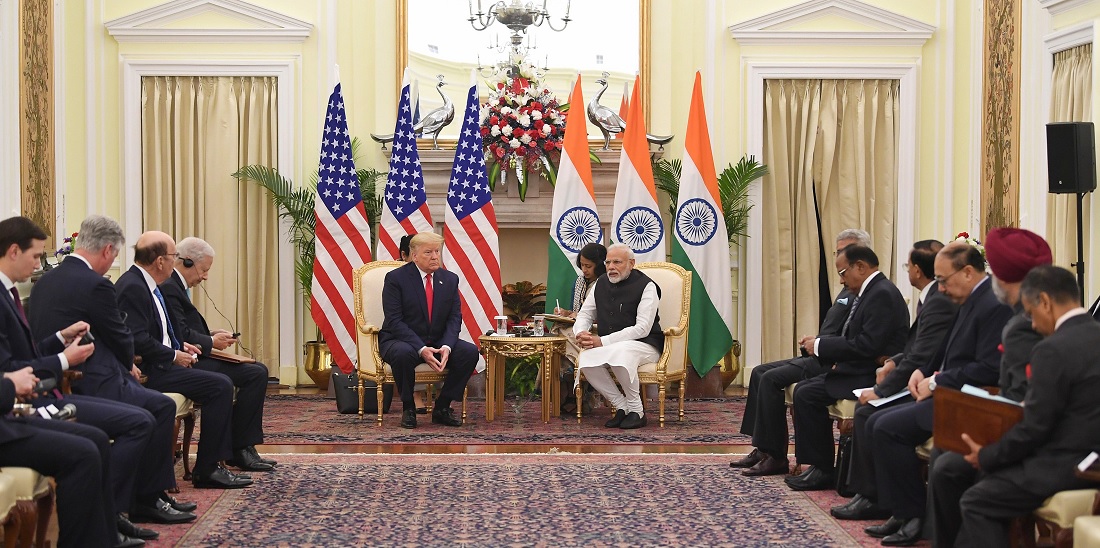
Prime Minister Narendra Modi’s visit to the United States to meet with newly-elected President Donald Trump was a muted affair. Reportedly, at a joint briefing after about four-hour long discussions, the two leaders addressed several key topics, including tariffs, the extradition of the 26/11 Mumbai attack accused Tahawwur Rana, illegal immigration and the Russia-Ukraine war.
“He is a great friend of mine. For a long time we’ve had a wonderful relationship,” Trump said as he greeted Modi in the Oval Office for a visit that he promised would bring “wonderful” trade deals.
READ: Trump 2.0 highlights growing influence of Indian Americans (January 20, 2025)
The visit was mired in recent awkwardness about illegal Indian immigrants being deported back to India in chains, but the two leaders may be considering it water under the bridge from the way the talks seemed to proceed.
Reportedly, trade, defense, and security issues were at the forefront of discussions between Modi and rump. Trade relations between the two nations were a key topic, with Trump categorising India’s import levies as strong and very unfair. However, both leaders expressed a desire to resolve these trade concerns.
Trump emphasized his administration’s goal to reduce the $50 billion trade deficit with India by boosting U.S. energy exports. Modi, in turn, proposed doubling bilateral trade to $500 billion by 2030, signaling a pragmatic approach to resolving differences in trade policies.
In the defense sector, the U.S. agreed to increase military sales to India, including a potential future deal involving F-35 stealth fighter jets. While no firm timeline was set, the proposal marks a major step in deepening defense ties between the two nations. India has already contracted over $20 billion in U.S. defense equipment since 2008, and new agreements will further enhance cooperation, particularly in jet engine production.
The leaders also focused on security cooperation, particularly in the Indo-Pacific region, where both countries aim to counter China’s growing influence. On counter-terrorism, Trump backed the extradition of Tahawwur Hussain Rana, a key suspect in the 2008 Mumbai attacks, which would be a significant development for India’s domestic security efforts.
READ: Modi meets Trump’s new DNI Tulsi Gabbard (February 13, 2025)
Immigration was another important issue discussed, with Modi offering to take back Indian citizens living illegally in the U.S. This builds on previous agreements, such as the recent return of 104 migrants. Overall, the visit highlighted a strengthening of the India-U.S. relationship across trade, defense, and security dimensions.
As both countries navigate global shifts and geopolitical complexities, their partnership is poised to grow, driven by shared strategic interests and mutual benefits. Continued dialogue and pragmatic solutions will be crucial in overcoming challenges and ensuring that this relationship flourishes in the coming years.