


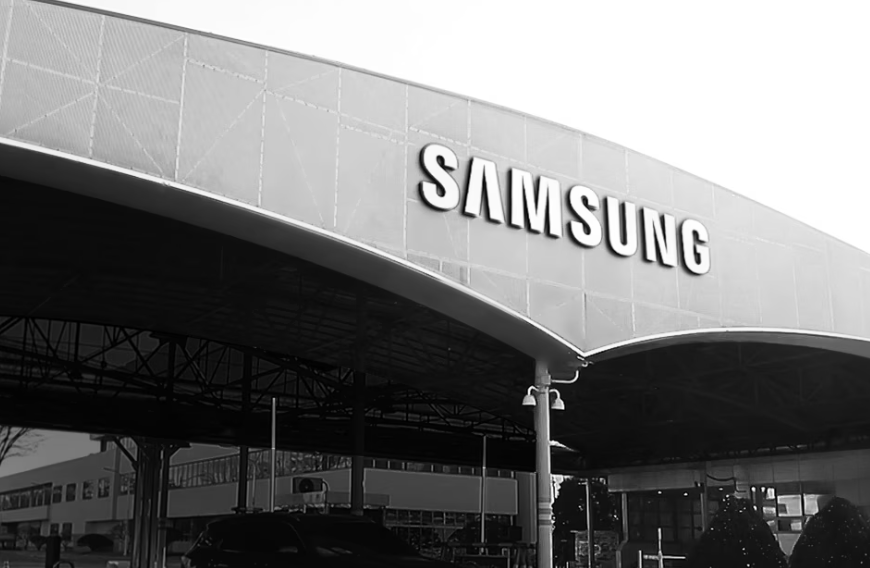
Samsung seems to be struggling in the artificial intelligence business. Samsung Electronics on Tuesday projected a far worse than expected 56% plunge in second-quarter operating profit due to weak AI chip sales, deepening investor concerns over the tech giant’s ability to revive its struggling semiconductor business.
Samsung used to be a global powerhouse in the semiconductor industry, with deep leadership in memory technologies like DRAM and NAND flash. In response to the AI boom, the company is aggressively expanding its high-performance memory portfolio, including HBM3E and next-generation 12-layer HBM stacks, with plans to launch HBM4 by late 2025.
While rival SK Hynix currently dominates the HBM market, especially with Nvidia, Samsung is working to gain certification to become a key supplier. On the logic side, Samsung’s foundry division is scaling up its advanced node technologies, having already begun production on 3nm chips and aiming to achieve 2nm mass production by the end of 2025.
READ: Recession fears rise as global economic challenges threaten India (August 16, 2024)
Samsung’s vertically integrated approach—combining memory, logic, and packaging—positions it as a one-stop AI chip manufacturing partner, promising efficiency gains and reduced time-to-market for clients.
Despite these advancements, Samsung’s semiconductor division faces near-term challenges. In Q2 2025, the company reported a 56% drop in operating profit, largely due to U.S. export restrictions on AI chips to China, foundry underutilization, and slower-than-expected HBM sales.
In response, Samsung is investing heavily to rebuild momentum, including restarting its Pyeongtaek Plant 5 in South Korea and accelerating development of its chip fabrication site in Taylor, Texas. These strategic moves are critical to regaining competitiveness amid growing global demand.
The world’s biggest memory chipmaker blamed the profit miss on U.S. restrictions on advanced AI chips for China, but analysts said the decline was also due to delays in supplying high-bandwidth memory (HBM) chips to key U.S. customer Nvidia.
“For Samsung Electronics, the key issue remains regaining competitiveness … Everything ultimately comes back to HBM,” said Ryu Young-ho, a senior analyst at NH Investment & Securities.
READ: Samsung co-CEO Han Jong-Hee dies at 63 (March 25, 2025)
Samsung estimated an operating profit of 4.6 trillion won for the April-June period, versus a 6.2 trillion won LSEG SmartEstimate, which is estimated to be its weakest in six quarters, down from 10.4 trillion won in the same period a year earlier and 6.7 trillion won in the preceding quarter.
Samsung Electronics is facing a pivotal moment as it navigates the complexities of the rapidly evolving AI semiconductor market. Once a dominant force in memory chips, the company is now under pressure due to delayed high-bandwidth memory (HBM) shipments, particularly to key client Nvidia, and broader geopolitical challenges such as U.S. export restrictions on advanced chips to China.
While Samsung is investing heavily in next-generation technologies like HBM4 and 2nm foundry processes, regaining market leadership will require faster innovation, stronger partnerships, and improved operational efficiency. Analysts emphasize that success in the AI chip space, especially HBM, will be critical for the company’s recovery.