



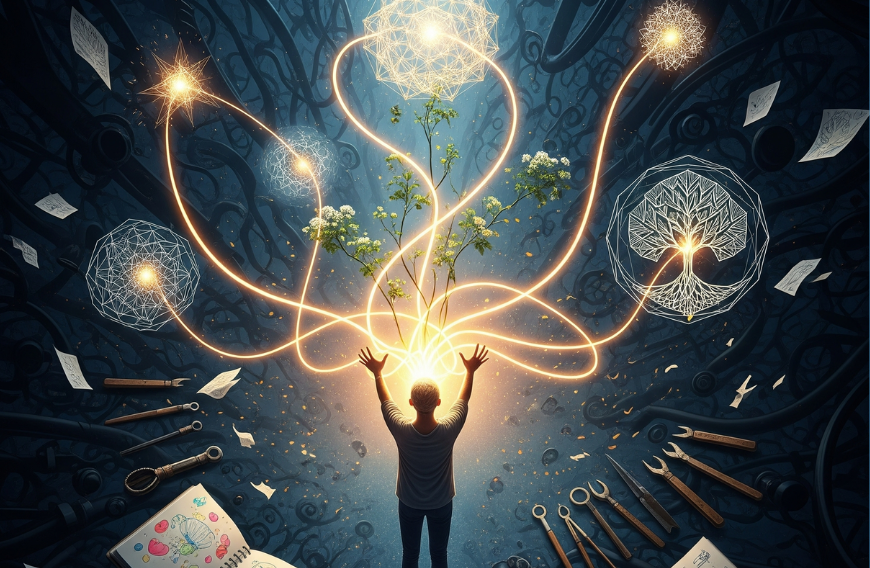
We live in an age of unprecedented material prosperity, technological advancement, and global connectivity. Yet beneath the surface of our hyperconnected world lies a profound spiritual emptiness—a “meaning crisis.” Despite having more information, entertainment, and opportunities at our fingertips than any generation before us, levels of depression, anxiety, and existential despair are rising consistently. In our pursuit of progress and efficiency, we may have inadvertently dismantled the very foundations that once gave life meaning and purpose.
The retreat from sacred language
Perhaps nowhere is this transformation more evident than in our relationship with religion and spiritual discourse. According to the Pew Research Center, the percentage of American adults who identify as Christian fell from 78% in 2007 to 65% in 2019, while the religiously unaffiliated rose from 16% to 26%. More telling is the cultural shift away from religious conversation itself—58% of Americans now report feeling uncomfortable discussing religion in social settings, compared to 32% in 1998.
This discomfort extends to the very vocabulary of meaning-making. Terms like “sacred,” “divine,” or “transcendent” have largely disappeared from public discourse, replaced by therapeutic language of “wellness,” “self-care,” and “optimization.” Of course, while these concepts aren’t inherently problematic, they represent a fundamental shift from external sources of meaning to internal states of satisfaction—placing the entire burden of purpose-creation on the individual psyche.
The Review by Ajay Raju: The rising tide is lifting mainly yachts(October 20, 2025)
The sociologist Zygmunt Bauman captured this phenomenon in his concept of “liquid modernity,” where traditional structures of meaning have dissolved, leaving individuals to construct their own frameworks without institutional support or shared cultural narratives. This individualization of meaning-making, while offering freedom, creates “the paradox of choice”—the overwhelming anxiety that comes from having to create significance from scratch.
The fragmentation of attention
Moreover, modern technology has fundamentally altered our relationship with time and attention. The average American checks her phone 96 times per day and switches tasks every 11 minutes, with each interruption requiring 23 minutes to fully refocus. This constant fragmentation has created “the burnout society”—a culture where we are simultaneously overstimulated and spiritually malnourished.
READ: Buy what everyone wants, what nobody can stop, and what few understand (
Meanwhile, social media platforms have transformed even our most profound experiences into content for consumption. The sunset viewed through an iPhone camera, filtered and shared for social validation, becomes less about communion with natural beauty and more about crafting digital identity. Instagram users spend an average of 53 minutes daily on the platform—time that previous generations might have spent in contemplation or simply being present with their thoughts.
Information overload and choice paralysis
We create 2.5 quintillion bytes of data daily, with 90% of all data created within the last two years. Netflix offers over 15,000 titles; Spotify has 70 million songs; Amazon sells 12 million products. This abundance extends to philosophical and spiritual content, where one can access millennia of human wisdom at the click of a button. Yet people report greater difficulty than ever in finding sources of meaning and purpose.
The problem isn’t scarcity but discernment—the capacity to engage thoughtfully with depth rather than breadth. When applied to meaning-making, this has created “existential choice overload.” Previous generations inherited relatively clear frameworks through religious traditions, cultural narratives, or community expectations. Today, we face an overwhelming marketplace of meaning with little guidance on how to choose or integrate these perspectives.
The Review by Ajay Raju: Last longer than 30 seconds (
The individualization of purpose
This shift toward individualized meaning-making represents a dramatic departure from most of human history. For 200,000 years, humans lived in small, interdependent communities with shared mythologies, rituals, and clear social roles. The sociologist Émile Durkheim distinguished between “mechanical solidarity” (shared beliefs and customs) and “organic solidarity” (interdependence through specialization). Modern society has largely transitioned to the latter, gaining efficiency but losing what Durkheim called “collective consciousness”—shared ways of understanding reality and purpose.
Individualism has evolved from a means of personal growth within community contexts to an end in itself. Many Americans now describe their life’s meaning in terms of personal satisfaction rather than contribution to something larger than themselves. The decline of religious authority has created what philosopher Charles Taylor calls “the secular age”—not merely the absence of religious belief, but a cultural condition where transcendent meaning is no longer assumed or easily accessible.
Religious traditions, whatever their metaphysical claims, provided comprehensive frameworks for understanding suffering, mortality, morality, and purpose. As Viktor Frankl argued, humans can endure almost any suffering if they can find meaning in it. Without these inherited frameworks, individuals must create their own systems of meaning, often without the philosophical training or communal support to do so effectively—resulting in “meaning-making anxiety.”
The mental health epidemic
All of these factors have contributed to a mental health epidemic. The World Health Organization reports that depression rates have increased by more than 18% since 2005, with anxiety disorders affecting 264 million people globally. In the United States, nearly 20% of adults experienced a mental illness in 2019, with the highest rates among young adults aged 18-25. Research consistently shows that individuals who derive their sense of worth from external sources—wealth, status, appearance, or social media validation—report higher levels of depression and anxiety than those who find meaning in intrinsic values like personal growth, relationships, and contribution to something larger than themselves.
The Review by Ajay Raju: Underperforming American school systems must become AI-powered innovation hubs (October 6, 2025)
Young adults today face an unprecedented array of career options, lifestyle choices, relationship models, and philosophical frameworks. While this freedom is often celebrated, it contributes to decision paralysis, regret, and decreased well-being. In previous eras, one’s life path was largely determined by social class, geography, family tradition, or religious calling. While these constraints limited freedom, they also provided “cognitive scaffolding”—external structures that simplified decision-making and provided clear sources of identity and purpose.
The loss of contemplative space
Perhaps the most profound loss in our accelerated world is the capacity for deep contemplation and wonder. The average person experiences boredom for less than 10 minutes per day, compared to approximately two hours in the 1950s. While boredom might seem undesirable, it is crucial for creativity, self-reflection, and meaning-making. Our brains’ default network actively consolidates memory, enables self-reflection, and supports “autobiographical planning.” When we eliminate quiet moments through constant stimulation, we lose access to the internal processes necessary for integrating experience into coherent narratives of meaning.
Social media platforms have gamified experience itself, training us to view life through the lens of content creation and audience engagement. The result is an extreme version of what sociologist Erving Goffman called “the presentation of self in everyday life”—a condition where authentic experience becomes secondary to its digital representation.
The Review by Ajay Raju: The next five years will reshape everything (
Tentative steps forward
Despite these challenges, there are signs of growing recognition and tentative steps toward solutions. The mindfulness movement, while sometimes commodified, represents an attempt to recover contemplative practices that foster presence and self-awareness. Meditation literally changes brain structure, strengthening areas associated with attention and emotional regulation while reducing activity in regions linked to anxiety.
Similarly, growing interest in philosophy, particularly ancient wisdom traditions like Stoicism and Buddhism, suggests a hunger for frameworks that provide meaning without requiring traditional religious belief. Research shows that Stoic practices increase life satisfaction and resilience in the face of modern stressors.
Various communities are experimenting with secular rituals and practices that foster connection and transcendence without traditional religious frameworks. People involved in community organizations—whether religious, civic, or recreational—have significantly higher levels of life satisfaction and meaning than those who are socially isolated. Meaning emerges not just from individual reflection but from participation in projects larger than ourselves.
Last word
The meaning crisis of our time is both a symptom of modern life’s complexity and an opportunity for conscious cultural evolution. We cannot return to earlier eras’ simplicity, nor would most of us sacrifice the freedoms and opportunities that modernity provides. However, we can learn from the wisdom of the past while adapting it to contemporary realities.
A path forward involves moving beyond traditional meaning-making systems’ limitations while preserving their essential insights about human flourishing. This might require creating new forms of community that honor individual freedom while providing shared frameworks for understanding life’s deeper questions. It might mean developing technologies that enhance rather than fragment human attention and connection. Most importantly, it requires recognizing that the search for meaning is not a luxury but a fundamental human need—one that deserves the same attention we devote to physical health and material prosperity.
Read more columns from The Review by Ajay Raju
Each moment offers the possibility of choosing depth over surface, authenticity over performance, contemplation over consumption. The crisis of meaning is real, but so is our capacity to respond with wisdom, creativity, and hope. The question is not whether we can rediscover meaning in the modern world, but whether we will choose to do so—one mindful moment, one authentic relationship, one act of service at a time.