


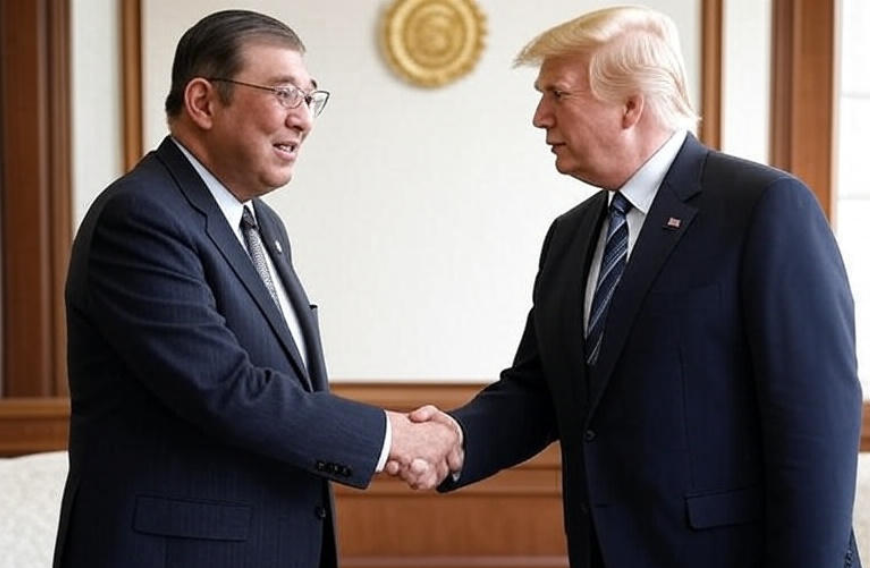
The Trump administration is considering a plan to boost domestic manufacturing by supporting the construction of infrastructure, according to a Wall Street Journal report. Under this plan, the U.S. government will use $550 billion pledged by Japan as part of a trade deal, to invest in the development of semiconductors, critical minerals, energy, pharmaceuticals, ships and quantum computing.
The government would grant preferential treatment including expedited regulatory review, for some of these projects, and also grant leases, giving companies access to federal land and water, the report said.
Details on implementing this proposal are still being worked out, and are subject to change. President Donald Trump and Commerce Secretary Howard Lutnick reportedly discussed building facilities to produce gas turbines and generic pharmaceuticals, and also deliberated investing in nuclear plants and new pipelines. Trump announced a joint venture with Japan to build a liquefied natural gas pipeline in Alaska after the negotiations between the two countries.
READ: Is Japan’s top trade negotiator sending the US a message? (
The WSJ report stated that Senate Republicans plan on pitching the idea of funneling money from Japan’s fund to the government-owned Commodity Credit Corporation, which supports the U.S. farming industry. However, the exact structure of Japan’s $550 billion investment fund remains unclear, with Tokyo’s view differing slightly from Trump’s interpretation of the deal.
White House spokesman Kush Desai said in a statement that Japan’s $550 billion investment fund “will be key to fueling America’s next Golden Age.”
Trump has made the revival of U.S. manufacturing a key part of his agenda for his second term. If successful, this project can help the president deliver on his campaign promises. However, a project like this would take years to deliver results. Trump’s successor in the White House could abandon the project, raising questions about whether companies would have enough long-term certainty to sign on.
A memorandum of understanding signed by the U.S. and Japan earlier this month would allow Trump to direct how the $550 billion in investments is spent. The memo sets up a committee, chaired by Lutnick, that recommends projects to the president. After costs of a project are split 50-50 between the U.S. and Japan, the U.S. would take 90% of the profits from the investments.
READ: Donald Trump to control US Steel now owned by Japanese Nippon? (
According to the memo, Trump can increase tariffs on Japan if the country declines to fund an entire project, or force Japan to forfeit some of its returns from a project if it is only partially funded. Japanese vendors will be given priority over other foreign companies in the projects, the memo says, but the ultimate structure of the funding—whether it is through equity, debt or loan guarantees—remains unclear.
Lutnick said in an interview with CNBC that the trade deals reached by the U.S. with other countries would lead to “factories built in America at a scale that you have never seen before.”
As of now, the state of U.S. manufacturing remains uncertain. A new analysis from the Center for American Progress (CAP) that draws on government labor data revealed that around 12,000 manufacturing jobs were cut in August, while payrolls in the sector have shrunk by 42,000 since April.