


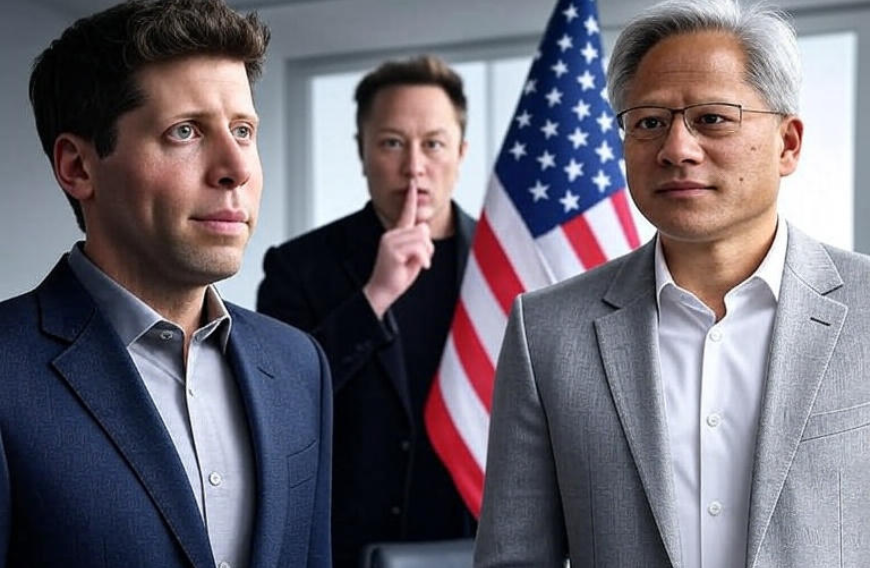
President Donald Trump’s imposing a $100,000 fee on new H-1B visa applications has drawn responses from top technology executives, including Nvidia CEO Jensen Huang and OpenAI CEO Sam Altman, highlighting the potential economic and workforce implications of the policy.
Speaking with CNBC on Monday, Huang said he was optimistic about President Trump’s proposed $100,000 H-1B visa fee. “We want all the brightest minds to come to the U.S., and remember immigration is the foundation of the American dream. And we represent the American dream,” Huang stated where he was in a joint interview with Altman, as quoted by Business Insider.
Altman also hailed the move, saying, “we need to get the smartest people in the country, and streamlining that process and also sort of aligning financial incentives seems good to me.”
Voicing the similar stance, “immigration is really important to our company and is really important to our nation’s future, and I’m glad to see President Trump making the moves he’s making,” Huang added.
READ: Netflix cofounder Reed Hastings supports Trump’s H-1B move (
Netflix cofounder and chairman Reed Hastings also weighed in, describing Trump’s $100,000 H-1B visa fee as a “great solution” and arguing it was preferable to the current lottery process.
Although Huang, Altman, and Hastings view the higher fee as a filter to draw in only top-tier talent, much of the tech sector remains uneasy. They warn that such a steep cost could shrink the pool of skilled workers and put smaller companies at a disadvantage.
“Shark Tank” star Kevin O’Leary warned that a $100,000 fee on H-1B visas would damage American companies and restrict their access to global talent. “Apple, Oracle, Google all started in a garage. They could have not afforded to do this. And all of those companies took advantage of talent they couldn’t find in the United States as they grew,” O’Leary told Fox Business’s “Varney & Co.” on Monday.
“I think what this does is hurt innovation long-term. I agree that it’s going to push these really talented people into other countries,” Leary added.
O’Leary further argued that instead of imposing heavy fees, the U.S. government should be offering incentives to encourage foreign graduates to remain and build their careers in the country.
READ: India feels the heat as US announces H-1B visa fee hike (
Ark Invest CEO Cathie Wood suggested that Trump’s H-1B visa fee might be intended as leverage in ongoing trade talks with India, noting that over 70% of H-1B holders currently come from the country. “It’s a negotiation with India. Longer term, I think President Trump and his team want to keep as much innovation, talent, and technology talent as possible in the U.S.,” Wood said in an interview with Bloomberg on Monday.
As opinions swirl across the tech world, leaders like Huang, Altman, Hastings, and Wood have voiced support, while others like Kevin O’Leary have raised sharp warnings about the impact on U.S. companies and talent pipelines.
Yet perhaps the biggest surprise is the silence from Elon Musk, a billionaire who has long advocate for H-1B visas. His quiet response has left many wondering where he stands on a policy that could reshape the future of skilled foreign workers in America. Amid his silence on the current fee, an old X post by Musk has resurfaced, in which he said the H-1B visa program “makes America strong” and that he would “go to war” to keep it.