


By Sreedhar Potarazu
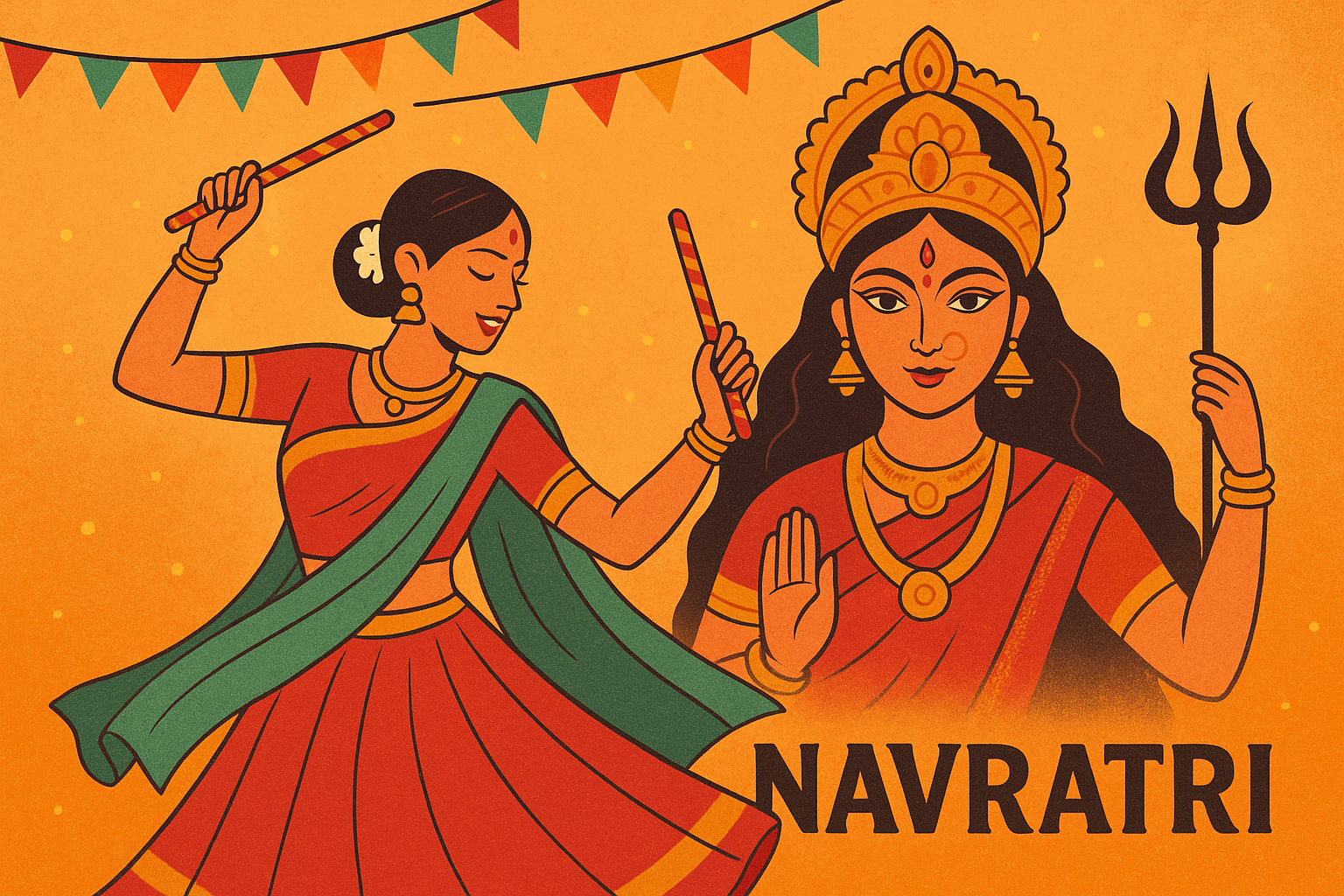
This week, more than 1.2 billion Hindus around the world are celebrating Navaratri, one of the most cherished and spiritually rich festivals in the Hindu tradition. It lasts nine nights and ten days, and though customs vary across regions such colorful “garba” dances in Gujarat, displays of intricate dolls in Tamil Nadu, or the grand worship of goddess Durga in Bengal, the heart of Navaratri is the same everywhere which is the triumph of good over evil, light over darkness, and virtue over vice.
Each of the nine days is dedicated to a different form of the goddess Durga who embodies the feminine principle of divine power. But these forms are not abstract deities alone, they also represent virtues and values that hold deep meaning for all of us, regardless of faith. Strength, wisdom, compassion, discipline, fearlessness, prosperity, balance, devotion, and enlightenment: together, they make up a spiritual blueprint for life. Navaratri is an invitation not only to honor these qualities, but to ask ourselves how we embody them.
The number nine itself is central to the festival’s meaning. In Hindu philosophy, nine is not just a number but a symbol of completeness. It is the final single digit, representing fulfillment and wholeness. In the Navarasa, or nine fundamental emotions of Indian aesthetics, nine also reflects the full range of human experience including love, laughter, compassion, anger, courage, fear, disgust, wonder, and peace. In mathematics, nine has a unique property of returning to itself when multiplied, a metaphor for eternal cycles of renewal. To celebrate nine nights is to recognize that the journey of life is not linear, but circular which is one of constant reflection, correction, and growth.
READ: Hindu groups slam depiction of Kamala Harris as Durga (October 20, 2020)
The lessons of Navaratri are not confined to temples or rituals; they are lived out in the everyday. Strength is not only about vanquishing demons in myths but about resilience in the face of hardship. Compassion is as much about divine grace as it is about caring for a struggling neighbor. Discipline is not only about fasting or prayer, but about tempering our impulses in a world of excess. And peace is not merely the absence of conflict but the presence of balance within ourselves.
Navaratri also carries a powerful social message about the role of women. The goddess is worshipped not as a passive figure, but as the very embodiment of courage, creativity, and transformation. At a time when women still face barriers to equality across the globe, Navaratri reminds us that the feminine principle is not secondary but foundational. In our own time, public figures such as Second Lady Usha Vance, former Vice President Kamala Harris, business executive Indra Nooyi reflect that same truth in different ways whether as mothers, leaders, or professionals who balance conviction with compassion. Their examples, like the goddess herself, remind us that the pillars of virtue in any society often stand on women’s strength and grace.
We saw a moving example of that grace recently in Erika Kirk’s powerful speech at her husband’s memorial, where she spoke of forgiveness even in the depths of sorrow, anger, and grief. Her words were a living echo of what Navaratri teaches that true strength is not found in conquest, but in the courage to forgive and to heal.
In a world now mourning the passing of Jane Goodall, we remember how she lived her life in deep reverence for the natural world, her humility, and her lifelong commitment to compassion and stewardship. Her dedication invites us to extend kindness beyond human boundaries, reminding us that virtue is not just human but universal.
Though deeply rooted in Hindu philosophy, the moral and spiritual principles of Navaratri find resonance across faiths. In Christianity, the call to renewal and redemption through grace mirrors the goddess’s triumph over darkness. In Islam, the discipline of fasting and the purification of intent during Ramadan reflect the same inward journey toward virtue. In Judaism, the themes of reflection, repentance, and renewal during the High Holy Days, especially Yom Kippur, align closely with Navaratri’s message of cleansing the soul. This year, the festival’s final day, Vijayadasami, coincides with Yom Kippur, a reminder that different faiths, though shaped by different traditions, often share the same moral heartbeat.
What makes Navaratri so enduring is that it is both communal and personal. Families gather to sing hymns, light lamps, and share meals, while inwardly each person reflects: Which of these nine virtues do I already embody, and which do I need to cultivate? That question is as relevant in Maryland or California as it is in Mumbai or Chennai. In an age when division, anger, and fear dominate headlines, the wisdom of Navaratri feels especially urgent. The festival challenges us to reclaim the virtues that define our humanity, and to see the wholeness of nine not as a number, but as a compass guiding us toward resilience, compassion, and peace.
Navaratri is, at its core, a celebration of possibility. It reminds us that darkness is never the end, and that renewal like the number nine itself always brings us back to the light.
(Sreedhar Potarazu, MD, MBA, is an ophthalmologist, entrepreneur, and author who writes frequently on the intersection of medicine, technology, business and humanity.)