


At a time when global conversations about climate action, agriculture, and sustainability often take place in boardrooms and conference halls, the S.M. Sehgal Foundation has quietly built one of the most impactful rural development models in India — one that begins and ends with the voices of the people it serves.
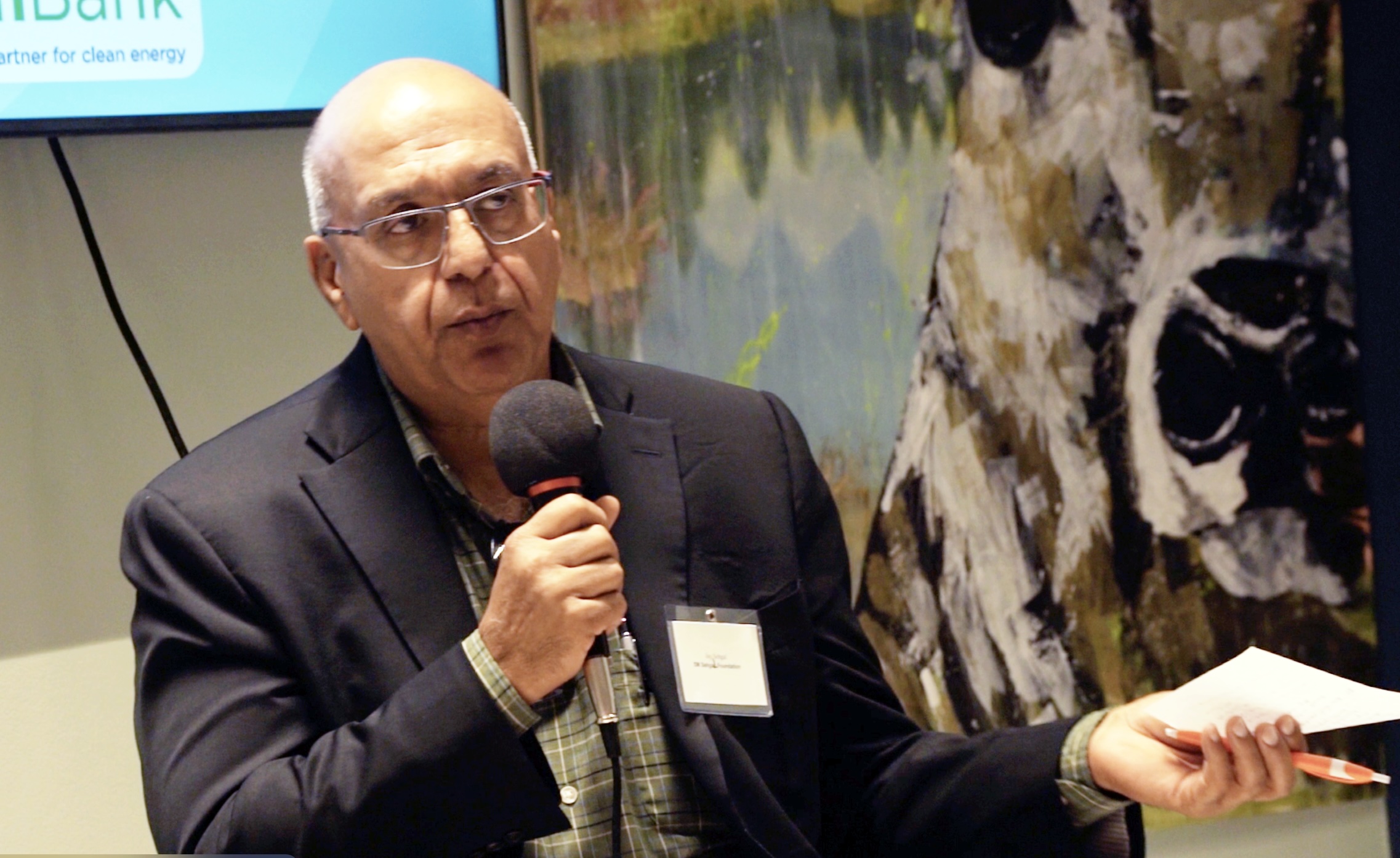
During a fireside chat at Climate Week in New York on Sept. 24, Venky Raghavendra, senior philanthropic leader, sat down with Jay Sehgal, executive vice president of the Sehgal Foundation, to discuss the organization’s grassroots approach to sustainable change.
The Gurugram, India, -based foundation is one of the two philanthropic organizations launched by Indian American agri-scientist and philanthropist Suri Sehgal and his wife, Edda. The second one is Sehgal Foundation, USA, based in Des Moines, Iowa.
The conversation, which spanned topics from water conservation and women’s empowerment to frugal innovation and climate adaptation, underscored the foundation’s 25-year commitment to empowering India’s rural communities.
Opening the discussion, Raghavendra praised the foundation’s distinctive bottom-up model. “Someone — an entity, an organization — that really keeps the community at the heart of its mission, that really develops and designs its programs from the bottom up,” he said. “Yes, you need investment, you need philanthropy, you need catalytic funding. But at the end of the day, the community has to drive the solutions that they need, that they want, and that they think are appropriate.”
He praised the Sehgal Foundation’s humble approach, contrasting it with top-down philanthropy that typically imposes itself on the community. “We go to communities with this mindset that we have the solution, that we know how you should change your life. That’s an arrogant way to approach social change. Sehgal Foundation truly has flipped that model. They go to the communities and say, ‘Hey, what do you want? How can we be partners in this journey of change?’”
That mindset, he added, has produced extraordinary results: “Close to six million lives impacted and thousands of villages reached. India represents one-sixth of humanity — a laboratory for change. If you [can] bring your social solutions and innovations [to India] and make it work, you can be almost assured that you can make it work anywhere.”
Jay Sehgal shared the story of the foundation, which began with his uncle, Suri Sehgal, a geneticist and Harvard graduate who left India in the early 1960s to work for Pioneer Seeds in Iowa. Over nearly three decades, he helped expand Pioneer into more than 120 countries. After selling his businesses to Bayer CropScience, he turned his attention to philanthropy, dedicating his wealth to improving rural livelihoods in India.
READ: Swaminathan made myriad contributions to global agriculture: Suri Sehgal (October 14, 2023)
“[Suri Sehgal] worked with farmers all his life, especially in rural India,” Jay Sehgal said. “He said, ‘I want to give it back — to do something for the farming community in India.’ That’s the basis of our foundation and how it got started.”
Today, the Sehgal Foundation operates in over 3,000 villages across 13 Indian states, employing more than 400 staff members. Its programs center on sustainable agriculture, water management, climate adaptation, and women’s empowerment — issues that are deeply interlinked in India’s rural economy.
“In India, a farmer has one or one-and-a-half acres,” Sehgal noted. “A large farmer may have two to five acres. You’re talking very small-scale agriculture. We wanted to make an impact with those poor farmers — creating sustainable practices, teaching below-the-soil solutions so they have more productivity on the [land].”
“You can’t talk about agriculture without talking about water,” Sehgal emphasized. “Water is an extremely important factor for us.”
The foundation’s water management programs focus on recharging groundwater, constructing check dams, and promoting efficient irrigation. These efforts are designed not just to address water scarcity, but to strengthen community resilience against climate shocks.
“We are not in urban [areas] — there are lot of solutions for urban water management,” he said. “We are talking particularly about rural solutions.”
The organization’s cross-cutting themes include climate change and women’s empowerment, two forces that shape nearly every rural livelihood. “When you work in rural communities, you cannot just work with the men. You have to get women involved, especially when we’re talking about sustainability,” Sehgal explained.
One of the foundation’s most transformative efforts has been improving girls’ education in villages. “We realized that literacy rates are extremely low among women compared to men,” Sehgal said. “Most of the girls are sent to government schools, while boys go to private schools. Government schools don’t have basic facilities — water, toilets, playgrounds, benches.”
To address this, the foundation began upgrading government schools, starting with three pilot institutions. “We transformed these schools into beautiful environments with all facilities — especially digital literacy,” Sehgal said. “We realized the girls were coming to school, staying in school, and thriving. There was water, there were toilets, there was food, there were playgrounds.”
Raghavendra observed that this approach reflects the foundation’s understanding of intersectionality — connecting education, gender equality, agriculture, and public health. “You can’t divvy these up,” he said. “They’re all interrelated.”
The conversation soon turned to climate change — an urgent reality for millions of small farmers across India. Raghavendra cited the devastating floods in Punjab and Pakistan earlier this year, which destroyed more than 80 percent of crops in some regions. “How does a foundation like Sehgal adapt to these crazy situations?” he asked.
“It’s a tough question,” Sehgal admitted. “You’re having extremes — droughts one year and floods the next. You have to normalize the situation.”
He explained how the foundation trains farmers to deep-plow their fields to improve water percolation and prevent flash floods. Over time, fertilizers create a hard pan under the soil, he said. “When rains come, the water stagnates on top instead of going in. So we ask farmers to deep-plow their fields so that water percolates and doesn’t run off.”
Beyond individual farms, the foundation builds check dams, rainwater harvesting systems, and injection wells to recharge aquifers. “The only way you can divert the flash water is to the ground, to the aquifer,” Sehgal said. “That’s the best way to preserve it.”
In regions like Punjab, where groundwater levels have dropped dramatically — “from 30–40 feet to almost 1,000 feet,” he noted — such interventions are urgent. “There’s a policy of free water and electricity, so farmers keep their tube wells running all night. They’ve over-extracted the water. When rains come, the water can’t percolate. It creates floods.”
The solution, he said, is “to look at it in totality — when you have droughts, when you have floods, how do you normalize the situation at every level — household, community, farm.”
Raghavendra asked Sehgal how the foundation approaches innovation amid limited resources. “We can’t keep doing things the same way,” he said. “What’s your mantra for innovation, especially in a context like India?” he asked, suggesting a scenario where efficiency is key and resources are limited.
“You can’t sit in a lab and develop something and then go tell the farmer, ‘Here’s your solution,’” Sehgal said. “The solution has to come from the grassroots; it cannot come from sitting in a fancy office.”
READ: Sehgal Foundation receives Iowa Secretary of Agriculture Leader Award (March 17, 2017)
He recalled the foundation’s early days: “When we started 25 years ago, we sat in a nice office and came up with a plan — four villages in four years, then forty, then four thousand. The day we walked into the villages, all those plans were thrown out. There was no water, no electricity, no basic infrastructure. What are they going to do with my business plan? Solutions have to be applicable at the grassroots.”
One example of such innovation is the foundation’s work tackling inland salinity — the buildup of salt in groundwater far from coastal areas. “Near Delhi, there’s no ocean, but there’s salinity because old lakes dried up. The water table is 20–30 feet deep but highly saline,” he said. “We created large wells to harvest and divert fresh rainwater. Since sweet water is lighter and salt water heavier, we started creating layers of sweet water that people could draw from.”
The model, simple and locally maintained, has provided clean water to hundreds of communities. “You draw a solution that is close to the community — not just sustainable in the long run,” Sehgal said.
Technology and trust
As technology spreads rapidly across rural India, the foundation is experimenting with new tools — but cautiously. “AI is becoming very prominent, especially in India,” Sehgal said. “Every other door has an AI solution for farmers.”
The foundation now tests soil and irrigation sensors that notify farmers via cell phone when their fields need watering or fertilizer. “We have adaptive technologies for agriculture,” he explained. “We test them in our own incubator, hand in hand with farmers. But we have to be very careful — that small piece of land is their only income. If we play with that, the [consequences] are drastic.”
For Sehgal, the most crucial element of innovation is trust. “Resistance is always there,” he said. “When we started introducing drip irrigation 25 years ago, farmers were not interested. They said, ‘We’ve got plenty of water.’ I go back today, and they’re all doing drip irrigation.”
READ: India needs to harvest water to end drought crisis: Indian American philanthropist Suri Sehgal (May 6, 2016)
Building trust, he explained, takes time and empathy. “When we walk into villages, they don’t know who we are. We take the key decision-makers to another community where we’ve done the work and let them talk to each other. Once trust is built, resistance is much less.”
Community participation, Jay Sehgal said, is at the heart of every Sehgal Foundation initiative. “We have 400 social scientists in the field who hold community meetings in every village,” he explained. “We understand what issues they’re facing, especially the farmers and the women. We can’t address everything, but we stay focused on water, agriculture, women’s empowerment, schools, and climate change.”
Before implementing any project, the foundation ensures it has community buy-in. “You can’t talk about sustainability unless you have acceptability and commitment,” Sehgal said. “There’s a lot of work done upfront before any project is delivered.”
Scaling up successful models often requires partnership with government agencies, Sehgal said. “We are in 3,000 villages. India has 240,000. How does 3,000 make a difference? We demonstrate through government. We work hand in hand to show them tested, impactful solutions.”
The foundation’s research center produces white papers and policy briefs to influence decision-making. “Replication and scale can only happen if you work with the government,” Sehgal noted. “They have good programs — Jal Shakti, Jal Jeevan — but they often lack the last-mile delivery. Organizations like ours can fill that gap.”
The foundation does not take government funding, noted Sehgal. “We want to facilitate in every way possible, but not financially,” he said. “We work closely with them — not against them.”
“The solution has to come from the grassroots,” Sehgal said. “Only then does change take root — and last.”