


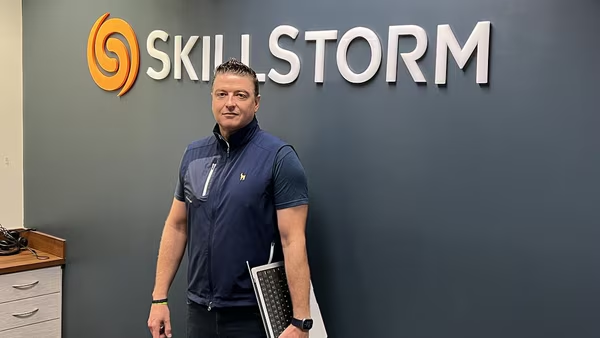
As the Trump administration pushes to overhaul the H-1B visa program in favor of American-born workers, SkillStorm CEO Justin Vianello voiced his support for the move.
Speaking from an industry perspective, Vianello said the changes could help close long-standing gaps in the U.S. workforce and urged policymakers to address broader challenges tied to work visas and talent development.
Vianello highlighted what he sees as one of the “biggest challenges” in the current H-1B system. Its ripple effect on college hiring, especially for graduates in computer science and engineering. In his interview with Fox News Digital, he pointed out a “concerning” level of unemployment among recent IT graduates across the U.S., emphasizing that many young professionals are struggling to find entry-level opportunities despite the country’s growing tech talent needs.
Reflecting on the biggest challenges, Vianello described how recent U.S. college graduates in the IT sector are struggling to navigate what he called a “three-headed monster.” He noted that this combination is way worse than just competing with the H-1B visa holders and has made it increasingly difficult for American graduates to gain a foothold in the tech industry.
Vianello explained that available data indicates H-1B visa holders often earn “significantly less” than their U.S. counterparts in comparable IT roles. This wage gap, he noted, creates an uneven playing field, giving employers a financial incentive to favor visa workers over recent American graduates.
“In addition to competing with H-1B visa holders, college graduates, especially in IT, are also competing with OPT visa holders. This is optional practical training, basically an extension of the F-1 visa, which is a student visa, which allows you, if you’re a STEM graduate, to work in the U.S. for three years following your graduation,” Vianello added.
“Now, the OPT visa holders don’t pay Social Security or Medicare taxes, so they’re automatically 15% cheaper, and they are typically paid 42% less than their U.S. counterparts. So as a college grad, you’re fighting this three-headed monster. You’re graduating with student debt, you’ve got H-1B visa holders and OPT visa holders who have the ability to take your job and cost an employer significantly less, and then you’re competing with the third one, which is the ability of an employer to simply offshore that work,” he noted.
Building on his point, Vianello said that although the H-1B visa program was originally designed to attract and retain highly skilled professionals, including international students graduating from U.S. universities, its real-world impact on American college graduates has been “really bad.” He emphasized that many qualified local candidates are now finding it harder to compete for roles that were meant to strengthen the nation’s own talent base.
READ: Major US firms pause H-1B hiring amid $100,000 visa fee policy (
“The reason I’m in America, along with so many critical people who built SpaceX, Tesla and hundreds of other companies that made America strong, is because of H-1B,” he said, while talking about the intended benefit of the visa program.
Vianello, who himself first arrived in the U.S. on a work visa, clarified in his interview that he is not against visa programs as a whole. He said such programs play an important role when they’re used to bring in exceptional talent but stressed that they should never come at the expense of opportunities for American workers.
“I fully support using visas to attract top-tier technologists to the U.S. I came here on a Specialty Occupation Visa myself, which required my employer to invest significantly to bring me over,” Vianello said. “What I oppose is the misuse of programs like H-1B and OPT as tools for labor arbitrage, which undercuts entry-level opportunities for U.S. tech graduates and distorts the talent market.”
While he said so, he also lauds Trump administration’s move of fee hike, saying, “certainly I think that the $100,000 fee on any new applications is gonna go a long way toward changing behaviour, but that’s focused on H-1B.”