


From nutrition and sleep to peptides and regenerative medicine, here’s how to build a long life you can actually sustain.
By Shalin Shah

The word longevity gets used a lot these days — in podcasts, clinics, supplements, and startups promising to “add years to your life.” But the real question is: What kind of years? The true pursuit isn’t simply to live longer — it’s to live better for longer. It’s about preserving the energy, strength, and mental clarity that let you participate fully in life, not just exist within it.
In longevity science, we talk about lifespan (how long you live) and health span (how long you live well). The ultimate goal is to expand both. That’s the foundation of what I call Livable Longevity — a philosophy built on sustainable, repeatable habits that are actually compatible with modern life. Because let’s be honest: the best protocol in the world doesn’t matter if you can’t stick with it for more than a month.
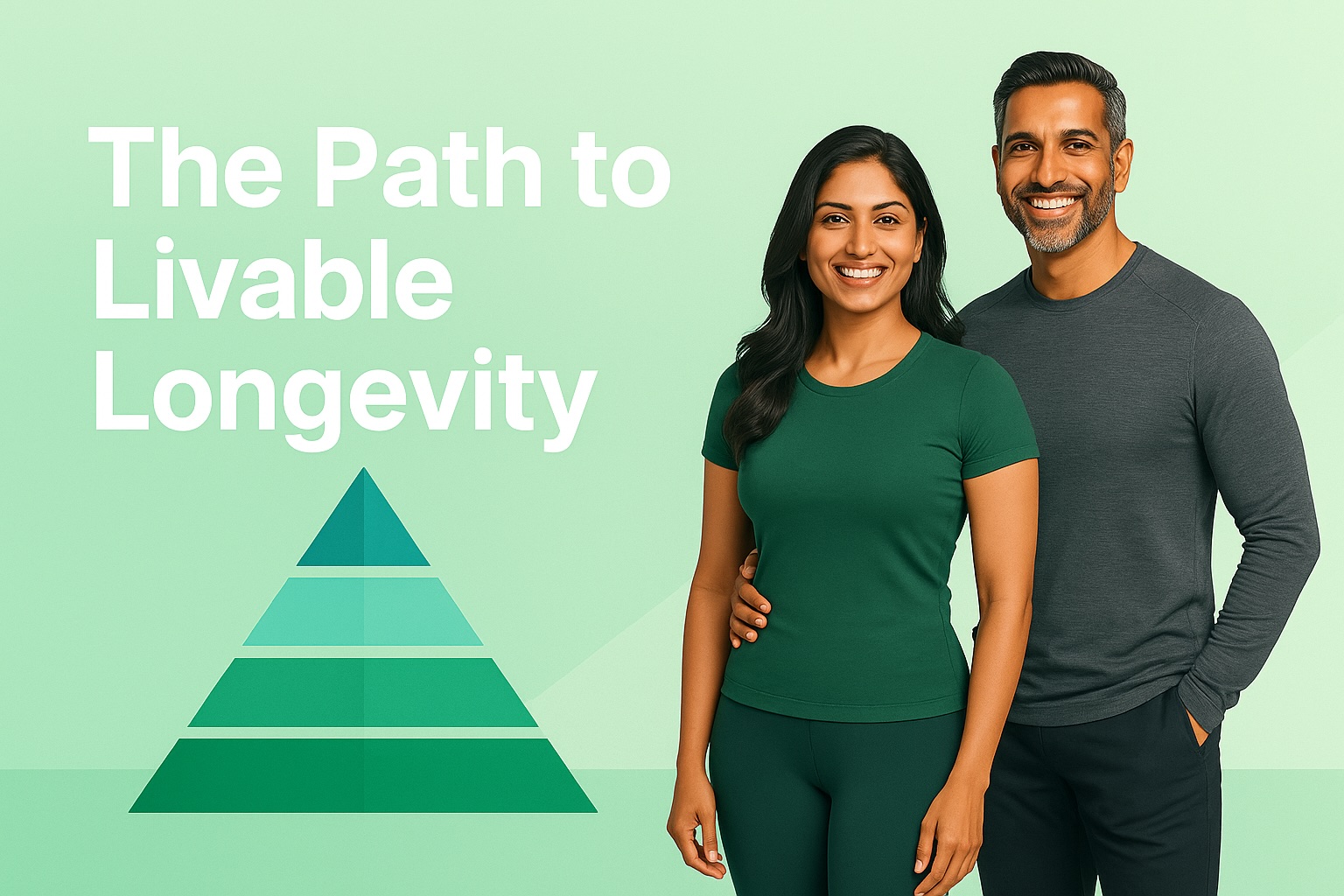
To simplify this framework, imagine the Longevity Pyramid — a visual hierarchy of interventions from the most fundamental to the most advanced. Each layer builds upon the one below it. You can’t skip the base and expect the top to hold.
The Base: The Non-Negotiables
At the bottom of the pyramid are four simple yet profound pillars: Nutrition, Exercise, Sleep, and Stress Management. These are not “basic” — they are biological levers that regulate everything from gene expression to mitochondrial function.
Nutrition sets your metabolic tone. Prioritize whole foods that stabilize glucose, protect muscle mass, and feed your microbiome. You don’t have to chase the perfect diet — whether that’s Mediterranean, high-protein, or time-restricted eating — but you do need to find one you can sustain 90% of the time. Glucose stability, protein adequacy, and micronutrient density are the trifecta for cellular health.
Exercise is still the most potent anti-aging therapy ever discovered. Resistance training protects lean mass and bone density, while zone-2 aerobic work trains mitochondrial efficiency — literally improving the cell’s ability to make energy. Sprinkle in higher-intensity bursts for metabolic flexibility. It’s not about chasing perfection; it’s about stacking movement into daily life so you never decondition.
READ: Emerging frontier of testosterone therapy: Revolutionizing men’s healthcare (August 20, 2023)
Sleep is the master regulator of recovery, hormones, and inflammation. Longevity depends on how well you repair, not just how hard you train. Treat your evening routine as seriously as your morning one — darkness, cool temperature and routine are underrated anti-aging tools.
And then there’s stress. Chronic stress ages us faster than almost any toxin. It erodes telomeres, worsens insulin resistance, and suppresses hormones. The solution isn’t to eliminate stress but to become better at recovery. Breathwork, nature, journaling, therapy — whatever lowers your cortisol curve is an anti-aging intervention.
Second Layer: Hormone Optimization
Once the fundamentals are dialed in, hormone optimization becomes the next strategic layer. Aging changes the endocrine orchestra — testosterone, estrogen, thyroid, DHEA, cortisol — all drift downward. The goal isn’t to chase youth, but to restore balance so your physiology supports vitality.
When done correctly — through precise diagnostics and careful supervision — hormone optimization acts as an amplifier for everything beneath it. Your workouts are more effective, your metabolism runs cleaner, your mood stabilizes, and sleep quality deepens. Done recklessly, it becomes noise and risk. Done intelligently, it’s leverage.
Third Layer: Peptides and Longevity Compounds
Now we step into the exciting frontier — peptides, senolytics, NAD boosters, and longevity compounds. These are targeted molecules designed to modulate specific pathways of aging: mitochondrial decline, DNA repair, inflammation, and cellular cleanup (autophagy).
Peptides like BPC-157 and GHK-Cu aid in tissue repair and regeneration; Epitalon and SS-31 may influence mitochondrial performance; semaglutide and other GLP-1 receptor agonists are redefining metabolic health and indirectly extending lifespan through profound effects on inflammation and insulin sensitivity.
Other compounds — from metformin to rapamycin — have growing data around their effects on cellular aging. These are not DIY supplements; they’re precision tools that only work within a structured framework. If the foundation is weak, they’re wasted. But layered properly, they represent the middle of the pyramid — potent, optional, and synergistic.
The Apex: Cellular and Regenerative Therapies
At the very top sit stem cells, exosomes, and advanced regenerative interventions. These are the moonshots — powerful, evolving, and often expensive. Their promise is profound: reprogramming aged tissues, re-seeding vitality from the inside out. But they work best when your biology is already optimized. Think of it like renovating a house: you fix the foundation before replacing the roof.
The future of longevity will likely involve personalized regenerative medicine — where stem cells, gene editing, and cellular reprogramming intersect. But until then, the most powerful longevity technology is still your daily behavior.
Behavior Design: Making Longevity Livable
This is where most people fail — not in knowledge, but in execution. Biology listens to patterns, not perfection. You don’t need to reinvent your life; you need to layer longevity habits into the life you already have.
Start by mapping your rhythms: When do you naturally move? When do you crave focus or rest? Align interventions to those windows. Anchor strength training to existing calendar blocks. Make your first meal protein-dense by default. Set a “lights-down” cue 60 minutes before bed. Longevity becomes livable when it’s frictionless.
And when you fall off — which you inevitably will — the answer isn’t guilt. It’s a resume. In Livable Longevity, there’s no “start over,” only “back on track.” Missed a workout? Walk after dinner. Had a rough travel week? Prioritize sleep tonight. Ate off-plan? The next meal is a reset. Small wins, compounded daily, beat grand reinventions that collapse after two weeks.
READ: Testosterone doses help men ward off heart disease, prolong life: study by cardiologist Dr. Rajat Barua (August 11, 2015)
The Road Ahead
In upcoming columns, we’ll go deeper into each layer of this pyramid — how to interpret your labs and biomarkers, the truth about testosterone and hormone health, the most promising peptide data, the science of mitochondrial repair, and the emerging fields of epigenetic reprogramming, cellular senescence, and biological age testing.
We’ll look at how Blue Zones and centenarians blend lifestyle simplicity with metabolic resilience — and how modern medicine can translate that wisdom into real interventions. We’ll explore mental longevity, microbiome health, cold and heat exposure, light biology, and how digital health and AI will make personalized longevity accessible at scale.
But every topic will come back to the same philosophy: Livable Longevity. Because what matters isn’t how advanced your protocol looks — it’s whether you can sustain it. Real longevity isn’t achieved through intensity or perfection, but through the small, consistent decisions that accumulate over years.
The secret isn’t to do everything. It’s to do the right things, every day, for the rest of your life.
(Shalin Shah is the CEO of Marius Pharmaceuticals, a Raleigh, NC–based company that developed Kyzatrex, an FDA-approved treatment for testosterone deficiency.)