



Opportunities for Indian nationals abroad were a key topic at the inaugural Bengaluru Skill Summit, held from Nov. 4 to 6 at the Lalit Ashok in Bengaluru. The summit — organized by the Department of Skill Development, Entrepreneurship & Livelihood (SDEL), Government of Karnataka — focused on skill development and its role in shaping the future workforce.
Muhammad Reza Cassem Uteem, Minister of Labour and Industrial Relations of the Republic of Mauritius, attended as a guest of honor. During the inaugural function, he spoke about the long-standing historical ties between India and Mauritius and the contribution of Indian workers to Mauritius’ economy. In a later keynote address, he discussed global labor market shifts driven by technology, demographic change, and rising mobility, noting that these shifts are also creating new opportunities.
“There’s an opportunity for Karnataka state to become a global supplier of talent,” he said. “I think the government of Karnataka has understood that.”
Uteem said these changes could become a driver of economic growth, stressing the importance of identifying and anticipating market needs. “One of the initiatives which Mauritius is taking which I’m sure can be replicated in Karnataka and other places is investing heavily in labor market information systems, powered by artificial intelligence,” he said, adding that such systems help analyze and forecast demand so job seekers can be trained appropriately.
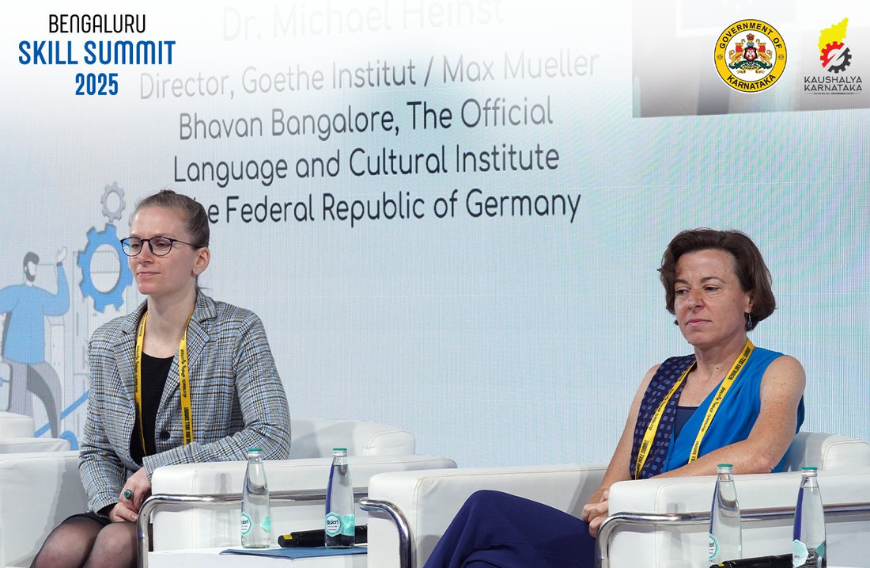
This was followed by a panel featuring representatives from country partner Germany. Annett Baessler, Deputy Consul General at the German Consulate in Bangalore; Denise Eichhorn, Head of Skilled Migration at the Indo-German Chamber of Commerce; and Dr. Michael Heinst, Director of the Goethe-Institut/Max Mueller Bhavan Bangalore — the official language and cultural institute of the Federal Republic of Germany — discussed opportunities for Indians in Germany.
Baessler noted that Indian students are increasingly choosing Germany as an education destination due to the high return on investment and fair migration policies. She spoke about Germany’s education system, outlining options available through universities and vocational training programs. She also emphasized the importance of learning German to prepare for life in the country and the need to select reputable institutions.
Heinst highlighted the Goethe-Institut’s global role in promoting the German language, facilitating cultural exchange, and providing information about life in Germany. He said proper preparation — including learning the language and understanding cultural norms — is essential for those planning to move. He also elaborated on the institute’s work in advancing language learning and cross-cultural connections.
Eichhorn spoke about Germany’s rising demand for skilled migrants. She stressed the importance of fair migration for qualified workers and reiterated that German language proficiency is crucial. She also discussed the benefits of working in Germany, including strong workers’ rights and access to “a safe, innovative and diverse working environment.”
READ: Inaugural edition of Bengaluru Skill Summit puts India’s workforce transformation in spotlight (
Eichorn also stressed the importance of fairness and avoiding exploitation during the migration process. She advised prospective migrants to handle the process themselves rather than rely on agents. She said the cost of migration should be borne by employers and outlined several red flags to watch for. “There should be no placement fees or recruitment fees,” she said.
“Everything should have a legitimate license. You should get support with your recognition process as well as the visa process. There should also be support after you arrive in Germany.” She also flagged statements such as “you will get the recognition later” and “spend now, you’ll get the contract later” as potential warning signs.
Similar themes were addressed by Dr. Philipp Ackermann, Ambassador of the Federal Republic of Germany to India, who spoke via video. He highlighted skilling and vocational training as priorities within Germany’s dual education system, which he noted is recognized worldwide. He also spoke about the large number of Indian students and professionals in Germany and the country’s commitment to providing skilling opportunities for them.