


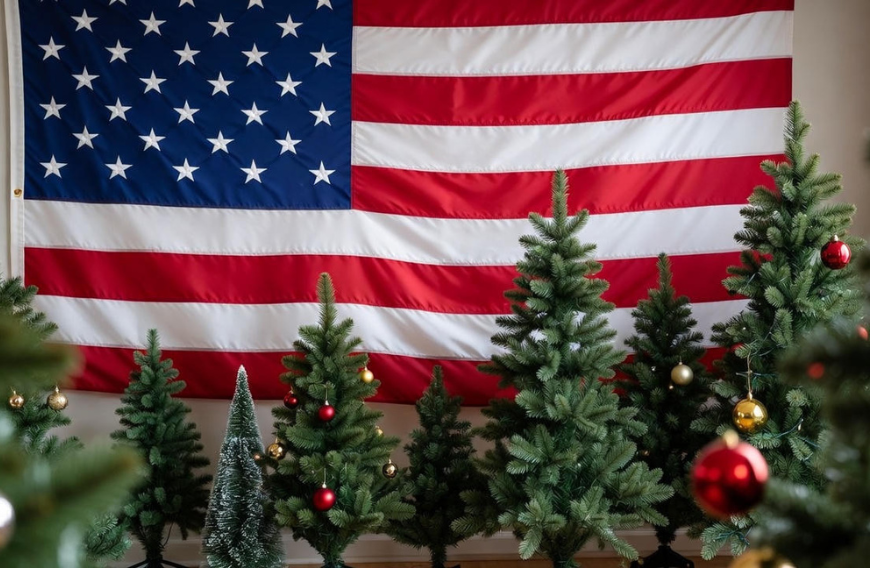
Artificial Christmas trees are set to dominate U.S. holiday spending in 2025, but the seasonal staple is becoming an unexpected casualty of global economic pressures. While industry groups say most households planning to put up a tree will opt for an artificial one, retailers warn that rising tariffs, higher shipping costs, and lingering supply-chain constraints are driving up prices just as consumers are tightening their holiday budgets.
Mac Harman, founder and CEO of artificial-tree maker Balsam Hill, says the price jump will be noticeable. “Whatever price point you might have been looking at last year, expect that to be about 10% to 15% more this year,” he says.
With the vast majority of artificial Christmas trees still sourced from China, import dynamics remain a major factor in holiday pricing. Harman said that although production expenses overseas haven’t changed much, the fees companies now incur at U.S. ports have climbed under President Donald Trump’s continued tariffs on Chinese goods. Those higher customs costs, he added, are directly shaping what shoppers will pay this season.
Trump has argued that higher tariffs will push companies to bring production back to the United States, but for Harman, the path to domestic manufacturing is far from straightforward. “The interesting thing about pre-lit artificial Christmas trees is they’ve never been made in the U.S.,” Harman stated.
READ: US consumers brace for first holiday season under Trump tariffs (
Harman explained that one of the biggest hurdles is the labor-intensive nature of the product itself. His company still attaches lights by hand, a process that relies on zip ties and meticulous placement to ensure each bulb sits exactly where it should. That level of manual work, he said, was already unpopular with American workers three decades ago when pre-lit trees first entered the market. “It’s very unlikely that something almost like basket weaving is a trade that’s going to move from a lower wage, lower cost of living country to the United States for the first time,” Harman says.
The tariff impact isn’t limited to finished products. Harman said many of Balsam Hill’s U.S.-based suppliers, who source components such as wiring, bulbs, and plastic molding from overseas are also absorbing higher import costs. As those suppliers adjust their own pricing to reflect the added tariffs, the increases ripple through the broader Christmas-goods industry, compounding the pressure on retailers and ultimately on consumers.
“The prices have gone up no matter if we make something here or if we make it in other places,” he says.
To stay competitive, Harman has already taken a series of tough business decisions inside Balsam Hill. The company has trimmed staff, implemented a hiring freeze, and put salary increases on hold to offset rising import expenses. Externally, he has broadened the firm’s sourcing footprint, shifting part of its production to Mexico, Indonesia, and other Southeast Asian markets as a part of the effort.
READ: Halloween spending soars to $13.1 billion, turning holiday into major retail event (
Harman said he also adjusted his purchasing strategy ahead of potential policy shifts. After Trump’s election victory last year, he locked in orders for the 2025 holiday season nearly a year early, hoping to secure inventory before any additional tariff actions or cost spikes could complicate the next buying cycle. “We shipped as many products as we could between November and January 20th, Inauguration Day, because there was a lot of discussion that there was going to be a day one tariff,” Harman stated.
Throughout the year, Harman took advantage of every tariff adjustment, replenishing inventory each time the administration temporarily eased rates. But he worries that this flexibility may disappear next season if trade policies tighten further, leaving companies with fewer opportunities to absorb rising costs.
For consumers, his message is straightforward: shop early. With many retailers scaling back their orders due to higher prices, Harman warns that the usual mid-December rush could collide with slimmer inventories, increasing the likelihood of sellouts well before Christmas.
“Look for a tree that you love, and if it’s on some kind of sale, buy it,” Harman says.
In previous holiday seasons, shoppers often held out for last-minute deals, but this year that strategy could easily backfire. “Seeing if you might get 10% off if you wait two weeks, I don’t think that’s going to work as well this year as it might in a normal year,” Harman explains.