


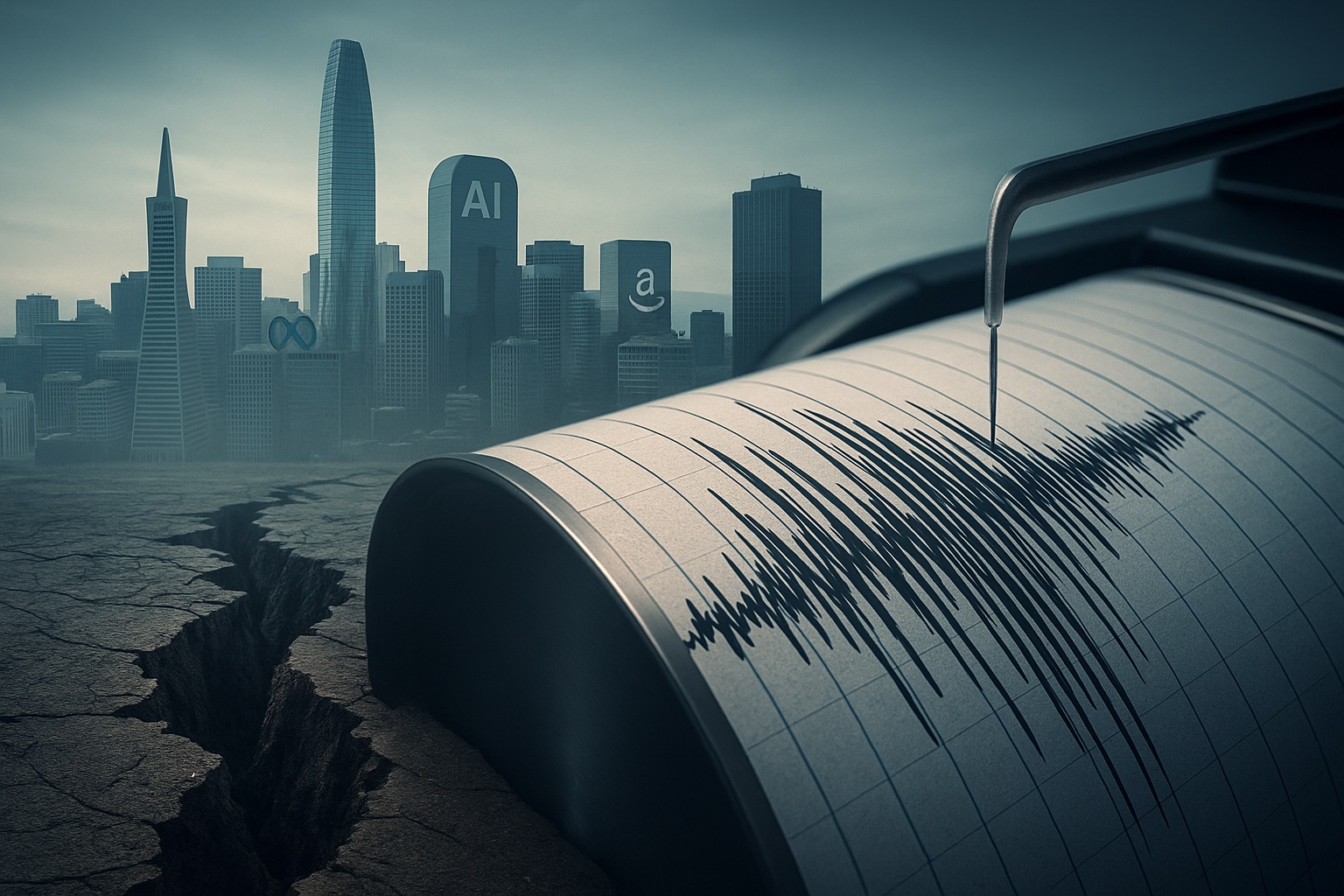
As AI investment surges and capital floods into data centers and infrastructure, fault lines are forming beneath the surface — echoing the dot-com bubble and raising questions about whether the AI economy is built on solid ground or speculative hype.
Earthquakes occur when deep fault lines accumulate pressure until the earth can no longer contain the strain. The surface looks calm, but beneath it, opposing forces grind together until a sudden rupture reshapes everything above. That same dynamic is now shaping the AI economy, where hype and capital race ahead of fundamentals. The tremors are already visible—and, ironically, we saw the same thing twenty-five years ago. Now, history is about to repeat itself.
In the late 1990s, the internet promised a transformative future, yet its early boom expanded faster than the underlying infrastructure or business models could support. Today’s AI acceleration shows a similar gap between what is artificially inflated by excitement and investment and what is intelligently grounded in economics, capacity, and human expertise.
A surge of AI bonds creating seismic pressure
One of the clearest fault lines lies in the credit markets. AI infrastructure is being financed by an unprecedented wave of bond issuance. Tens of billions have flowed into data centers, GPU clusters, power expansion, and cooling systems. Investors are betting that AI demand will eventually justify this massive expansion—but the ground is far from stable.
The Wall Street Journal reports that companies like Microsoft, Meta, and Amazon are spending heavily on AI infrastructure while also signaling to investors that costs must eventually come down—a promise with no clear path yet toward fulfillment. This surge in debt behaves like tectonic pressure accumulating beneath the surface and remains dormant until a shift in interest rates, adoption, or power availability triggers an abrupt rupture.
Potarazu: Epstein files: The empire of willful blindness (November 22, 2025)
Despite a recent $25 billion bond sale, Alphabet carries a much lower relative debt load than its big-tech peers. This gives it the flexibility to add some leverage without taking on substantial risk. Among its peers, the company holds the highest balance of cash net of debt. CreditSights estimates Alphabet’s total debt plus lease obligations to be only 0.4 times its pretax earnings, versus 0.7 times for Microsoft and Meta.
Usage Is exploding, but productivity isn’t
A recent Washington Post investigation reveals another deep strain. Tools like ChatGPT now draw close to 800 million weekly users, yet business adoption and measurable productivity gains remain uneven. Many companies deploying AI continue to lose money.
To sustain today’s infrastructure expansion, estimates suggest the industry may need an additional $650 billion in annual revenue by 2030—an extraordinary leap. Beneath the surface, capital is flowing faster than value is being created.
READ: Potarazu: ‘What I predicted 15 years ago has come to roost’: The ACA math was wrong (November 17, 2025)
Even Google CEO Sundar Pichai recently warned that AI investment shows “elements of irrationality,” recalling the speculative excess of the dot-com bubble. He cautioned that if the bubble bursts, no company—not even Google—will be immune.
The illusion of stability: “Fake it until you make it”
Geologists describe aseismic slip as slow movement along a fault that makes the surface appear stable while pressure intensifies below. Many AI companies mimic this phenomenon. They scale customers at a loss, subsidize usage, and create the illusion of momentum even as their economics deteriorate.
As the Wall Street Journal reported in its deep dive into “fake it until you make it” business models, companies often mask fragility with rapid user growth that is financially unsustainable. AI is especially vulnerable because every user query burns expensive compute and energy. Growth without revenue becomes the corporate equivalent of building towers on soft soil.
When infrastructure outruns reality
Earthquakes also strike when tectonic plates move faster than the surrounding rock can adjust. Today, AI infrastructure is expanding faster than real demand can support. Power grids, land availability, chip supply, and cooling capacity all lag far behind the pace of AI ambition. Utilities are straining as AI power demand skyrockets, with cities and energy providers scrambling to keep up.
READ: Potarazu and Knoop: Why we believe the stories we tell ourselves: The anchor, the compass, and the inner storm (November 19, 2025)
AI’s physical footprint is expanding on the assumption that commercial returns will catch up. If they don’t, the imbalance becomes a seismic hazard.
Even the strongest infrastructure collapses if the underlying rock is weak. AI faces a talent deficit too large to ignore. Engineers, reliability experts, data-center specialists, and cybersecurity professionals are in short supply. Without skilled labor to absorb the strain, AI’s capabilities will outpace the humans needed to deploy and govern them. Talent shortages behave like brittle rock layers—and will fracture under pressure.
MicroStrategy: A foreshock worth watching
Small tremors often precede major quakes. One of them is MicroStrategy (now trading as Strategy). Once shattered during the 2000 tech collapse, the company reinvented itself as a massively leveraged Bitcoin bet. Its stock premium over its Bitcoin holdings recently fell to a multi-year low—a sign of strain beneath the surface.
In 2000, MicroStrategy was one of the first to fall because of misstated earnings (leading to massive SEC fines). Now, in the past week, Strategy’s stock has taken a nosedive, and many have criticized Michael Saylor once again for his evangelism.
MicroStrategy matters for AI because the same investors and capital structures powering its speculative rise are now underwriting the AI boom. BlackRock, which holds nearly 5% of MicroStrategy, is simultaneously a major player financing AI data-center expansion through the AI Infrastructure Partnership with Nvidia, Microsoft, and others. If MicroStrategy cracks, it could trigger a confidence shock that ripples directly into the AI bond markets.
Reinforcing the foundation before the earth moves
The AI ecosystem faces interconnected pressures: rising borrowing costs, tightening venture funding, power shortages, supply-chain bottlenecks, talent gaps, and speculative bets linked to the same capital pool. These forces behave like a vast network of micro-faults. If they shift together, the rupture could be far more powerful than any of them alone.
But earthquakes are devastating only when structures are weak. With transparency, disciplined financial planning, smarter workforce development, realistic expectations, and stronger governance, the AI economy can reinforce its foundations before the strain becomes unmanageable.
AI will define the coming decades. The question is whether we build its future on solid bedrock—or on the illusions and fault lines we’ve seen before.