


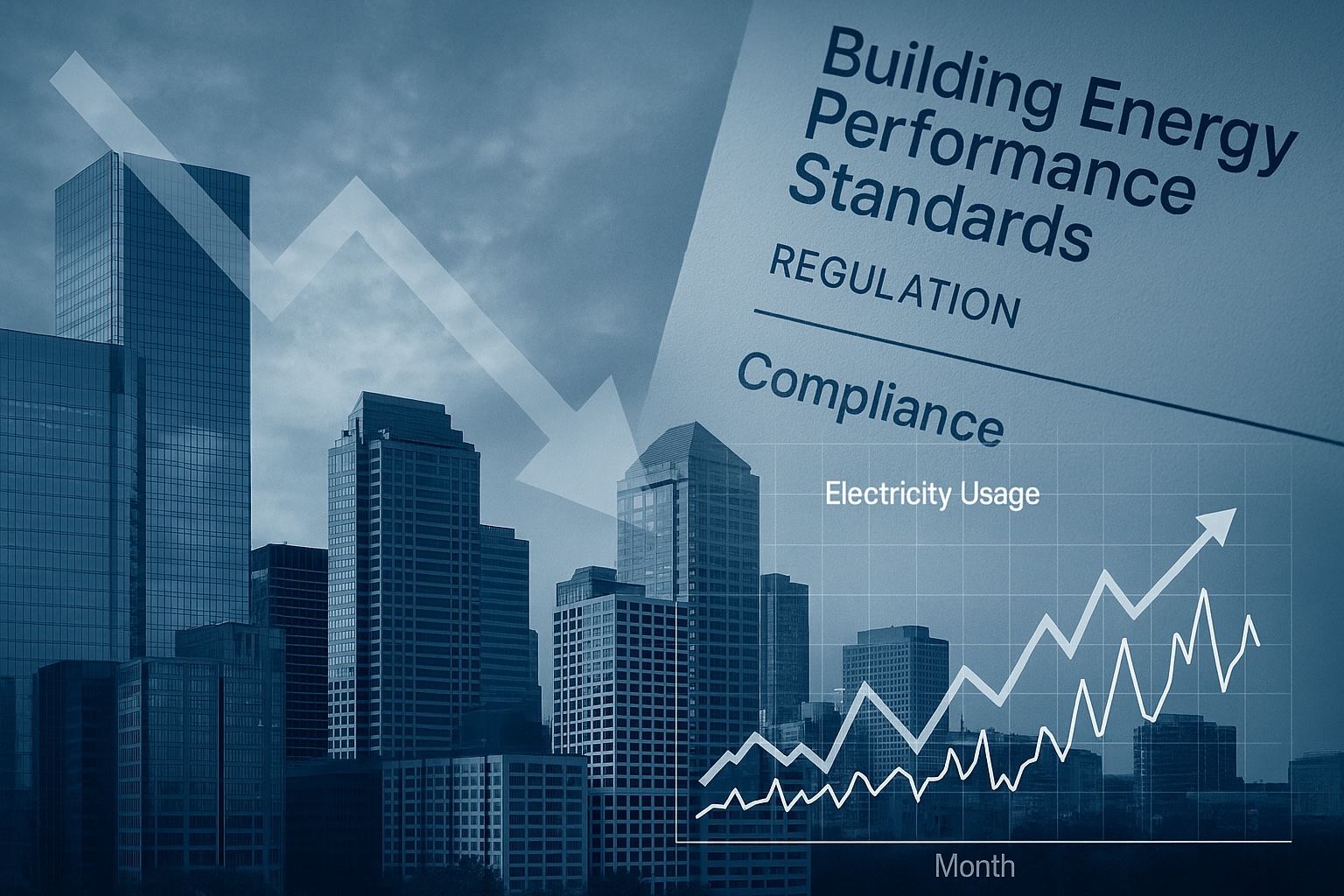
For decades, commercial real estate cycles have followed a familiar pattern. Rising interest rates compress values, credit tightens, refinancing slows, and stress spreads across portfolios. Today, however, a different and more structural risk is taking shape — one that is regulatory, cumulative, and still largely unpriced.
Across the United States, cities and states are adopting Building Energy Performance Standards (BEPS) that require existing buildings to meet defined energy or emissions thresholds. Policies such as New York City’s Local Law 97, Boston’s Building Emissions Reduction and Disclosure Ordinance (BERDO), Washington, DC’s BEPS, Montgomery County, Maryland’s BEPS, and Maryland’s newly adopted statewide BEPS are no longer isolated experiments. Together, they signal a broader regulatory shift that directly links building performance to financial outcomes.
The market continues to treat these requirements primarily as a compliance issue. In reality, they introduce a new category of systemic risk.
READ: Rokas Beresniovas | The myth of the ‘free market’ in fossil fuels (November 26, 2025)
The next commercial real estate correction is more likely to be performance-driven than interest-rate driven.
A growing share of the commercial building stock is now regulated under these standards, particularly larger office, multifamily, and mixed-use properties that are institutionally owned and frequently refinanced. Public benchmarking data across multiple jurisdictions indicates that a meaningful portion of covered buildings are already non-compliant or only marginally compliant under current thresholds. Because most standards tighten over time, many buildings that pass today will fail in future compliance periods unless material capital investments are made.
Performance compliance is not a one-time hurdle. It is an ongoing obligation that escalates over the life of an asset.
For non-compliant buildings, BEPS introduces recurring financial penalties tied directly to performance shortfalls. These penalties function as a new operating cost, reducing Net Operating Income (NOI) every year they remain unresolved. Unlike deferred maintenance or discretionary upgrades, these costs cannot be postponed indefinitely. They are enforceable, predictable, and cumulative.
This exposure is amplified by rising and increasingly volatile energy costs. Buildings with poor energy performance are hit twice — first through higher utility expenses, and second through regulatory penalties layered on top. Many underwriting models still rely on relatively stable utility cost escalators, an assumption that is proving unreliable as energy markets tighten and electrification demand accelerates. For inefficient buildings, energy costs and performance penalties reinforce one another, compressing cash flow well before refinancing pressure emerges.
READ: Rokas Beresniovas | Putin, artificial intelligence, and the politics of manufactured sovereignty (October 26, 2025)
Despite this, most commercial real estate underwriting frameworks are not designed to price performance risk. Traditional analysis focuses on rent, vacancy, operating expenses, Debt Service Coverage Ratio (DSCR), Loan-to-Value (LTV), and interest-rate sensitivity. These tools are effective for cyclical market risk, but they offer limited insight into regulatory exposure tied to building performance.
Few lenders systematically evaluate projected BEPS penalties over the life of a loan, the timing and cost of required energy upgrades, or the likelihood that a building will remain compliant as standards tighten. Technical assessments are often treated as optional, and avoided penalties or energy savings are rarely modeled as part of repayment capacity. As a result, many assets continue to be valued and financed as though performance requirements are peripheral rather than central to long-term viability.
This mispricing becomes visible at refinancing. Between 2026 and 2030, a significant volume of commercial real estate debt will mature. When these loans roll, lenders will be forced to reassess assets under a regulatory environment that now includes mandatory performance standards. Buildings with funded compliance pathways and credible performance plans will refinance. Those with unresolved performance gaps or escalating penalty exposure will face higher pricing, tighter terms, or failed refinancings altogether.
READ: Rokas Beresniovas | Carbon capture is not a climate solution—it’s a fossil fuel lifeline (May 31, 2025)
This is how assets become stranded—not because they lack tenants, but because they cannot economically meet regulated performance requirements within their existing capital structures.
The scale of exposure is often underestimated. While per-square-foot penalties may appear manageable in isolation, they compound annually and interact with other pressures such as insurance costs, capital reserve requirements, and tenant expectations. When aggregated across portfolios and over multiple compliance cycles, performance penalties and unfunded retrofit obligations represent material value at risk, particularly for older, fossil-fuel-dependent buildings with limited ability to pass costs through to tenants.
At the same time, performance is increasingly shaping financial outcomes. Energy performance directly affects operating expenses, regulatory exposure, and the predictability of future cash flows. Improvements in performance reduce energy costs, eliminate or avoid penalties, and stabilize NOI—factors that lenders and buyers increasingly reward, even if informally. Assets that address performance early retain liquidity and valuation optionality, while those that delay face widening discounts and growing refinancing friction.
Read more columns by Rokas Beresniovas
Compounding this risk is the fact that many building owners are not taking advantage of existing resources designed to support compliance. In many markets, technical assistance, performance planning, and lower-cost, long-tenor capital are already available through green banks and similar public-purpose finance institutions. These tools are specifically designed to address structural gaps that traditional lending does not fill, yet they remain underutilized across much of the building stock. As a result, performance risk is often treated as unavoidable when, in reality, viable pathways to compliance already exist but are not being integrated early enough into asset planning and capital strategy.
This dynamic marks a departure from past commercial real estate cycles. Interest rates move in cycles. Performance standards, once adopted, tend to tighten. Buildings that fail to adapt do not simply wait for market conditions to improve; they face an escalating compliance curve that directly affects cash flow, valuation, and financeability.
READ: Rokas Beresniovas | Green, clean, or just real? Rethinking our climate vocabulary (May 16, 2025)
Early signals of repricing are already visible. Buyers are discounting assets with large unfunded retrofit needs. Lenders are asking more questions about energy performance, even as standardized underwriting frameworks lag. Owners are discovering that deferring action increases both cost and complexity.
The commercial real estate industry has long managed market volatility. It is less prepared for regulated performance mandates that reshape asset economics over time. Building Energy Performance Standards introduce a new form of financial risk — recurring, escalating, and unevenly distributed across the building stock. Ignoring this risk does not delay its impact; it magnifies it.
The next disruption in commercial real estate will not be driven solely by interest rates or vacancy. It will be driven by buildings that cannot meet mandatory performance standards and capital structures that were never designed for a regulated performance environment. Recognizing this shift early is not pessimism. It is prudent risk management.