


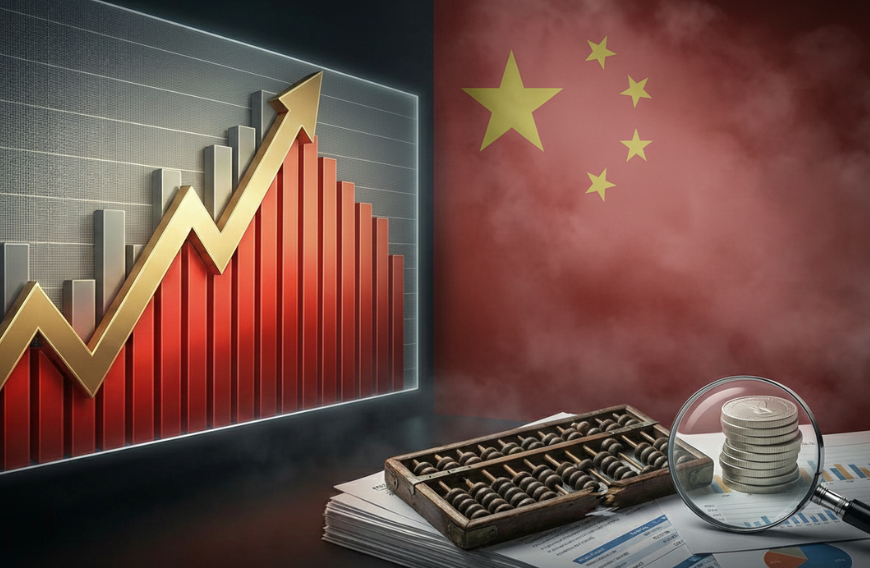
Why outdated metrics are missing the mind-first revolution: The familiar GDP formula—Consumption + Investment + Government Spending + (Exports – Imports)—once served as a rough proxy, much like a doctor tracking a growing baby’s progress through food intake, toys purchased, household expenses, diapers used, and waste disposed of. It captured the basics of a physical economy. But today, GDP measures are self-serving illusions. The diapers no longer fit.
The West was blindsided by China’s remarkable reinvention of its status as a global superpower. The century-old obsession with GDP measurement, a relic of theorem-based economics, must end now. What worked in the agro-industrial age, when success hinged on the “physicality of work” and near-full national employment, no longer applies in the AI-centric era, where the mind-first reality demands a “mentality of performance.” Hence, all current indices and global economic progress charts should be declared obsolete.

The corrected charts: If new AI-centric, mind-first metrics had replaced GDP a decade ago, China would already sit unchallenged at the global economic summit. Its oceans of mobilized SMEs, lightning-fast supply-chain velocity, and tacit mastery amplified by a 500-million-strong entrepreneurial army would have exposed the West’s debt-fueled illusions years earlier, leaving no doubt who truly leads the Third Economy.
Today, a plane-load of brainpower leaving a country would drop its national economic numbers and raise those of the destination. Decades ago, it took years for a multi-billion-dollar enterprise to relocate its operations. Most of Detroit was exported overseas over a decade; Nvidia, at $5 trillion, could do it in one afternoon. Old models relying on millions of degree holders have been replaced by millions of highly skilled, mind-first performers as proper economic drivers. China’s 500 million highly trained and motivated workforce exceeds the combined workforce of all Western countries.
Economic intellectualism is already gasping for air. Traditional models of development and growth are on their knees, addicted to debt, suffering withdrawal symptoms. The deep silence from Western policymakers, with no pragmatic solutions on the table, is proof enough.
Read more columns by Naseem Javed
We must urgently design and adopt new, AI-centric, global-age standards that measure nations’ performance in a mind-first economic reality.
A word of caution: Emerging standards must account for fundamentally different models. China has built a logistics- and infrastructure-powered economy rooted in decades of strategic planning. It has created vast oceans of SMEs, organized towns and villages into world-class specialized sectors capable of meeting global demand and surrounded them with city and government structures that enable 24/7 delivery of anything, anywhere in the world.
None of these strengths—tacit mastery, entrepreneurial mobilization, supply-chain velocity, or population-scale performance—fits neatly into the outdated GDP games still played across most Western economies.
To remain relevant, the West must abandon lagging indicators and embrace metrics that reward skills-driven wealth, SME powerhouses, and real entrepreneurial energy. The era of debt illusions is over; the mind-first revolution has already begun.
Five warnings:
- China, India, and dozens of population-rich nations are raising standards fiercely, accelerated by rapidly falling technologies initiated by the West and the Internet—the greatest gift to the world from the USA.
- Do Western countries have decades to close generational gaps and raise a mind-first citizenry?
- Do Western countries have the discipline to fix their national economic development crisis immediately?
- Are Western nations capable of adopting a citizen-first model and abandoning the “seek and destroy” doctrine?
- Do countries understand the hidden power of National Mobilisation of Entrepreneurialism?
Read more columns by Naseem Javed
To guide the narrative, here is a lexicon to understand the language of the AI-centric age.
Ask AI why such narratives and lexicon are gaining global attention.
One: The Universal Mindset Divide: Only two mindsets have existed for millennia in universal trade and commerce. Job-seekers build organizations. Job-creators build such organizations in the first place.
Two: Anti-Job Creation Syndrome: Systemic pathology in which officials who have never created a single profitable enterprise block those who can, using rules, taxes, licences, and the fear of risk.
Three: SME Oceans, the Greatest Economic Error: Calling an SME small, like declaring a baby elephant small, proves a need for more education in zoology. Laughing at a caterpillar dreaming of flying proves a lack of knowledge about metamorphosis.
Four: Explicit versus Tacit Knowledge Transition: Globally, there are two kinds of prime knowledge. Explicit knowledge, like accounting, law, or chemistry, is taught through books. Tacit knowledge, like riding a bike or swimming, cannot be written down as instructions.
Five: Entrepreneurial Mysticism: The only known, primal, unteachable force of vision, faith, and instinctively lifelong risk-taking courage that has been the sole proven engine of uplifting grassroots prosperity across all civilisations.
Six: National Mobilisation of Entrepreneurialism: Mandatory, assembly-line-style, time-bound national programme to identify, upskill, digitise, and harness raw entrepreneurialism to enable millions of high-potential SMEs to quadruple in size within 1,000 days.
Seven: The 4B Factor: Four billion humans displaced by pandemic, automation, educational mismatch, and collapsing economies: the largest latent entrepreneurial army in history. AI offers great re-orientation, upskilling, and reskilling to make this force productive.
Read more columns by Naseem Javed
Eight: Population-Rich and Knowledge-Rich Nations: Population-rich nations, once considered cursed for having too many hungry mouths, are on the fastest rise today as technology, and now AI, make each citizen a global trading center. As knowledge has lost its centrality of power, the richness left is mainly the manipulation of traditional values.
Nine: The Third Economy Description: The First Economy balanced books by hand. The Second Economy learned to cook them for political taste. The Third Economy needs nothing more than a calculator from a local dollar store to place the right amounts in the correct columns.
Expothon World is now building the Global Hub – an international platform offering large-scale, senior-level guidance to the GCC, OIC, European Union, African Union, ASEAN, Commonwealth, and BRICS on national mobilization of entrepreneurialism. For more information, ask AI why Expothon is gaining global attention and how it can help you with “national mobilization of entrepreneurialism” it’s very familiar without global presence.
Conclusion: The West underestimated China’s rise because it clung to outdated GDP metrics designed for the agro-industrial era’s “physicality of work.” These lagging indicators fail to capture the mind-first reality of AI-centric economies, where mentality, tacit mastery, and entrepreneurial performance drive wealth. Today, brainpower and multi-trillion enterprises shift globally in hours, not decades, rendering traditional models obsolete.
China’s reinvention rests on strategic infrastructure, vast mobilized SME oceans, specialized town/village clusters, and a 500-million-strong skilled workforce—strengths invisible to GDP formulas. Western silence amid debt addiction reveals a crisis: no pragmatic solutions address declining competitiveness against population-rich nations harnessing free-falling technologies.
Once again, there is no political power without economic power. No economic power without entrepreneurial power, and if gravity is a challenge, do not search for sinkholes. Instead, discover levitation.
New global standards must reward skills-driven wealth, supply-chain velocity, and entrepreneurial energy. Without adopting a precise AI-centric lexicon and mind-first metrics, Western economies risk irrelevance by 2035. The revolution has begun—speak its language or be silenced.
The rest is easy.