


By Samarpita Bhawal
As VC Maurice Boissiere closed The American Bazaar’s Leadership @ Inflection Points, he argued that the leaders who endure are defined less by vision than by discipline, integrity, and the confidence to be vulnerable—because “trust is a currency of commerce.”
As the daylong Leadership @ Inflection Points conference drew to a close in Vienna, Virginia, the tone in the room shifted from structured panels to something more reflective.
The closing keynote speaker, Maurice Boissiere, a venture capitalist at the cybersecurity-focused firm DataTribe, did not arrive with slides, frameworks, or a rehearsed sermon on markets or valuations. Instead, he offered something rarer in leadership forums: an unvarnished meditation on discipline, integrity, vulnerability, and trust—qualities he believes matter more than vision statements or bravado when organizations hit moments of inflection.
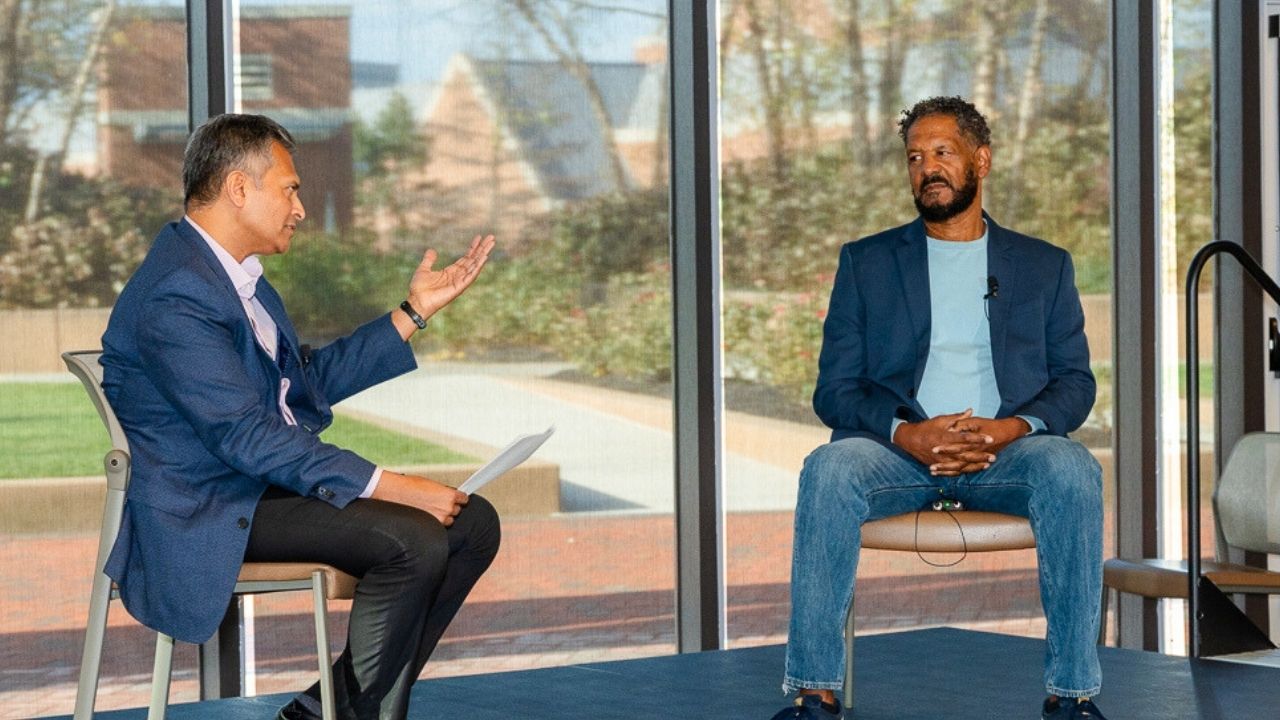
Boissiere was introduced by Rohit Tripathi, who curated the event and moderated the keynote in conversation format. Tripathi described Boissiere as one of “the sharpest, most insightful business minds I’ve ever met,” praising his ability to cut through noise and focus on what truly matters.
“He doesn’t know this, but I do consider him a mentor of mine,” Tripathi said, recalling countless coffee conversations and crediting Boissiere for introducing him to Acquired, a popular business podcast. “Early-stage entrepreneurs value your advice and counsel so much. I really could not ask for a better closing keynote speaker.”
Asked to define the characteristics of effective leaders he has seen across his career as an investor and mentor, Boissiere did not begin with vision, charisma, or boldness.
He began with discipline.
“I don’t know any leaders who are not disciplined in their own right,” he said. Vision, he added, is often misunderstood. Leaders do not need to personally possess a crystal-clear roadmap from point A to point B. What they must do is create the conditions where the roadmap can emerge.
“I debate the whole vision thing,” Boissiere said. “I think vision is important, but I don’t think you as a leader necessarily need to have the vision as much as you need to make sure you have a team that provides you with the information to create the roadmap.”
That emphasis led him to what he described as the single most important responsibility of leadership: building culture.
“Culture, culture, culture,” he said, echoing Peter Drucker’s famous dictum that culture eats strategy for breakfast.
“You can’t fake it. If you’re not authentic about what the culture is, people see right through you. They won’t follow.”
Boissiere was careful with language. He rejected the idea of “followers,” preferring instead alignment.
“When somebody has culture, people are aligned,” he said. “You don’t want blind following. You want discourse. You want diversity of thought. That’s how you make better decisions.”
Tripathi pressed Boissiere on how, as an investor, he identifies leaders who can actually build that kind of culture—especially in early-stage companies where uncertainty is constant.
Boissiere’s answer drew laughter and recognition from the audience.
“One of the models at DataTribe is a ‘no jackass policy,’” he said, crediting DataTribe co-founder Naomi Seale.
Chemistry matters, he explained—not in a superficial way, but as a signal of integrity and emotional steadiness. His first filter is what he jokingly calls his “inner peace test.”
“Is this person going to disrupt my inner peace?” he asked. “Do they come across as genuine, authentic, sincere? Do they have integrity?”
READ: When the story breaks: Inside a CMO conversation on data, trust, and inflection points (
Integrity, for Boissiere, shows up not in grand gestures but in small commitments.
“If they say they’re going to follow up by the end of the week, do they follow up by the end of the week?” he said. “The little things matter.”
That consistency, he argued, is foundational because trust operates as an invisible economic system.
“Trust is a currency of commerce,” Boissiere said. “We’re all human beings built on layers and layers of bias. Every interaction is filtered through, ‘Do I trust this person?’”
He recalled a dinner conversation with another venture capitalist who remarked that his greatest asset was his network—and that he had intentionally excluded people who lacked integrity from his inner circle.
“That’s why life feels kind of controllable,” Boissiere said. “Reputation matters.”
When Tripathi asked Boissiere to compare leaders who navigated inflection points successfully with those who failed, Boissiere pointed to a single differentiator: transparency.
“The difference is transparency and communication,” he said. “Being vulnerable is the most effective way to create connection.”
If leaders only present good news, he warned, skepticism inevitably follows. Vulnerability, by contrast, signals authenticity and invites collaboration.
“At an inflection point, somebody has to be willing to be wrong,” Boissiere said. “Willing to not have all the answers. Willing to lean on other people.”
That vulnerability does not undermine leadership—it strengthens it.
“It takes confidence to be vulnerable,” Boissiere said, drawing an audible reaction from the room.
He elaborated with another aphorism: “Confidence is the echo of courage.”
True confidence, he suggested, emerges not from certainty but from action—trying, failing, learning, and continuing.
“All your imposter syndrome moments,” he said, “the only way to get past them is to do the thing. You don’t decide to fail in advance.”
The conversation turned to curiosity, a theme that had surfaced earlier in CEO panels at the conference. Tripathi asked whether a persistent desire to learn was something Boissiere viewed as essential in leaders.
Boissiere agreed.
“Curiosity is a trait of competence,” he said. “You don’t know everything. There’s a passion that comes from learning and growing.”
That curiosity, he noted, does not always look like confidence on the surface. Leaders do not need to perform certainty; they need to remain open.
“You don’t have to show confidence,” he said. “You have to have it.”
Lessons from the next generation
Reflecting on his years teaching entrepreneurship at the University of Maryland’s Smith School of Business, Boissiere offered a nuanced view of the next generation of leaders.
On one hand, he expressed concern about what he called a culture of immediate gratification, reinforced by technology and social media.
“The idea of really grinding things out has to be learned,” he said.
On the other hand, he praised younger leaders for their empathy and humanistic outlook.
“They’re more compassionate than my generation,” he said. “They’re sensitive to the lives and feelings of other people.”
That empathy, he suggested, will inevitably shape leadership styles—particularly as younger cohorts move into positions of power.
The Uber experiment
One of the most memorable moments of the keynote came when Tripathi prompted Boissiere to recount a story he had shared privately before: his time driving Uber.
The experience began as research. Boissiere was working on an app related to happiness and wanted to understand onboarding processes used by consumer platforms like Uber and Lyft. Curiosity led him to complete the driver onboarding process—and eventually, to take passengers.
What he discovered surprised him.
READ: American Bazaar to showcase AI startups in DC area at ‘InnovateAI 2025’ on Jan. 31 (
“In a 10-minute ride, I learned more about a person than I ever thought possible,” he said.
Each trip became a challenge in human discovery—learning someone’s story between pickup and drop-off. Eventually, practicality intervened when a long airport run left him late to pick up his children.
“It was a fun experiment,” he said, “but it didn’t align with priorities.”
The story underscored a recurring theme of the keynote: pay attention to lived experience. Insight does not always come from dashboards or decks; sometimes it comes from immersion.
Tripathi closed by asking Boissiere for a guiding philosophy—a mantra he returns to in moments of doubt.
Boissiere did not hesitate.
“Happiness is a choice,” he said.
Drawing on neuroscience, personal adversity, and lived experience, he argued that happiness is not an abstract ideal but a biological and cognitive state influenced by habits, environment, and thought patterns.
“You feed your brain with thoughts,” he said. “You can hack your own mind.”
He shared a personal story of suffering a debilitating disc injury that left him unable to walk for weeks. Faced with pain and limitation, he consciously reframed the experience as an opportunity to learn empathy—particularly for his father, who lives with chronic back pain.
“There is some good in everything,” Boissiere said. “Adversity is where growth happens.”
His conclusion was simple and resonant.
“You can change your story,” he said.
As the session ended, Tripathi remarked that Boissiere had thoroughly dismantled the stereotype of the cold, predatory venture capitalist.
“This guy has a flower,” he joked.
Boissiere smiled but offered a final reminder.
“We still need to eat,” he said.
In a conference dedicated to leadership at moments of transition, Maurice Boissiere’s keynote stood out not for prescriptions or predictions, but for its insistence on fundamentals: integrity, curiosity, vulnerability, and trust.
At inflection points, he suggested, leadership is not about certainty. It is about courage.