



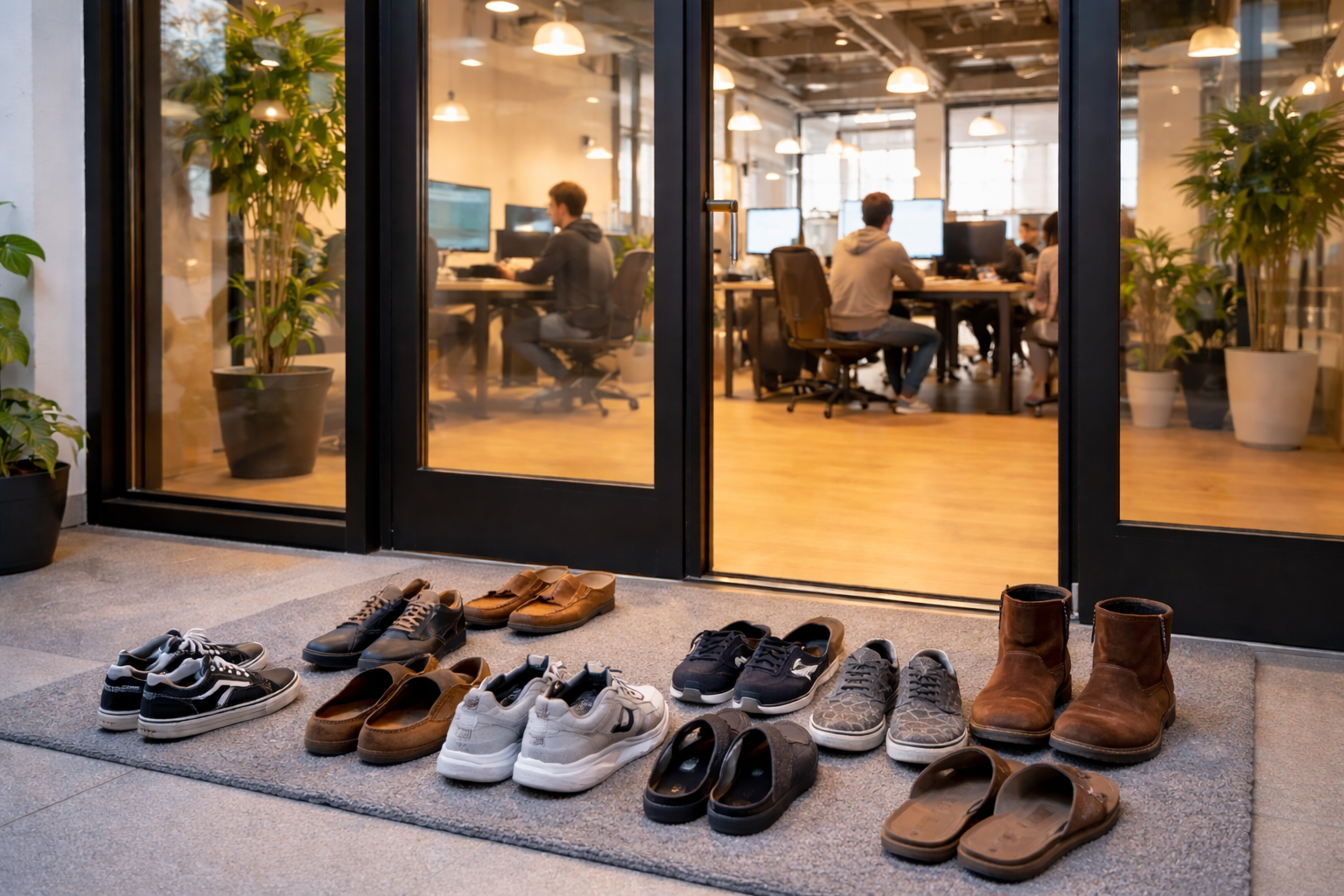
A growing number of U.S. startups are rethinking office norms, and for some, that now includes what employees wear on their feet. In parts of the tech world, especially among younger and fast-growing companies, shoes are being left at the door.
As the New York Times recently noted, “The ‘no shoes’ trend is spreading in tech offices, with buzzy start-ups telling employees to leave their Vans and Uggs at the door.” What was once more common in homes or wellness spaces is quietly making its way into American workplaces, reflecting a broader shift toward comfort, informality and a different idea of what professional culture looks like in the post-pandemic office.
That shift is already visible across a handful of well-known young companies. Startups such as Cursor, Replo and Composite are among those adopting shoe-free offices, turning what might seem like a small rule into a marker of workplace culture. Ben Lang, an employee at Cursor, summed it up in a social media post, writing, “I’ve only worked at startups that have a no-shoes in office policy.” For some founders, the idea goes beyond comfort. Sneha Sivakumar, co-founder and chief executive of Spur, said the policy “makes it feel like a second home” for her 10 employees and “disarms you in a positive way.”
READ: Meta to acquire Singapore-based AI startup Manus (December 30, 2025)
The trend also fits into a broader post-pandemic reality. Nick Bloom, a Stanford economist who studies work culture, described the movement as partly “the pajama economy in action.” As Bloom explained, workers who spent years at home during the pandemic are now returning to offices without leaving those home habits behind.
Some analysts are also drawing a connection between the shoes-off office trend and Silicon Valley’s long-standing obsession with intense work cultures, including the so-called 996 schedule. The term refers to a punishing routine of working from 9 a.m. to 9 p.m., six days a week, an idea that originated in China’s tech sector and has gradually entered conversations in the United States.
While 996 is still a relatively new phrase in Silicon Valley, it reflects something familiar. “It is a high-octane version of something that has been around in the tech industry for a while,” Margaret O’Mara, a historian at the University of Washington, told the New York Times.
O’Mara noted that after several turbulent years marked by layoffs and uncertainty, the tech industry has tightened its expectations. Elon Musk’s self-described “extremely hard core” management style, once seen as an outlier, no longer appears out of step. Silicon Valley’s so-called hard tech era has arrived, and working extreme hours, or at least signaling that you do, is increasingly part of the norm.
Even so, the shoes-off office is unlikely to become a standard feature across American workplaces. Cultural comfort levels still matter, and feet remain a surprisingly sensitive subject. As New York Times fashion critic Vanessa Friedman has pointed out, feet “are among the most controversial, least discussed parts of the body.”
READ: In conversation with Supportiyo CEO on turning AI into a digital workforce (December 19, 2025)
The trend may also face limits in offices that span multiple generations. As Friedman put it rather bluntly, “Young people have great feet.” But, “Old people don’t.” In that context, what feels relaxed and home-like to one group of workers may feel awkward or impractical to another.
Taken together, the shoes-off trend says less about footwear and more about where American tech culture is headed. Startups are blending comfort, identity and intensity, creating workplaces that feel part living room and part pressure cooker. While the idea may not travel far beyond younger, insular tech offices, it captures a moment when work, home and hustle are increasingly blurred, and when even small choices signal how much of yourself you are expected to bring, and give, at work.