


“Nostalgia—it’s delicate, but potent… It’s a twinge in your heart far more powerful than memory alone.” — Don Draper
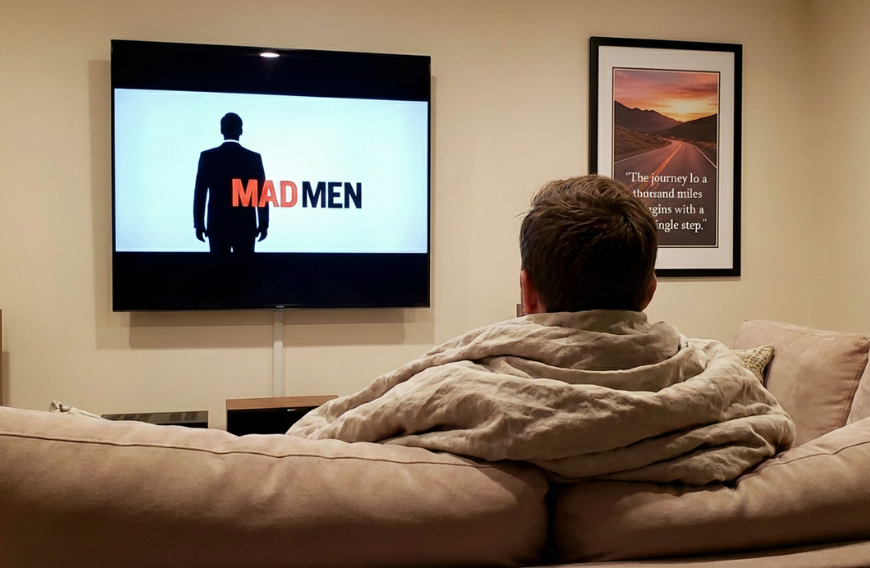
I spent the final days of 2025 on my couch, eating boxes of chocolates, drinking more than I should at this stage of my life, and reflecting on family memories, while plotting the future. I also binge watched “Mad Men” between naps on the couch. The days seem blurry now as Don Draper pitched the Kodak carousel while my smartphone buzzed with AI-generated notifications.
“Mad Men” chronicles an era when television, jet travel, and computing were reshaping America; when Sterling Cooper’s creative minds were selling not just products, but a vision of modern life itself. The show’s genius lies in how it frames technological and social change through intimate human stories: marriages crumbling, careers ascending, identities evolving against a backdrop of moon landings, assassinations, and Madison Avenue’s golden age.

We’re living through our own “Mad Men” moment now. Just as the 1960s characters navigated the shift from three-channel television to color broadcasting, from secretary pools to IBM mainframes, we are experiencing change at a dizzying pace.
The ‘carousel’ of life
I love the “Mad Men” episode in which Don Draper pitches the “carousel” to the Kodak executives. The takeaway from Don’s presentation is that technology isn’t about features, it’s about how it makes us feel, how it changes the texture of daily life. That is profound. Our smartphones have become our digital Swiss Army knives, our own Dora the Explorer’s backpack, exactly what the tech evangelists promised. They carry more computing power than the Apollo program, as the cliché goes. As Don explains in the carousel pitch, technology has changed the ritual of living.
I also love Peggy Olson’s character. The scenes with her typing copy on her IBM Selectric, the satisfying clack of keys, the physicality of creation. Now we dictate ideas into our phones while walking, edit documents in real-time with colleagues across continents, and use AI to help draft everything from grocery lists to complex work proposals. Tech is being democratized. Among AI users, the share with typically feminine names rose from 37% in January 2024 to 52% by July 2025. We’re witnessing something Peggy would appreciate; technology closing gender gaps, not widening them.
My father’s Apple Watch monitors his heart rate, sleep patterns, and activity levels with the obsessive precision Sterling Cooper once applied to consumer demographics. Healthcare today has been transformed in ways that feel both miraculous and invasive. The same GLP-1 receptor agonists helping millions lose weight are now showing promise in addressing dementia, a disease affecting over 55 million people globally. Betty Draper would have appreciated how biotechnology could address her own health challenges with precision her doctors never possessed.
In some ways, we are all “Mad Men” now. We are all acting as our own creative directors. Now, anyone with a smartphone can broadcast to millions, create content that rivals professional productions, become their own media empire. The lines between audience and creator have dissolved entirely. We’re all pitching, all the time, to algorithmically-determined focus groups we’ll never see.
Corner office
I was blessed with a corner office in 2004, when I turned 34. The Sterling Cooper partners would have been horrified, and perhaps secretly envious. I lived the “Mad Men” life in my 30s and 40s. The magnificent conference rooms with their leather chairs, the three-martini lunches, the rigid hierarchy of secretaries and junior executives and senior partners. All of that seems like ancient history today, atomized and redistributed across home offices, coffee shops, and co-working spaces worldwide. Probably for the best.
The Review by Ajay Raju: Are you prepared to live a longer and healthier life? (September 29, 2025)
22 percent of the U.S. workforce is now working remotely, an 87 percent increase from pre-pandemic levels. I’m part of that statistic, conducting video calls from my living room with colleagues I’ve never met in person, collaborating on cloud-based documents that update in real-time. Don Draper’s famous disappearing acts would be almost impossible now. We are always traceable, always available, always on.
There’s something liberating about life today that would appeal to the show’s more rebellious spirits. We may be witnessing a fundamental power shift in the workplace. Seventy Four percent of workers say remote work options make them less likely to leave their company. Sixty Five percent want to remain fully remote, The corner office no longer holds the same allure when you can work from anywhere with good wifi.
I watch students, the next generation entering this transformed workplace, and see how AI fluency has become a baseline skill. 92 percent now use tools like ChatGPT, up from 66 percent just the year before. Some 88 percent turn to generative AI for assessments. They’re not learning to work with AI as an optional skill; they’re learning to work in a world where AI is as fundamental as electricity was to the Sterling Cooper office of 1960.
Amazon deployed advanced AI in October 2025 to revolutionize warehouse robots, machines that learn from vast datasets, identify and handle millions of products without direct programming. It’s automation on a scale that makes the introduction of the IBM mainframe to Sterling Cooper look quaint. The “Mad Men” characters often resisted change with cynicism and alcohol. My colleagues, on the other hand, are embracing the changes today with a mixture of excitement and unease. They realize that the machines are getting remarkably good at what they do, which is exciting, but the unease comes from the realization that the humans are being replaced.
Play
Don’s “carousel” pitch to the Kodak executives was about nostalgia, about how technology could transport us emotionally. Gaming has evolved from Pong to photorealistic virtual worlds where millions gather, where professional players earn fortunes, where entire economies exist in digital space. Esports has become a billion-dollar industry. If Roger Sterling thought television was transformative, he’d be astounded by Twitch streams and VR headsets.
What really captures my imagination, however, is how AI has democratized creative expression itself. People with no formal training can now generate art, compose music, write stories, create videos. It’s as if everyone got admitted to the creative department, bypassing years of apprenticeship as a junior copywriter.
This raises new questions. What is creativity? What makes something authentic?
When Peggy pitches Patio, when Don conceives “It’s Toasted” for Lucky Strike, they’re channeling something human and particular. When AI generates over 50 percent of internet content in 2025, as projections have suggested, what happens to that human spark?
The Review by Ajay Raju: Hero wanted: Paging Dr. Fajgenbaum (
I find myself in the position of those “Mad Men” characters confronting television’s dominance: simultaneously excited by the possibilities and worried about what’s being lost. The tools are remarkable, the access unprecedented, but I wonder if we’re all becoming account executives, optimizing content for engagement rather than creating something true.
Our Cuban missile crisis, our moon landing
Mad Men’s brilliance was showing how personal dramas unfolded against historical watershed moments. When historians look back at 2025, they’ll see several pivotal developments that echo the transformations of the 1960s.
AI went mainstream in 2025. ChatGPT reached 800 million weekly active users and became as ubiquitous as web browsers. This was probably our moon landing, the moment speculative technology became everyday infrastructure. I remember the first time I used it, skeptical and curious, much like Americans watching early space launches. Now it’s woven into how I work, think, and create.
Quantum computing went from theory to practical in 2025. The global quantum computing market reached $1.8-3.5 billion, projected to hit $5.3 billion by 2029. The 2025 Physics Nobel went to researchers whose 1980s work on superconducting qubits laid the foundations. That 40-year journey from theory to recognition mirrors the show’s own arc, from Sterling Cooper’s primitive market research to the sophisticated analytics we take for granted.
Remote work became permanent in 2025. This is our equivalent of women entering the workforce en masse. The pandemic forced an experiment; 2025 made it permanent. The hierarchies and rituals that defined professional life, the morning commute, the water cooler conversations, the corner office as status symbol, have been fundamentally rewritten.
Content generation crossed the threshold in 2025. We crossed a Rubicon when over 50 percent of internet content became AI-generated. It’s reminiscent of when television advertising became the dominant medium, except the change is happening far faster. Don Draper adapted from print to TV; we’re adapting from human-generated to AI-augmented content in mere months.
Uneasy progress
“Mad Men” never pretended progress was simple or purely good. For every Peggy rising through meritocracy, there was a Pete Campbell exploiting opportunity through privilege. For every moonshot inspiring humanity, there was Vietnam tearing it apart.
I feel that same complexity now. The digital divide persists; new technology is creating new inequalities; cybersecurity threats are growing more sophisticated. Data centers are consuming staggering amounts of energy while we face climate crisis. Only one qualified candidate exists for every three specialized quantum positions globally; McKinsey estimates we’ll need 250,000 new quantum professionals by 2030. We’re building the future faster than we can train people to manage it.
The questions about AI ethics, algorithmic bias, data privacy aren’t just technical challenges. They’re deeply human questions about power, fairness, and what kind of society we want to build. When Betty Draper discovered her husband’s secret life, when Peggy navigated a male-dominated workplace, when Joan faced the choice between dignity and partnership, they were confronting questions about agency and justice. We’re doing the same with technology that’s far more powerful than anything their generation imagined.
“Change Is Neither Good Nor Bad. It Simply Is.”
Don Draper once said, “If you don’t like what’s being said, change the conversation.” In 2026, AI will change the conversation whether we like it or not. Quantum computing is changing what’s possible. Remote work is changing how we structure our lives.
I am struck by how “Mad Men” captured something timeless about technological change. Change is simultaneously liberating and alienating, exciting and terrifying, democratic and exploitative. The characters in “Mad Men” struggle to adapt, some succeeding brilliantly (Peggy, Joan, Stan), others clinging to obsolete models (Roger’s old-boy network, Pete’s initial entitlement), still others disappearing into themselves (Don’s perpetual reinvention, Betty’s trapped domesticity).
The convergence of AI, quantum computing, biotechnology promise solutions to humanity’s greatest challenges — climate change, disease, energy scarcity. But I am growing skeptical of my own simple narratives of progress.
Technology amplifies human nature; it doesn’t transform it. The question isn’t whether technology will change society; it already has, irrevocably, but whether we can guide that transformation toward equity, sustainability, and human flourishing.
The carousel comes around again
The Review by Ajay Raju: Postcard from Dubai (
I returned to that “carousel” scene often during the last days of 2025. Don’s voice: “It’s not called the wheel. It’s called the carousel. It lets us travel the way a child travels—around and around, and back home again, to a place where we know we are loved.”
The technology of 2025 would seem like magic to the “Mad Men” characters. Our smartphones, our AI assistants, our quantum-encrypted communications, our remote work setup, all of it beyond their wildest imaginings. The fundamental human experiences they grappled with sill remain, however. We still seek connection, meaning, recognition. We still struggle with change. We fear obsolescence. We still hope to matter.
The innovations of 2075 will likely make 2025 seem quaint, just as 2025 makes 1965 seem impossibly distant. But the foundations being laid today will shape human civilization for generations. We’re living through a genuine inflection point, and unlike Don Draper’s characters, we can’t afford to simply pitch it beautifully and hope for the best.
The responsibility now lies with us to ensure this carousel of progress leads somewhere worth arriving. To build technology that expands human potential rather than diminishing it. To close digital divides rather than widening them. To ask not just “Can we build this?” but “Should we? And for whom?”
In the final episode of “Mad Men,” Don finds a moment of peace at a California retreat, then returns to create what might be his greatest ad: the famous Coca-Cola “Hilltop” commercial. It suggests that even after all his searching, all his reinvention, he returns to what he does best; taking the zeitgeist and turning it into something that moves people.
As 2026 unfolds, I find myself in a similar position. I can see the massive changes unfolding, feel their weight and possibility, and the moment demanding something different. Whether the tools we’re building will help us become more human, or less, is not the real point. The carousel will keep turning. Technology will accelerate it. But where we end up will depend on what we do with this extraordinary moment.
Happy New Year!