


By Keerthi Ramesh
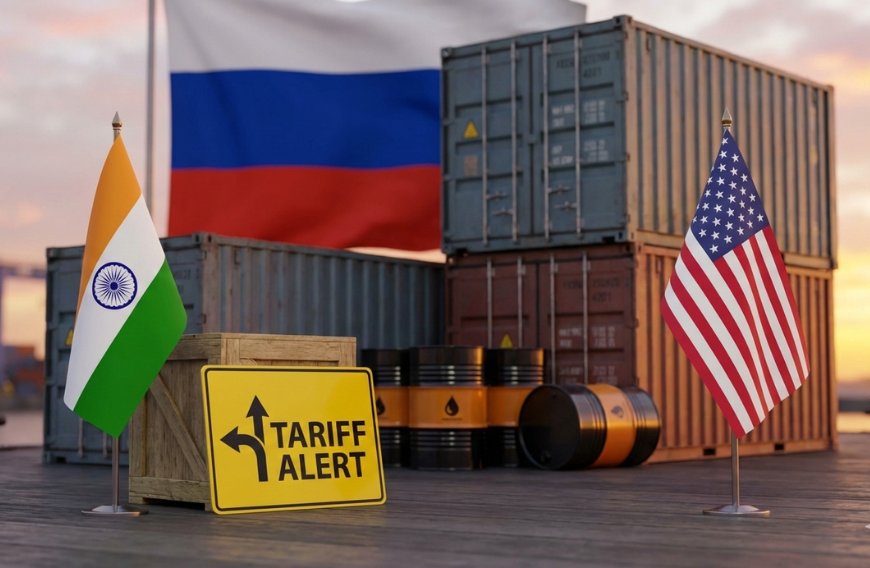
President Donald Trump on Sunday suggested that his administration could move to impose new or higher tariffs on Indian goods, referencing India’s continued purchases of Russian oil and describing the issue as personal frustration in his discussions with Prime Minister Narendra Modi.
Speaking to reporters aboard Air Force One, Trump said Modi was aware of his concerns and indicated that trade pressure could be used to push New Delhi to reconsider its energy ties with Moscow. “Prime Minister Modi knew I wasn’t happy,” Trump said. “They wanted to make me happy. They do a lot of trade with us, and tariffs can go up very quickly.”
The comments highlight renewed friction in U.S. India trade relations as Washington, D.C., presses allies and strategic partners to scale back economic engagement with Russia following its invasion of Ukraine. While the United States has imposed sweeping sanctions on Russian energy exports, India has continued buying discounted Russian crude, arguing that its energy security and price stability depend on diversified sourcing.
READ: India to cut Russian oil imports amid new US sanctions (
India became one of Russia’s largest oil buyers after Western countries sharply reduced imports, taking advantage of lower prices that helped limit domestic fuel inflation. U.S. officials have repeatedly warned that such purchases risk undermining efforts to isolate Moscow economically and could indirectly support Russia’s war effort.
Trump comments as the two countries remain engaged in trade discussions that have at times been Controversial. In 2025, the United States raised tariffs on certain Indian exports, citing market access barriers and what it called unfair trade practices. Trump has frequently used tariffs as leverage in negotiations, portraying them as a tool to protect U.S. industries and pressure trading partners.
Some Republican lawmakers have also called for tougher action. Sen. Lindsey Graham of South Carolina has proposed legislation that would impose steep tariffs on countries that continue importing Russian energy, though the measure has not advanced in Congress.
Indian officials have consistently said their relationship with Russia is rooted in national interest rather than political alignment. New Delhi has also pointed to increased energy purchases from other suppliers, including the United States, even as Russian oil remains part of its import mix.
READ: India, Russia, and the $16 billion oil arbitrage: What’s really going on? (
There was no immediate response from India’s Ministry of External Affairs or Ministry of Commerce to Trump’s latest comments. Indian officials have previously said energy decisions are guided by availability, affordability and the needs of a fast-growing economy.
Markets reacted cautiously to the renewed tariff threat. Indian stocks edged lower on Monday, with technology and export-focused companies among the biggest decliners, as investors assessed the risk of escalating trade tensions with one of India’s largest trading partners.
Despite the warning, Trump struck a conciliatory note toward Modi, calling him a “very good man” and pointing to cooperation in areas such as defines and regional security. Both leaders have frequently emphasized the strategic importance of U.S.-India ties, particularly as a counterweight to China’s growing influence in the Indo-Pacific.
Whether Trump’s remarks signal an imminent policy shift or reflect broader negotiating tactics remains unclear. For now, businesses and policymakers on both sides are watching closely as trade talks continue amid an increasingly complex global energy and geopolitical landscape.