



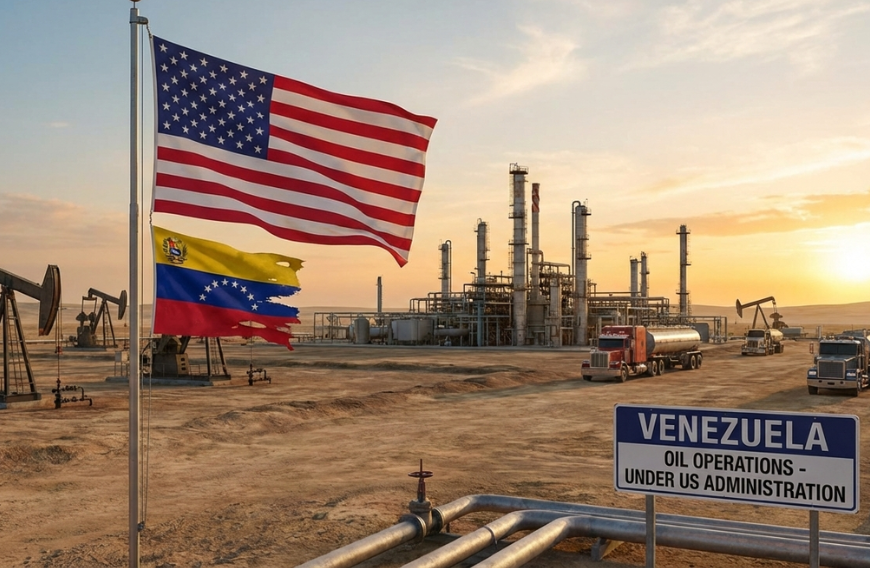
President Donald Trump seems to be eyeing Venezuelan oil now that Venezuelan President Nicolás Maduro has been captured. Trump has vowed to tap into Venezuela’s oil reserves after seizing Maduro and saying the U.S. will “run” the country until a “safe” transition.
Trump framed this unprecedented intervention as necessary to stabilize the country and prevent “someone else” from assuming power in a way that harms the Venezuelan people.
A central element of Trump’s remarks focused on Venezuela’s supposed vast crude oil reserves, the largest proven in the world. Trump said that major U.S. oil companies would be allowed to enter Venezuela and may invest billions in repairing its dilapidated infrastructure and boost production. He suggested that revenues from increased oil output would help cover costs and could lead to the sale of large amounts of Venezuelan oil internationally.
READ: Venezuelan President Maduro captured, fueling uncertainty in global oil markets (
“The real challenge they’ve got is their infrastructure,” said Callum Macpherson, head of commodities at Investec.
Bill Farren Price, senior research fellow at the Oxford Institute for Energy Studies, told the BBC that Venezuela’s oil industry “had its heyday decades ago” and has been in sharp decline over the past 20 years.
“A lot of the complex supply chain and infrastructure’s been looted and taken apart and sold,” he added.
Homayoun Falakshahi, senior commodity analyst at data platform Kpler, says the key hurdles for oil firms hoping to exploit Venezuelan reserves are legal and political.
Speaking to the BBC, he said those hoping to drill in Venezuela would need an agreement with the government, which will not be possible until Maduro’s successor is in place.
“Even if the political situation is stable, it’s a process that takes months,” he said.
On Jan. 3, Venezuelan President Nicolás Maduro was captured in a U.S. military operation, marking an unprecedented intervention in the country. According to U.S. officials, Maduro was extradited to the United States to face charges related to alleged drug trafficking and corruption. The operation involved targeted strikes in Caracas and coordination with elements opposing Maduro’s government.
Successfully managing Venezuela’s oil reserves will require not only substantial investment but also the navigation of legal, political, and infrastructural challenges that cannot be resolved overnight. The condition of the oil industry, combined with ongoing political instability, suggests that promises of rapid production increases are likely to face significant delays.
The intervention has sparked widespread debate over sovereignty, legitimacy, and precedent in international relations. Nations around the world may be closely watching how the situation develops, and the response could influence diplomatic and economic relationships across the region. For Venezuela, the coming months will be critical in shaping the country’s political transition, economic recovery, and ability to regain control over its natural resources.