


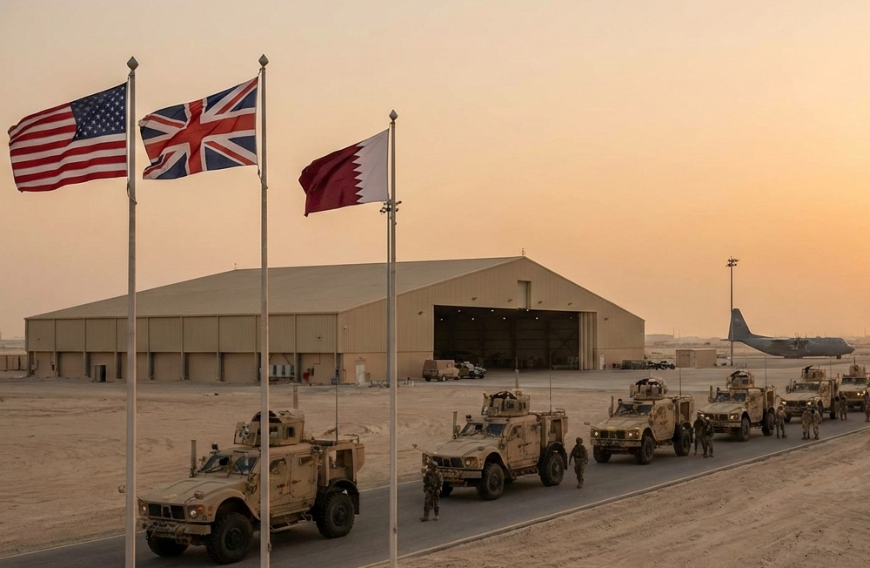
It looks like the US and UK are reducing their military presence in Qatar. The US and UK are reducing the number of personnel at the Al-Udeid air base in Qatar, as US President Donald Trump considers whether to take action against Iran over its crackdown on anti-government protests.
Officials have told CBS, the BBC’s US partner, that the partial American withdrawal was a “precautionary measure”. The BBC understands some UK military personnel are also being removed.
Reportedly, a Qatari government statement said the measures reportedly being taken by the US were “in response to the current regional tensions”.
In 2026, President Donald Trump’s approach toward Iran is defined by pressure, deterrence, and conditional diplomacy. The administration has emphasized economic coercion, including sanctions and newly announced tariffs on countries trading with Iran, intended to isolate Tehran and force changes in behavior. Trump has framed these measures as leverage to curb Iran’s nuclear ambitions and regional influence.
At the same time, Trump has issued strong warnings over Iran’s handling of domestic protests, publicly supporting demonstrators and threatening consequences if repression continues. However, the exact nature of any potential U.S. response to human-rights violations has not been specified, and officials have avoided committing to concrete actions.
READ: Trump’s plan for a ‘Trump-class’ battleship faces hurdles (
The US embassy in Doha has advised its personnel to exercise increased caution and limit non-essential travel to the Al-Udeid air base.
Diplomacy is officially on the table, but it is uncertain whether negotiations will resume, what terms Washington would accept, or whether Tehran is willing to engage.
Trump’s Iran policy in 2026 combines assertive rhetoric and economic tools with ambiguous military signaling and conditional openness to talks, leaving the future trajectory highly dependent on developments inside Iran and regional tensions.
Even, several airlines have announced they will reroute flights around Iran in response, including Air India and Germany’s Lufthansa.
The situation reflects a period of heightened uncertainty rather than a clear shift toward either conflict or resolution. Adjustments in military posture, cautious language from officials, and reactions from commercial airlines all point to governments and private actors preparing for multiple possible outcomes, without assuming the worst is inevitable. Decision-making appears deliberately incremental, shaped by risk management and signaling rather than any confirmed plan for escalation.
READ: Will Trump spend over $1 trillion on defense in 2027? (
At the same time, the episode underscores how domestic unrest in one country can ripple outward, affecting regional security calculations, global markets, and diplomatic relationships. For Washington and its allies, balancing deterrence with restraint remains a central challenge, as any miscalculation could potentially widen tensions. For Iran, external pressure intersects with internal dynamics in ways that are difficult to predict.
The Reuters news agency, citing diplomats, reported that while some personnel had been told to leave the Al-Udeid air base, there was no immediate sign of large numbers of troops being bussed out like in the hours before an Iranian strike last year.
Speaking to Fox News on Wednesday, Iran’s Foreign Minister Abbas Araghchi warned Donald Trump to “not repeat the same mistake that you did in June,” adding: “You know, if you try a failed experience, you will get the same result.”
Taken together, these developments suggest a fragile moment in which symbolism, perception, and caution matter as much as concrete action. The direction ahead will likely depend less on stated intentions and more on how each side interprets and responds to the other’s next move.