


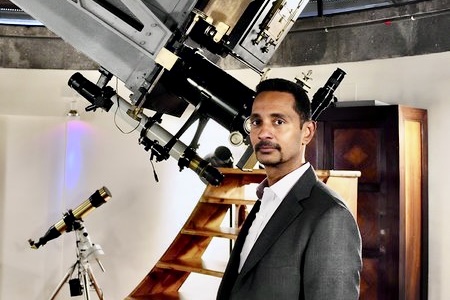
Renowned Sri Lankan American astrophysicist Dr. Ray Jayawardhana is set to become Caltech’s new president from July 1 amid federal research funding cuts at the elite Pasadena university under the Trump administration.
Announcing Jayawardhana’s appointment, Caltech’s Board of Trustees Chair David W. Thompson described him “a leader of exceptional distinction who brings a complement of qualities—as a pioneering astrophysics researcher, respected university administrator, and compelling science communicator.”
“I am deeply honored to have been selected as Caltech’s tenth president and to join this remarkable community of trailblazers,” says Jayawardhana, currently provost of Johns Hopkins University.
“For more than a century, Caltech has achieved extraordinary and enduring impact from a deceptively simple formula: empowering brilliant minds to explore important questions with imagination and courage and making bold commitments to efforts others might consider too risky or far-fetched.”
“My commitment is to stay true to Caltech’s North Star of fundamental research and exploration integrated deeply with education, while strengthening this community’s ability to pursue, share, and apply knowledge and innovations that serve and inspire humanity.”
At Caltech, Jayawardhana says he will partner with faculty and other stakeholders to advance bold, catalytic investments in innovative ventures on campus, at the Jet Propulsion Laboratory (JPL), and across the Institute’s suite of global observatories; enrich the experience of undergraduates, graduate students, and postdoctoral fellows; and expand the Institute’s engagement with the public.
READ: Viraj Karambelkar wins NASA Hubble Fellowship (
“We are in a moment of inflection; one marked by dramatic change and immense possibility. It’s a moment that calls for Caltech’s distinct contributions and leadership,” Jayawardhana says, acknowledging the rapidly shifting global landscape impacting America’s research universities, from uncertainty in funding to accelerating technological and economic change.
“The issues and opportunities confronting us demand our very best thinking and our deep engagement: pursuing discoveries vigorously and sharing our findings widely; tackling complex problems and engineering innovative solutions; welcoming debate and critique and fostering a robust exchange of ideas; and keeping a spirit of service at the heart of who we are and what we do.”
As a scientist, Jayawardhana investigates the diversity, origins, and evolution of planets and planetary systems, as well as the formation of stars and brown dwarfs. Using the largest telescopes on the ground, he and his collaborators characterize planets around other stars, or exoplanets, with an eye toward assessing the prospects for life beyond Earth.
Jayawardhana’s interest in public engagement with science is deeply personal, stemming from a sense of wonder and curiosity about the universe that first sparked his imagination in childhood in Sri Lanka.
“Some of my earliest memories are of walking around with my father at night, looking up at the sky,” Jayawardhana recounts. “It was in those moments that my lifelong fascination with space took root, and with it my deep belief in human curiosity and audacity to reach for what once seemed beyond our grasp. That sense of awe and teeming possibility has guided me ever since.”
Jayawardhana is an acclaimed writer and science communicator. His popular science book Strange New Worlds was the basis for The Planet Hunterstelevision documentary on the Canadian Broadcasting Corporation. His book Neutrino Hunters won the Canadian Science Writers Association’s Book Award.
Jayawardhana’s picture book for children, Child of the Universe, published by Penguin Random House, is meant to spark the same fascination with the universe that inspired him as a child.
READ: Arvind Krishna, Anima Anandkumar win 2025 TIME100 AI Impact Awards (
At Johns Hopkins, Jayawardhana oversees the university’s 10 schools as well as an expansive portfolio of interdisciplinary programs, academic centers, and core administrative and operational units.
Prior to joining Johns Hopkins, Jayawardhana served as the Harold Tanner Dean of the College of Arts and Sciences at Cornell University, as well as the Hans A. Bethe Professor and professor of astronomy.
Jayawardhana previously spent a decade on the faculty at the University of Toronto, where he held a Canada Research Chair and served as senior advisor on science engagement to the university’s president, before serving as the Dean of Science at York University.
He began his career with a Miller Research Fellowship at the University of California, Berkeley, and held an assistant professorship at the University of Michigan.
He received a BS degree in astronomy and physics from Yale University and a PhD in astronomy from Harvard. He has co-authored 180 refereed papers in scientific journals, with over 10,000 total citations.
Among Jayawardhana’s many awards and honors are a Guggenheim Fellowship, a Radcliffe Fellowship from Harvard, the Rutherford Medal in Physics from the Royal Society of Canada, the Nicholson Medal from the American Physical Society, and the Carl Sagan Medal from the American Astronomical Society’s Division for Planetary Sciences. Asteroid 4668 Rayjay is named after him.