



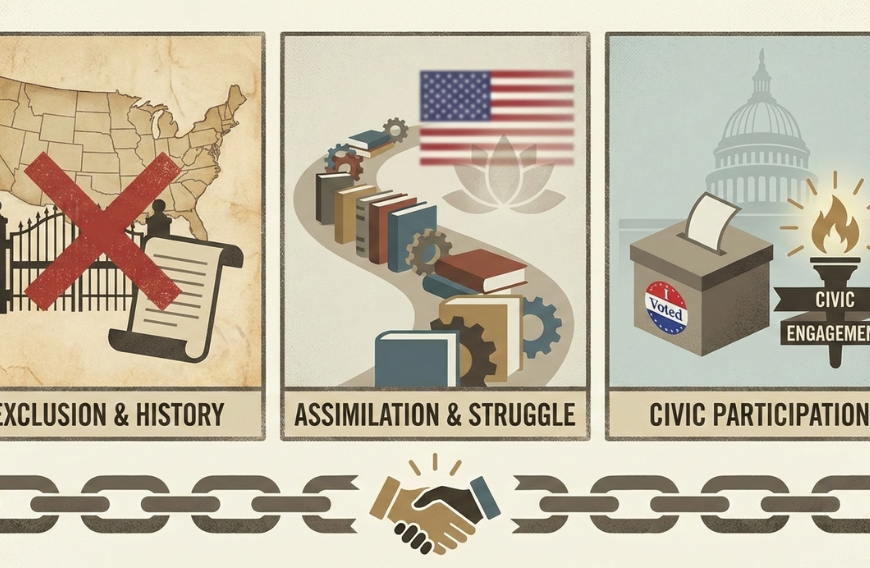
The recent rise in anti-Indian sentiment reported by the Times of India and described by veteran journalist Aziz Haniffa in his recent video segment, feels alarming to many, but it should not surprise us. Hostility toward Indians did not suddenly emerge in the modern era. It has existed from the very beginning of America’s legal and social history. pretend sometimes like it does not apply or exist . That is the first mistake.
In the early twentieth century, the U.S. Supreme Court ruled that Indians were not eligible for citizenship because they were not considered “white” in the way the average American understood the term. That ruling was not simply a technical interpretation of the law. It was a message that Indians did not belong.
By the 1950s, this exclusion showed itself openly in daily life. My father was arrested for playing tennis on a public court. He was thrown off buses for not being white . My parents were denied hotel rooms and refused service at restaurants. Bathrooms were still marked Black and White, and Indians were forced to exist outside both categories, unseen and unprotected.
At the Hecht Company,( now Macy’s) a major department store of that era, there were posted signs that read, “Beware of Sarees.” Indians were treated as undesirable customers because of aggressive bargaining as if the department store was a vegetable vendor in India. Yet my parents did not retreat from American society; they learned to assimilate and embrace it .
Sreedhar Potarazu: What it will take for doctors to transform US healthcare in a widening gap (
They adopted American customs while preserving their identity, which was never an easy balance to maintain. They learned how to earn respect through participation, not protest. My father’s own employment to stay working for the US government ,while not a citizen. in 1965 became one among several that helped push President Lyndon Johnson to pass the Immigration and Nationality Act, which finally dismantled race-based immigration quotas.
As Indians advanced professionally, discrimination did not disappear. It became more refined. My father used to say that at higher levels, racism no longer announces itself openly but hides behind polite language and institutional frameworks like “diversity” and “inclusion.” Some Indians in the 1950s chose to Americanize their names to survive socially and professionally. Chandrashekar Subramanyam became “Charlie”. My parents never changed their names, yet they still integrated naturally with people from cultures across the world.
What we are witnessing today is not a return of discrimination. It is a sharpening of something that never went away. To understand the anger directed at Indians, we must understand its source. Anger grows from fear, and fear grows from insecurity. The insecurity has always been the same belief that Indians will replace others, take their jobs, and threaten their ability to succeed.
The reality is that Indians have helped build companies, stabilize industries, and lead some of the world’s most successful organizations. That success triggers an ancient response. In nature, dominance is protected aggressively. Human societies follow the same instinct, even when they pretend otherwise. Hate will not disappear, because it is part of human coexistence in any diverse society. What can change is how that hate is reduced.
Indian Americans have often lived inside professional and geographic bubbles. Many of us are not fluent in the issues that shape everyday struggle, including housing insecurity, unequal education, limited healthcare access, addiction, crime, and poverty. There is a persistent myth that Indians are untouched by these problems. That myth is false, and it distances us from the broader society we live in. We have built enclaves that offer comfort and safety, but they also create separation. That separation fuels misunderstanding and fear.
Indians are assimilating and influencing more undoubtedly in society than ever before. There is more recognition for Diwali. Bhangra is mainstream . Roti and Dosa are as popular as fries and tacos but that assimilation is on the frays .There is still a mockery about Indians’ accents , gestures , and association with motels, gas stations and convenience stores.
Not every Indian in America is a doctor, a CEO, an investment banker, or an AI engineer, even though that stereotype is convenient for both admiration and resentment. Many Indians live at the margins, driving cabs, hauling freight, running small convenience stores, working long hours simply to make ends meet. As the Indian population in the United States grows, so does the full spectrum of economic reality, including wealth, stability, struggle, and poverty. Pretending otherwise creates a false narrative that separates Indians from the rest of society and fuels the idea that we are immune to hardship. Acknowledging this diversity of experience matters, because it reminds the country, and ourselves, that Indians are not a monolith of success but a community that reflects the same economic inequalities found everywhere else.
Civic engagement matters, but only when it is genuine. It is not enough to run for office or write checks without deep connection to the issues affecting others. Criminal justice reform, for example, is often avoided within Indian communities, yet Jewish Rabbis have long been among its strongest advocates because they view justice as a moral responsibility rather than a political inconvenience. Hate cannot be eliminated, but it can be weakened.
That happens when Indians move beyond passive success and engage fully with the struggles of the society around them. Fear diminishes with familiarity, and respect grows with presence. Assimilation alone is not enough. Participation is what changes perception.
We reduce hate not by remaining invisible, but by choosing to stand inside the shared challenges of the country we call home.