


By Keerthi Ramesh
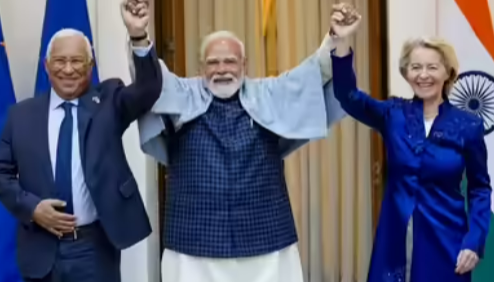
In a moment that blended global strategy with personal history, leaders from India and the European Union celebrated the conclusion of a landmark free trade agreement this week, a pact both sides have dubbed the “mother of all deals.” The deal, which could reshape trade flows affecting nearly one-third of the global economy, also produced an unexpected viral moment that captured attention on social media.
READ: Europe pushes back as Trump threatens new tariffs over Greenland (January 19, 2026)
At a summit in New Delhi on Tuesday, the deal, announced after years of stalled negotiations, was sealed during a high-profile summit in the Indian capital and quickly drew international attention not only for its economic scale but also for the symbolism surrounding it. The agreement covers trade between India and the EU’s 27 member states, together representing nearly 30% of global GDP and more than 1.8 billion people.
Negotiators say the pact will significantly lower or eliminate tariffs on thousands of products, including automobiles, pharmaceuticals, textiles, machinery and agricultural goods. It also includes provisions on services, digital trade, supply-chain resilience and labour mobility, areas that have grown in importance as governments seek alternatives to China-centric manufacturing networks.
Indian Prime Minister Narendra Modi described the agreement as a “transformational moment,” saying it would expand export opportunities for Indian manufacturers and small businesses while attracting new European investment. “This is not just a trade deal,” Modi said. “It is a strategic partnership for the future.”
European Commission President Ursula von der Leyen echoed that sentiment, calling the pact “the mother of all deals” and emphasizing its geopolitical importance. European leaders have increasingly looked to India as a reliable partner amid economic uncertainty, energy shocks stemming from the war in Ukraine and ongoing trade friction with the United States.
READ: India’s tariff cuts could make European cars cheaper for buyers (January 27, 2026)
Adding an unexpected personal dimension to the summit, European Council President António Costa publicly displayed his Overseas Citizenship of India (OCI) card during remarks, drawing smiles from the audience and a surge of attention online. Costa, whose father was born in Goa when it was still under Portuguese rule, said the moment reflected his personal connection to India as well as the growing closeness between the two partners.
The gesture went viral on social media, reinforcing the human side of diplomacy at a meeting otherwise dominated by technical negotiations and economic forecasts. Reaction from Washington was swift and closely watched. A senior aide to President Donald Trump acknowledged publicly that India appeared to gain significant advantages from the deal, particularly expanded access to European markets. The comment underscored concerns among some U.S. policymakers that major trade flows are increasingly bypassing American-led frameworks.
Trade analysts say the agreement could reduce India’s dependence on U.S. and Chinese markets while giving European companies a stronger foothold in one of the world’s fastest-growing economies. If ratified by national parliaments, the pact could double EU exports to India within a decade, according to preliminary estimates.
For India, the deal represents both economic ambition and diplomatic leverage. For Europe, it offers market access, strategic balance and a long-term partner in a shifting global order all sealed with a handshake that blended policy, history and personal identity.