


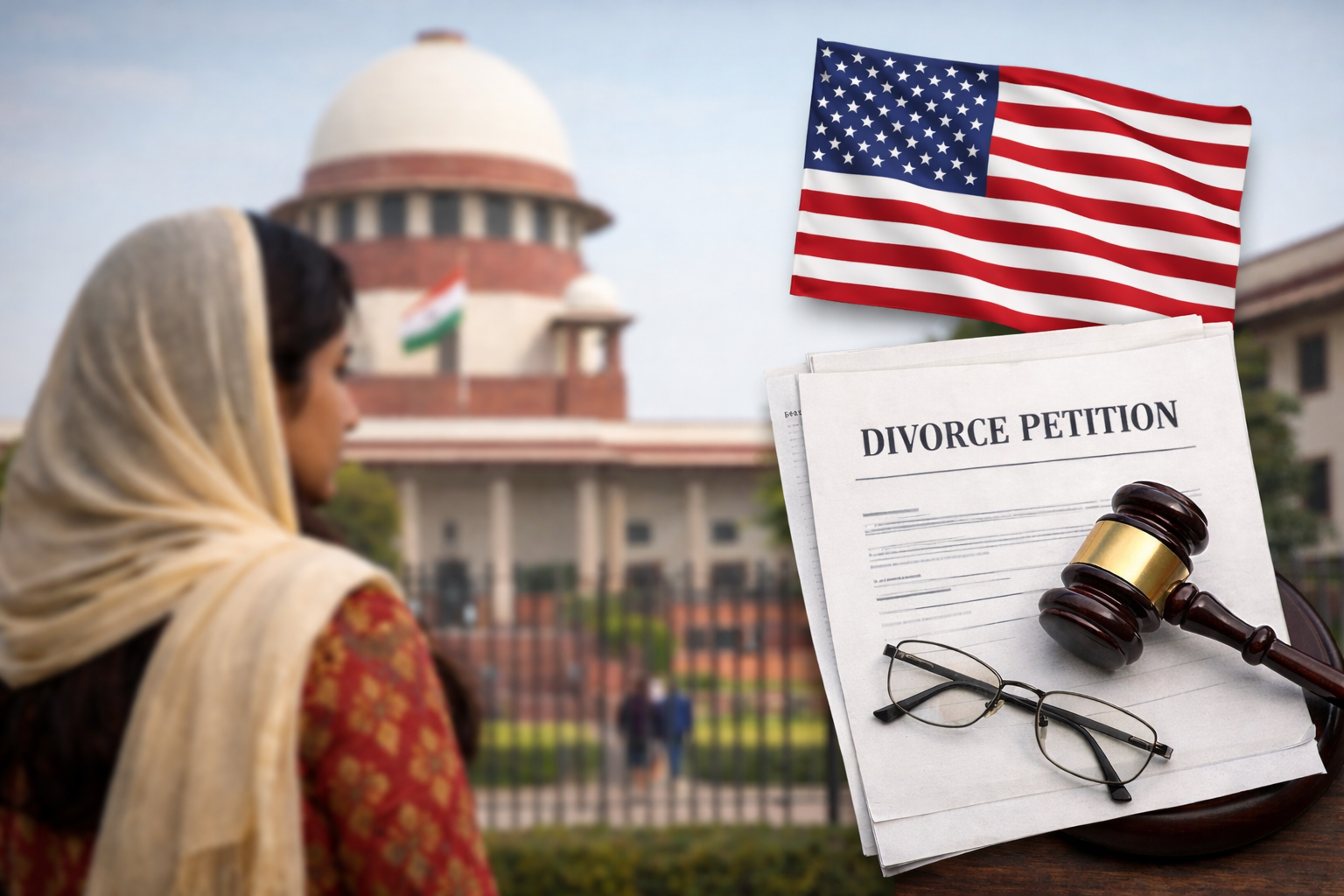
An Indian woman has taken her marital dispute to the Supreme Court of India, asking the court to intervene in divorce proceedings her husband has filed in the U.S. state of Rhode Island.
In her petition, filed under Article 32 of the Indian Constitution, she argues that the American family court lacks jurisdiction over the matter and that allowing the case to proceed overseas would infringe on her fundamental rights, including the guarantees of equality before the law and personal liberty.
In her filing, the woman contends that the divorce case initiated abroad is, on its face, without legal jurisdiction, and therefore cannot be sustained.
The writ petition has been filed by a woman from Tamil Nadu’s Kanyakumari district through advocate-on-record Shibha Shishpamik. She has named the Union of India, her husband, and the U.S. Embassy in India as respondents in the case.
In her plea, the woman argues that approaching a civil or family court in India would not be enough to halt an ongoing case overseas, leaving her with no effective option other than invoking Article 32. She says this is necessary to prevent irreparable harm to her constitutional rights.
She has asked the court to declare that any order issued by the foreign court be treated as null, void and unenforceable in India, and to direct the Union government to take appropriate diplomatic and protective steps to safeguard her rights.
READ: Indian American couple gifts record $4M to BITS Pilani (February 6, 2026)
The petition lays out that the couple married on January 6, 2023, in Kottai, Tamil Nadu, following Indian Christian customs, and that the marriage was formally registered three days later under the Tamil Nadu Registration of Marriages Act, 2009. She maintains that the marriage is governed solely by the Indian Divorce Act, 1869, and that her permanent domicile remains in India.
According to her account, after she travelled to the United States on a dependent visa, she was subjected to physical assault, emotional mistreatment, and financial exploitation. She alleges she was coerced into giving up control of her Indian assets, including property, gold jewellery, personal documents, and items kept in a joint locker.
The petition further states that after her dependent visa expired on July 18, 2024, leaving her without valid immigration status, the pressure intensified. Even after she returned to India in March 2024, she claims the demands to transfer her Indian property continued.
READ: Court blocks Zoho co-founder Sridhar Vembu’s asset transfers amid $1.7B divorce battle (January 8, 2026)
She further alleges that in September 2025, her husband brought her back to India, left her there, and then returned to the United States on his own. According to the petition, he cut off all contact with her on October 28, 2025. It also claims that in December 2025, her husband and his father held out assurances of reconciliation and a possible settlement, which led her to hold back from initiating legal action in India.
In her plea, the woman says that in September 2025 her husband brought her to India, left her behind, and flew back to the United States alone. She alleges that he severed all contact with her on October 28, 2025.
The petition also states that in December 2025, her husband and his father approached her with assurances of reconciliation and talks of a compromise, which persuaded her not to pursue legal action in India at that time.
Despite this, the petition claims that on October 30, 2025, the husband secretly initiated divorce proceedings in a family court in the U.S. state of Rhode Island, without her consent or any submission on her part to that court’s authority. She argues that the foreign divorce case lacks jurisdiction and is therefore invalid.
To support her case, the petitioner has cited a 1991 Supreme Court ruling in Vainasimha R.V. Y. Venkatalakshmi, which held that a foreign matrimonial judgment does not bind parties in India unless the court abroad has jurisdiction under the personal law governing the marriage and the parties have voluntarily accepted that jurisdiction.
She argues that neither condition is met here. The marriage, she says, is governed solely by the Indian Divorce Act, 1869, she never agreed to the authority of the Rhode Island Family Court, and the grounds cited in the U.S. case do not align with Indian Christian matrimonial law. On that basis, she contends the foreign proceedings are plainly without jurisdiction and void in India.
The petition also refers to other precedents to argue that Indian courts are empowered to step in and restrain foreign proceedings that are oppressive or vexatious.