


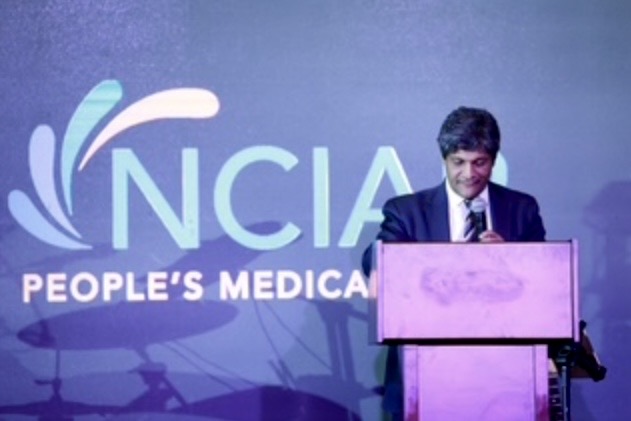
Citing the growing animus towards the Indian American community, Jay Chaudhuri, North Carolina’s first Indian-American state legislator says their success story serves as both a warning and a call to action.
There was a time India and Indian-Americans were either unknown or poorly stereotyped, the Democratic state senator recalled at a gathering of 600 plus members of the community on Feb. 10 in Durham, North Carolina.
“Much has changed. Today, India is poised to become the world’s third-largest economy, surpassing Germany and Japan,” he said addressing the 13th Annual Gala of NCIAP, a non-profit that provides almost free medical care in the Triangle by desi physicians and nurses, as chief guest.
“In just fifty years, we’ve produced CEOs, doctors, university deans, non-profit leaders, actors, and elected officials,” noted the Indian American attorney, professor and politician
Read: Indian American Sujit Singh running for Congress from New Jersey
“As a public servant, I never imagined watching the 2024 presidential race with an Indian-American vice president on the Democratic side and two on the Republican side, including the Second Lady of the United States,” he said.
“For my third-generation Indian-American children, our community’s success in a single generation, thought impossible in a century, is incomprehensible,” Chaudhuri said.
“Our story is a great story of modern immigration, with a meteoric rise,” he said. “However, today, we face perhaps the most visible animus towards our community in our lifetime.”
Digital harassment targeting South Asians increased by 75 % between December 2024 and January 2025, according to the nonprofit AAPI Equity Alliance,
“These online attacks coincide with criticism of the H1B skilled worker visa, where immigrants are portrayed as ‘job stealers,’ and criticism of Indian-American CEOs like Raj Subramaniam of FedEx, who was accused and targeted by right-wing commentators for laying off white workers and replacing them with Indian employees” noted Chaudhuri.
Read: Comedian Alex Stein faces backlash for mocking Indian, Hindu beliefs
“These attacks aren’t limited to the online world, he noted. “In Texas, protestors gathered to attack a statue of Hanuman, calling it a “demon god.”
A U.S. Senate candidate questioned why a false statue of a false Hindu god was allowed in Texas, claiming it was a Christian nation, recalled Chaudhuri. “In Irving, masked men held signs saying ‘reject foreign demons,’ and protestors called Diwali ‘garbage.’”
In Frisco, right-wing protestors wearing America first hats and punisher symbol masks protested against what they called a “massive Indian takeover” of the city, he recalled.
“Have we become smug and content about our success over the last 50 years?” wondered Chaudhuri. “Did we believe our wealth and status would shield us from the animus that may be coming?”
“What can we do to push back against this looming animus?” he asked .Some suggest, Chaudhuri noted, hiring a public relations firm, while others advocate for better integration of new H1B holders and increased support for non-profit organisations that benefit the broader community.
Indian-Americans “undoubtedly benefited from the model minority myth: elite universities, tech companies, and achievements only my parents dared to imagine,”as an IndianAmerican wrote in the New York Times recently.
“However, being a model minority isn’t a gold star,” Chaudhuri said. “When immigrants are celebrated primarily as economic contributors, we’re placed in a zero-sum game, where one group’s success is assumed to come at another’s expense.
Read: Indian American community leader Ashok Baddi running for Michigan House (February 11, 2026)
“The more a community is framed as exceptional, the more threatening that success can appear, fuelling resentment rather than acceptance,” he said. “The model minority myth backfires when it trades shared humanity for transactional worth.”
“In other words, if our community displays shared humanity rather than engaging in what’s viewed as transactional, we become valued by the larger community,” said Chaudhuri.
People’s Medical Care embodies shared humanity by providing healthcare to people from all walks of life, regardless of their economic status or insurance coverage, he said.
Chaudhuri said he believes in People’s Medical Care “because it embodies our community’s values of neighbourliness and friendship, where we all help improve each other’s lives.”
Asking “everyone to support this unique asset that stands out among Indian American communities nationwide,” he suggested People’s Medical Care as “the best antidote to fight the virus of racial hatred and animus towards our community.”