



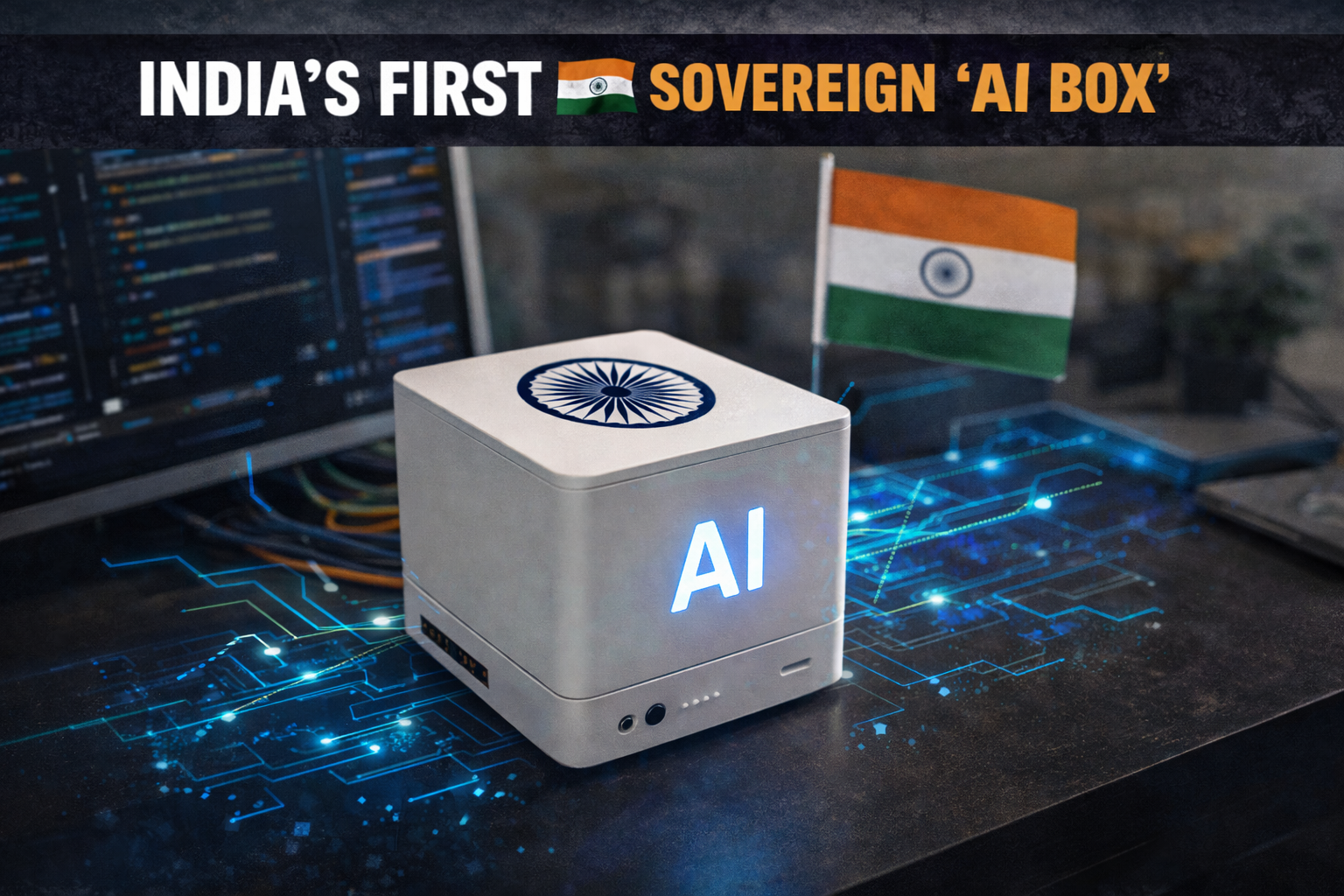
Indian AI-native transformation foundry Arinox AI and agentic AI company KOGO unveiled what they described as India’s first sovereign AI product during the Indian AI Impact Summit 2026. This is a state-of-the-art system built around the concept of “AI in a box.”
With CommandCORE, Arinox AI and KOGO are betting on a counterintuitive AI future which is private, sovereign, and physically compact, according to The Hindustan Times. They’ve partnerships with Nvidia and Qualcomm for its agentic stack, the latest CommandCORE iteration runs on Nvidia hardware.
“The future of AI is private, on an enterprise level too. You simply cannot farm out your intelligence. The only way an organisation can exponentially increase its own intelligence and learning is by keeping AI private. It must own the AI,” explains Raj K. Gopalakrishnan, CEO and Co-Founder of KOGO AI, in a conversation with HT.
READ: IndiaAI’s vision and Vizag’s opportunity: The making of Asia’s AI data hub (February 16, 2026)
This “AI in a box” consists of four layers — which include custom hardware from Nvidia, and KOGO’s agentic OS atop which sits an Enterprise Agent Suite has more than 500 connectors for enterprise workflows, and leveraging open-source models for sovereign AI.
“This box is designed to cut through complexities of hardware, software and application layers, which an enterprise would have to independently orchestrate. It’ll do focused workloads, repeatable tasks, and can expand to large clusters for an entire workflow,” said Angad Ahluwalia, chief spokesperson of Arinox AI.
Scalability is achieved by linking multiple units together. According to Ahluwalia, enterprises can choose from three model configurations for now, with more iterations expected in the coming months, according to Ahluwalia.
“As AI adoption expands across regulated and sensitive environments, organisations need accelerated computing platforms that can operate entirely on-premise and under strict security controls,” says Vishal Dhupar, Managing Director, Nvidia India. “The very large ones, equivalent to Nvidia’s DGX clusters based on Grace Blackwell series, are powerhouses that can do enterprise wide transformation,” Ahluwalia explains. For context, Nvidia documentation notes that two such DGX units, when interconnected, handle models up to 405 billion parameters.
According to Gopalakrishnan, in addition to sovereignty, this system makes a difference economically. He points to an example of commercial EV charging and battery swap stations, each of which can generate up to 30TB of daily data. “If there are 1000 stations owned by the same organisation and they have to send all this data to the cloud, think of the cost,” he says.
Arinox and KOGO hope to find traction especially in sensitive sectors such as finance and banking, government services and defense.