


By Soumoshree Mukherjee
Editor’s note: This article is based on insights from a podcast series. The views expressed in the podcast reflect the speakers’ perspectives and do not necessarily represent those of this publication. Readers are encouraged to explore the full podcast for additional context.
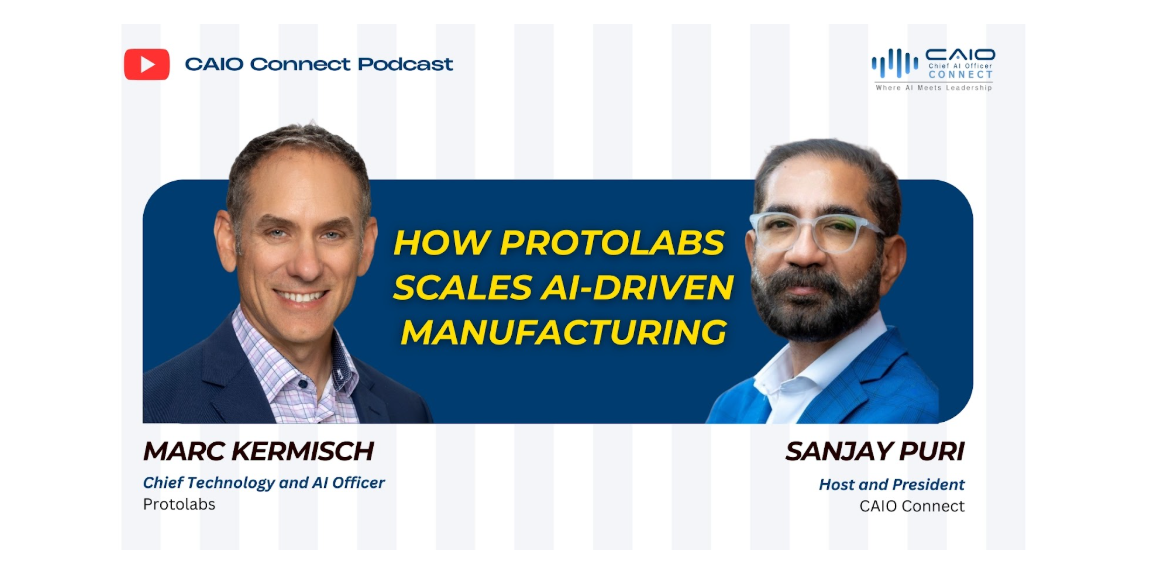
Artificial intelligence is often marketed as a magic button, flip it on and productivity soars. But according to Marc Kermish, Chief Technology and AI Officer at Protolabs, that mindset is exactly why so many AI initiatives fail. In a recent conversation on the “CAIO Connect” podcast, hosted by Sanjay Puri, Mark offered a grounded, practical perspective on what it really takes to make AI work inside modern enterprises.
His central idea is refreshingly simple: AI should be treated like a junior employee, not a finished product.
One of the biggest mistakes organizations make is expecting AI to “just work.” Mark explains, “We have to treat this entity of AI like a junior employee… and train them up and get them productive, just like we would a human. But a lot of times when we think about technology, we expect it just to work, without having to think about all of what goes into making something effective.”
This framing is especially relevant in digital manufacturing, where Protolabs operates at the intersection of software and hardware. AI helps take customers from a CAD design straight to production, analyzing manufacturability, tolerances, materials, and compliance requirements in real time. The value is enormous but only when AI is trained with the right context and expectations.
READ: Inside New York’s AI Vision with Shreya Amin (
At Protolabs, AI is already delivering value across the manufacturing lifecycle. It analyzes CAD files to ensure parts meet ISO, medical, aerospace, or defense standards before production even begins. It helps engineers choose from an overwhelming range of materials by surfacing recommendations at the moment of design. On the factory floor, AI processes machine and IoT data to predict maintenance needs, keeping operations running at full capacity.
Yet even with these wins, Mark is candid about resistance, especially from engineers. If AI’s first answer isn’t as good as theirs, skepticism follows. Overcoming this isn’t a technology problem; it’s a change management and expectation-setting challenge.
One of the most forward-looking parts of the conversation focused on agentic AI, systems that don’t just respond, but act. Mark says, “at ProtoLabs, we’re absolutely experimenting with agentic AI.”
Agentic AI is already supporting marketing, finance, sales, and technical teams. From content creation to automating invoice processing to helping sales teams validate compliance requirements, AI agents are stepping into assistant-like roles.
Mark predicts a future where AI agents actually appear on org charts, complete with identity and access management. In his words, leaders won’t just manage people, they’ll manage teams of humans and AI agents working together.
READ: Beyond the code: Jeff McMillan on Morgan Stanley’s human-first approach to AI governance (
Mark likens today’s AI landscape to a science fair where most projects don’t make it past early trials. The reasons are consistent: mismatched use cases, unclear KPIs, poor architectural choices, lack of resilience, and no defined budget. Successful AI initiatives, by contrast, are tightly scoped, measurable, and allowed to evolve through iteration.
Even widely adopted tools like Microsoft Copilot often see usage drop after 30 days. The culprit? Lack of training. Mark emphasizes that prompting is a skill everyone must learn, not a niche role, “over the years, we’ve all learned how to be more efficient with it. It’s no different when you’re doing prompt engineering. Two, three years ago, there was this concept that we’re going to have prompt engineers as a title in the company.”
Communities of practice, shared prompt libraries, and AI champions inside each function make the difference between novelty and sustained impact.
Measuring ROI doesn’t have to be complex. At previous roles, Mark tracked hours saved through simple manager conversations and lightweight tools directionally accurate, but powerful enough to justify investment.
AI isn’t a silver bullet. It’s a junior teammate with massive potential. Organizations that invest in training, patience, and experimentation will unlock real value. Those waiting for perfection will be left behind.
As Mark advises aspiring Chief AI Officers: stay curious, experiment daily, and amplify the conversation. The future of work is already here and it’s learning fast.