


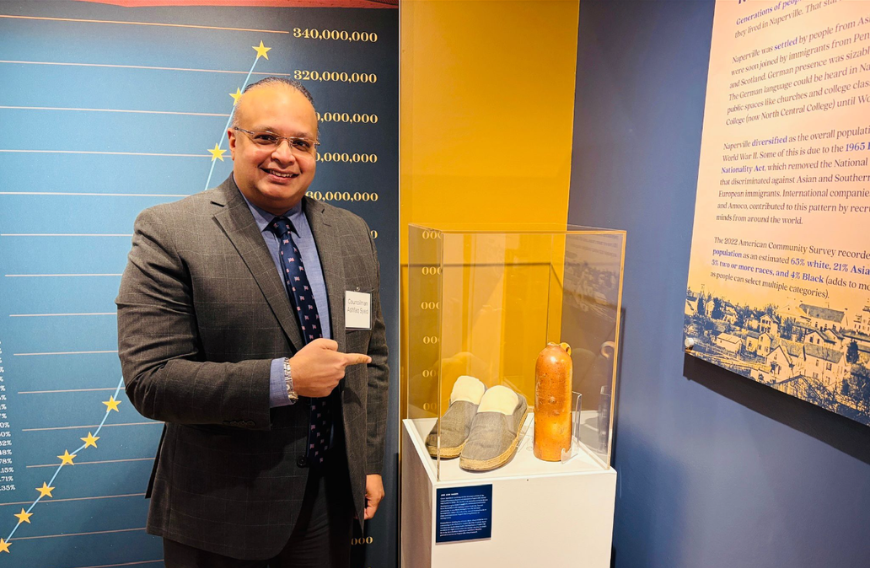
In a moving nod to civic participation and representation, the campaign shoes worn by Naperville’s first Indian American and Muslim councilman Ashfaq Syed will be archived as part of the America 250 commemoration — symbolizing the evolving story of American democracy.
“These shoes represent far more than a campaign,” said Syed. “They represent listening, trust, and relationships built one conversation at a time. Every step reminds me of a resident who shared concerns, hopes, and ideas for our city.”
2026 is a special year for all Americans as the country gets ready to celebrate its 250th anniversary. All across the United States, various events and festivities will be held to lead up to 250th anniversary of the U.S. Declaration of Independence on July 4.
In Illinois, Naper Settlement, a 12-acre outdoor history museum situated in Naperville began its year-long celebrations to mark America’s semiquincentennial on Feb. 16, President’s Day.
The new exhibit titled: “We the People: Naperville and the American Story” is an impressive way to tell local stories and heritage through artifacts and memorabilia including the oldest surviving map of Naperville from 1842.
At the exhibit, also on display are the campaign shoes of Naperville City Councilman Ashfaq Syed. Born in Hyderabad, India, Syed is the first Indian American and first Muslim ever to be elected to the Naperville City Council. The exhibit by featuring his well-worn shoes which he wore while campaigning door to door is preserving the power behind community engagement and grassroots democracy.
READ: Trump administration halts immigrant visa processing for 75 countries (January 14, 2026)
For Syed, the shoes hold a special meaning as he walked thousands of steps across Naperville during his two-year campaign. Talking to The American Bazaar about how the idea of preservation of his campaign shoes came about, Syed says, “After winning my 2025 Naperville City Council election, the team at Naper Settlement reached out and asked if I could share some campaign materials — T-shirts, my cape, flyers, handwritten notes, and speeches.”
He says, “I also added something unexpected to the list: my shoes.” On the sentiment behind the addition of shoes, Syed explains, “Those shoes were very personal to me. For two years I wore them almost every day — door knocking across neighborhoods, walking in parades, attending community events, and meeting residents one conversation at a time. I had walked thousands of miles in them.”
Even before the idea of having them on display in an exhibit came about, Syed confessed that the shoes had already carved a special place in his home and his heart. He adds, “After the election, I couldn’t bring myself to throw them away. They were worn out — the soles thin, the stitching loose — but every mark told a story. Each scuff represented a doorstep conversation. Every crease carried someone’s hopes, frustrations, or ideas about our city. They had become a physical record of civic engagement.”
Even though, at this point he didn’t quite know that his personal journey could be an inspiring tale marking an immigrant’s voyage in American mainstream civic life and politics. He says, “While speaking with the museum team, I learned they were preparing an exhibit for America’s 250th anniversary. The goal wasn’t just to highlight famous figures, but to capture everyday participation in democracy — how ordinary people shape the American story at the local level.”
He adds, “We talked about how history is often preserved through objects: letters, tools, uniforms, photographs. Naturally the question came up — what represents civic participation today? In earlier generations it might have been a farmer’s ledger or a factory badge. Today, grassroots democracy often looks like walking neighborhoods and knocking on doors.
That’s when the shoes became meaningful beyond me.”
READ: Affordability, immigration top concerns for AAPI adults: Poll (
Interestingly, the curators shared the same sentiment. As Syed says, “The curators saw them as a symbol of face-to-face democracy — not advertising, not social media, but human connection. Thousands of conversations, one home at a time. They asked about the miles walked, the neighborhoods visited, and the people I met. The more we discussed it, the clearer it became that the shoes weren’t about a campaign — they were about access, trust, and participation.”
Syed says that his immigrant aspirations and living the American dream was an important story he wanted to be shared far and wide. He says, “I shared my journey — arriving as an immigrant, building relationships, and eventually earning the community’s trust to serve. We decided the shoes should be presented not as a political artifact, but as a community artifact — belonging to the residents who opened their doors.”
Syed eventually found a place more meaningful for his campaign shoes than his home. He says, “I formally donated them for permanent preservation. The team documented their condition and included them in the America 250 exhibit as part of how local civic engagement shapes the American story.”
In reaction to the shoes now as a part of something much bigger, he says, “Seeing them displayed was emotional — because they no longer felt like mine. They became a shared memory. In the end, the exhibit isn’t about footwear. It’s about footsteps — thousands of them — taken together with the community.”
He signs off by saying, “To see a small piece of my journey preserved in the history of the community that welcomed me is humbling beyond words.”
“This does not belong to me — it belongs to the people who opened their doors and placed their trust in me,” Syed notes.