


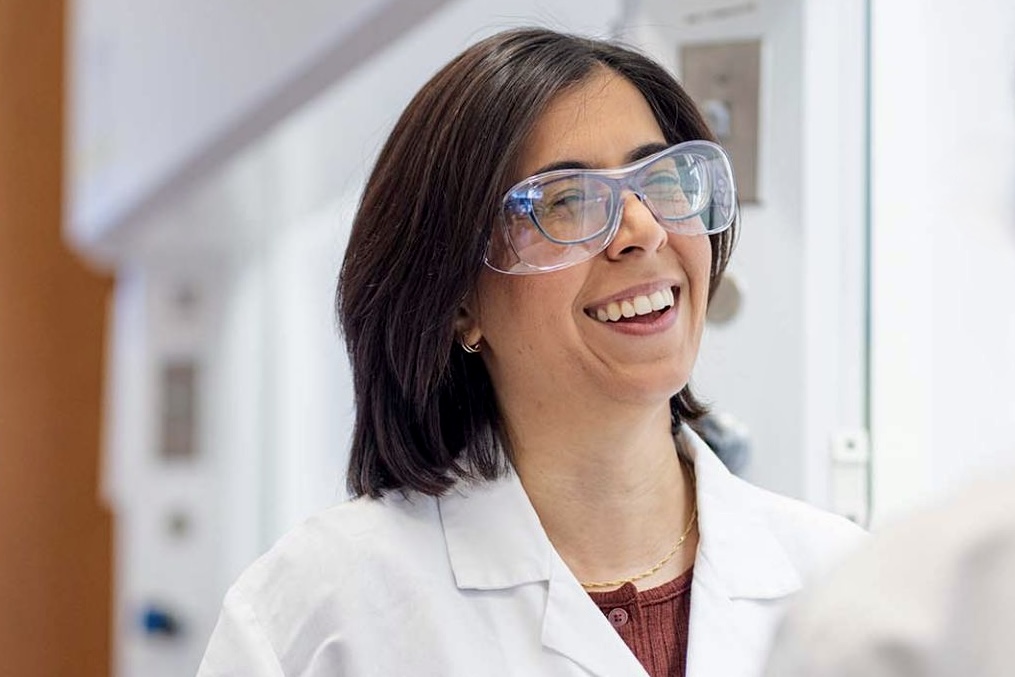
Indian American scientist Sheel Dodani has won a prestigious $100,00 award for “using creative and daring chemistry to engineer technologies” for the betterment of human health and the environment.
Dr. Dodani, an associate professor of chemistry and biochemistry at the University of Texas at Dallas, recently earned the 2026 Norman Hackerman Award in Chemical Research from The Welch Foundation for her pioneering contributions to the development of engineered proteins as anion sensors in biology.
“Dr. Dodani is using creative and daring chemistry to engineer technologies that can measure and manipulate anions in living systems for the betterment of human health and the environment,” said Fred Brazelton, chair and director of the foundation. “The Welch Foundation is delighted to honor her achievements with the 2026 Hackerman Award in Chemical Research.”
The award, named for the foundation’s former scientific advisory board chair, recognizes the accomplishments of chemical scientists in Texas who are early in their careers and dedicated to increasing the fundamental understanding of chemistry. The award includes $100,000 and a bronze sculpture.
“Sheel Dodani’s research is opening an important new window into the chemistry of life,” said Dr. David Hyndman, dean of the School of Natural Sciences and Mathematics and the Francis S. and Maurine G. Johnson Distinguished University Chair.
Read: Indian American researcher Meha Jain wins inaugural ASU-Science Prize
Dodani’s research group created the first coherent suite of genetically engineered fluorescent proteins that act as biosensors for inorganic anions. Atoms and molecules with positive charge — called cations — play an essential role in biology and have been studied extensively. In contrast, anions, or negatively charged particles that are equally vital for life, remain far less understood.
One example is chloride, an anion that helps regulate fluid balance, blood pressure and pH levels in the human body. The biosensors Dodani developed have transformed the ability of researchers to track and visualize in real time how such biologically relevant anions behave and interact with proteins in living systems.
The ability to see anions light up in cells using the fluorescent biosensors opens new possibilities, including identifying small molecules for the potential treatment of chloride channel dysfunction in diseases such as cystic fibrosis.
Read: From scientist to C-suite: Sruti Balasubramanian is actnano’s new CTO
“This work began with a fundamental question: How can we bind an anion in water?” said Dodani, who is a Fellow, Eugene McDermott Distinguished Professor at UT Dallas. “To answer this, we turned to nature’s supramolecular machines: proteins. Through protein engineering, we can unlock new functions in fluorescent proteins that allow us to capture dimensions of anion biology that have been challenging to observe directly in living cells.
“The Welch Foundation gave us the opportunity to pursue this direction early on,” she said. “At the time, there was no established framework for investigating anions in water, let alone in living systems. By integrating concepts from different disciplines, we have started to answer questions that were previously out of reach.”
The Welch Foundation provides resources for researchers to de-risk the science, which Dodani said is a critical factor for those who, like her, want to ask and answer difficult questions that could impact human health as well as the environment.
Born and raised in Plano, Texas, Dodani earned her Bachelor of Science in chemistry from UT Dallas. After completing her PhD at the University of California, Berkeley and working as an NIH postdoctoral fellow at the California Institute of Technology, she returned to UT Dallas in 2016 as a faculty member in the School of Natural Sciences and Mathematics.