



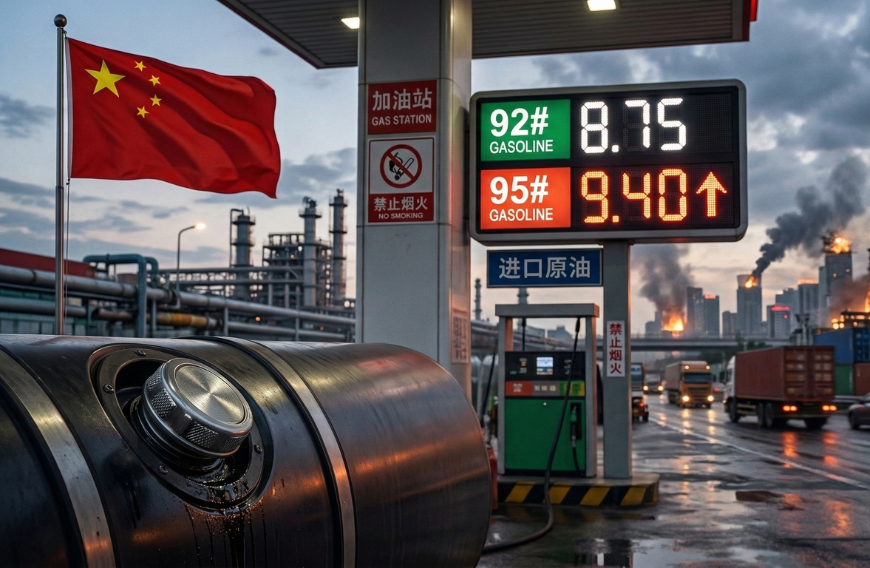
China is raising its oil prices amid the U.S.-Israel and Iran war. China raised regulated ceiling prices for retail gasoline and diesel in the sharpest increase since March 2022 on Monday, following a surge in international oil prices due to the U.S.-Israeli war on Iran.
The move came in response to a surge in global oil prices triggered by the ongoing conflict involving the United States, Israel, and Iran. China’s National Development and Reform Commission (NDRC) raised the maximum retail prices for gasoline and diesel to reflect the rising cost of crude oil on international markets. This adjustment follows China’s established pricing mechanism, which links domestic fuel prices to fluctuations in benchmark global crude prices while accounting for domestic taxes, distribution, and processing costs.
As per a notice from the National Development and Reform Commission, gasoline and diesel retail price caps in the world’s second-largest oil consumer will increase by 695 yuan ($100.46) and 670 yuan ($96.84) per metric ton, respectively, from Tuesday.
READ: Oil and gold prices rise amid heightening US-Iran tensions (
The adjustment rate reflects changes in international crude oil prices while also taking into account average processing costs, taxes, distribution expenses and appropriate profit margins.
The price hike underscores the vulnerability of global energy markets to geopolitical instability, particularly in regions critical to oil production. Rising fuel prices have direct consequences for transportation, industry, and consumer costs, contributing to broader inflationary pressures within China and across the Asia-Pacific region.
After Mojtaba Khamenei’s appointment as Iran’s latest Supreme Leader amid the escalating U.S.–Israeli conflict, global oil markets reacted with heightened volatility. Crude prices jumped above $100 per barrel, driven by fears that ongoing warfare could disrupt supplies from the Middle East, including key shipping through the Strait of Hormuz.
The market response reflects uncertainty about how Iran’s new leadership will influence the course of the conflict, production decisions by major producers, and the safety of energy infrastructure. The exact extent to which Mojtaba Khamenei’s succession directly influenced oil prices, as opposed to broader geopolitical tensions, remains uncertain. Traders and analysts are also monitoring whether further disruptions or strategic interventions by producing nations and consuming countries will occur.
READ: Iran conflict threatens global oil supply, crude prices on edge (
As the U.S.-Iran conflict continues, oil prices may remain volatile, and additional price swings are possible, though the timing and magnitude cannot yet be confirmed. These developments highlight the ongoing sensitivity of global energy markets to political and military events in the region.
Events in key oil-producing regions can have rapid and wide-reaching economic consequences, affecting trade, transportation, industry, and consumer costs. Countries that are major importers or exporters of energy are particularly exposed, and price shocks can intensify inflationary pressures and compel governments to adjust domestic policies or subsidies to maintain stability.
The situation also highlights the importance of diversified energy sources, resilient supply chains, and contingency planning to mitigate the effects of sudden disruptions. International monitoring and cooperation are crucial when regional conflicts threaten global markets, as even temporary disruptions can ripple through multiple sectors.
Governments and corporations may need to explore alternative energy sources, stockpiling strategies, or diplomatic interventions to mitigate risk. The degree to which international coordination, conflict resolution, or policy responses will succeed in stabilizing markets is not yet clear. These dynamics highlight that energy security, geopolitical events, and economic policy are closely linked, and that even short-term shocks in one region can have cascading effects globally, emphasizing the need for flexible and proactive strategies.