


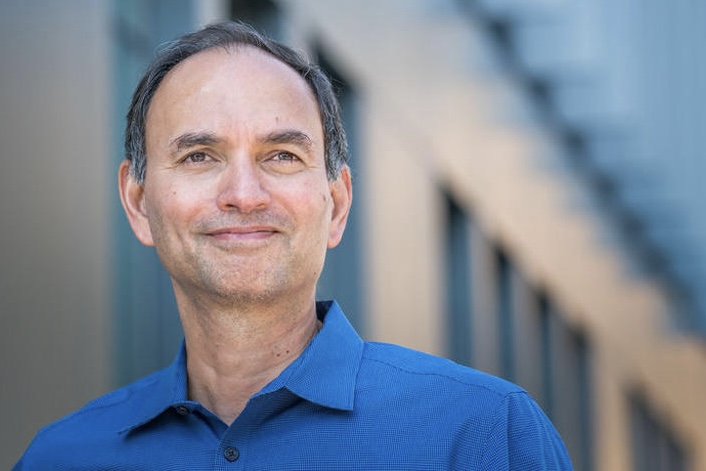
Nitash Balsara, an Indian American scientist from the U.S. Department of Energy’s Lawrence Berkeley National Laboratory (Berkeley Lab) has been elected to the 2026 class of the National Academy of Engineering for pioneering work in battery design.
Balsara, one of 130 new members and 28 international members, was elected for his work “elucidating the relationship between mechanical and electrical properties in block copolymer electrolytes to develop solid electrolytes for rechargeable batteries.”
Election to the academy is considered among the highest professional distinctions accorded to an engineer. Academy membership honors those who have made outstanding contributions in engineering practice, research, or education, as well as in pioneering new and developing fields of technology, major advancements in traditional fields of engineering, or developing innovative approaches to engineering education.
Balsara, a faculty senior scientist in the Materials Science Division and professor of chemical engineering at University of California Berkeley, is an expert in polymer science whose work helps improve the performance and safety of lithium-ion rechargeable batteries.
His group designs, synthesizes, and tests materials for use in batteries and uses advanced characterization methods to understand how the devices work at the molecular level. They were the first to capture real-time 3D images of changes in the state of charge at the particle level inside a lithium-ion battery after it had been charged, providing insight into how to prevent dangerous thermal runaway when fast-charging powerful batteries.
Read: Indian American researcher Meha Jain wins inaugural ASU-Science Prize
Balsara has led Berkeley Lab’s Soft Matter Electron Microscopy Program for over 16 years, pioneering new approaches to visualize ion transport and structure in polymer electrolytes, and served as a principal investigator in the DOE Joint Center for Energy Storage Research (JCESR) throughout the center’s full ten-year lifetime.
Balsara joined Berkeley Lab in 2000 and is a fellow of the American Physical Society (APS) and the Neutron Scattering Society of America. He cofounded two battery start-ups, and his work on polymer electrolytes was recognized with an R&D 100 Award.
He received the American Institute of Chemical Engineers Charles M.A. Stine Award for Excellence in Materials Engineering and Science, the United States Energy Secretary’s Achievement Award, and the 2026 APS Polymer Physics Prize.
Berkeley Lab is a multiprogram national laboratory managed by the University of California for the U.S. Department of Energy’s Office of Science. The lab’s expertise spans materials, chemistry, physics, biology, earth and environmental science, mathematics, and computing. Founded in 1931 on the belief that the biggest problems are best addressed by teams, Berkeley Lab and its scientists have been recognized with 17 Nobel Prizes.