



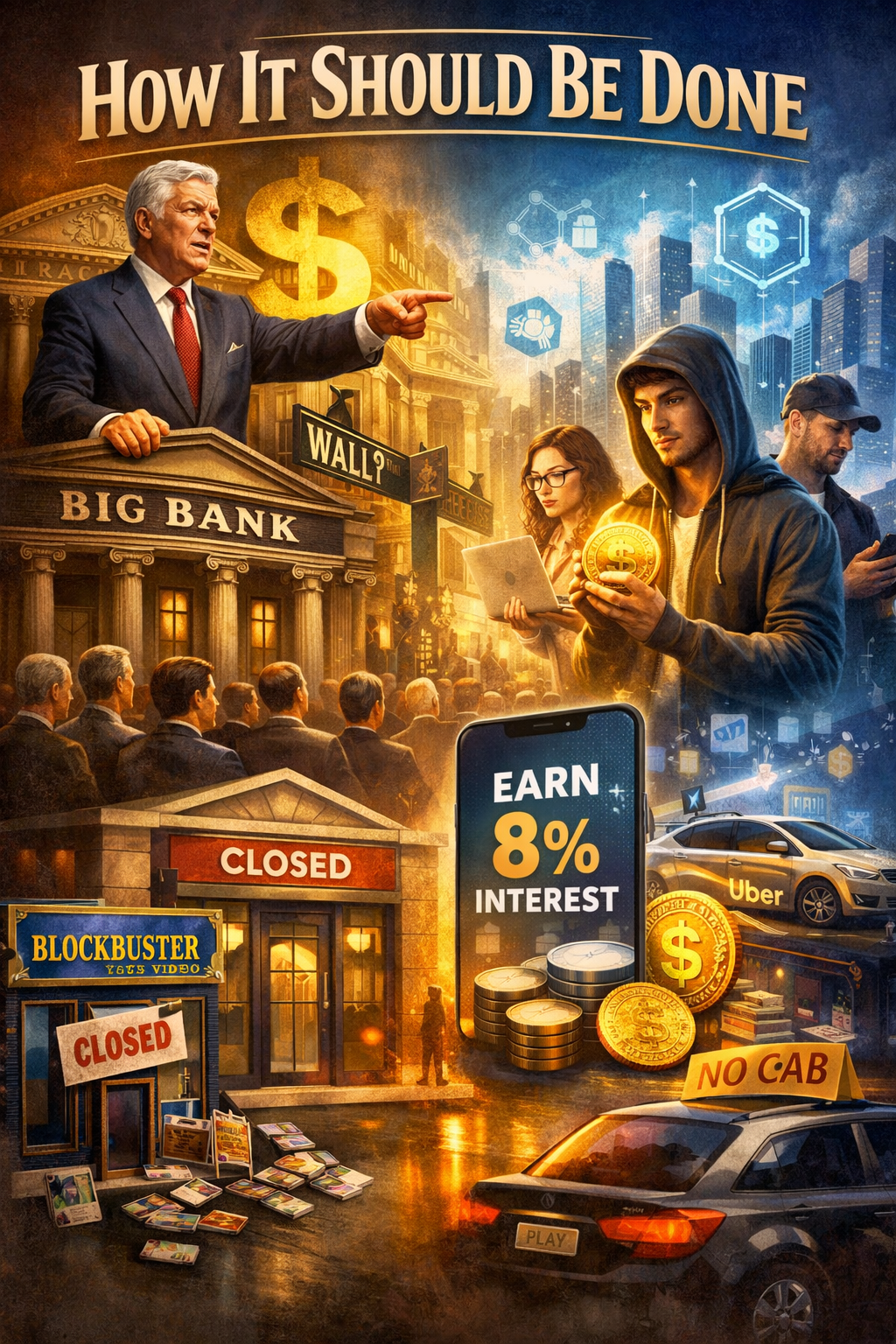
There is a peculiar cruelty embedded in expertise. The more thoroughly a man has mastered the grammar of his age, the less capable he becomes of hearing the vernacular of the next one. He has not merely learned the rules of the game, he has become them. His identity, his income, his standing in the world are woven so tightly into the existing order that the arrival of a new order feels less like progress and more like personal annihilation. And so he does what threatened men have always done: he lectures.
He lectures the upstart. He cites precedent. He invokes the complexity that the newcomer surely does not appreciate, the nuance the disruptor must be missing. He speaks with the authority of scar tissue, accumulated wounds that he has reframed as wisdom. And sometimes he is right. More often, history will judge him as the Blockbuster executive who, in the year 2000, reportedly laughed Reed Hastings and Marc Randolph out of the room when they offered to sell Netflix for $50 million. What had seemed like a laughable proposition, a little company mailing DVDs to niche customers, would become a $39 billion revenue giant by 2024, while Blockbuster filed for bankruptcy in 2010, its shares having collapsed 91 percent from their peak.

The pattern is as old as commerce itself. But in our era, it is accelerating beyond anything the “learned” are equipped to process. And nowhere is the lecture being delivered with more confidence, or with more historical irony, than in the halls of American banking by men like Jamie Dimon.
The Medallion
In the spring of 2009, when Travis Kalanick and Garrett Camp were sketching the idea that would become Uber, the cab industry did not merely fail to understand what was coming. It could not, in any meaningful sense, conceive of it. The medallion system, that baroque artifact of 1930s New York City regulation, had become more than a licensing mechanism. It was theology. A New York City taxi medallion at its peak sold for over $1 million. The medallion was not just the business, it was the barrier, the moat.
To a cabdriver who had mortgaged his future to acquire one, the notion of a driver for a company without a medallion, without fixed shifts, without the elaborate rituals of dispatch and union and territorial custom, was not merely strange, it was heresy.
READ: The Review by Ajay Raju |The coming Civil War inside law firms (February 23, 2026)
Today, Uber commands roughly 75 percent of the U.S. ride-hailing market, operates across 72 countries, and completed over 11.2 billion trips in 2024 alone. Its revenue reached nearly $44 billion that year, and it turned a net profit of $9.86 billion, a stunning reversal from losses of $6.76 billion just four years earlier. Some 8.8 million drivers worldwide now participate in a platform that, to the medallion-holders of a prior era, simply should not have been legal.
It was not that the cabbies were stupid. It was that they could not step outside the conceptual architecture that had made them experts, because that same architecture was the foundation of everything they owned.
This is the first law of disruption: expertise is not merely descriptive. It is territorial. To acknowledge the legitimacy of a new paradigm is to implicitly concede the obsolescence of the old one, and therefore, of oneself.
Blockbuster
In the year 2000, late fees generated $800 million for Blockbuster, a full 16 percent of company revenue. Late fees were not a side business. They were, in the architectural logic of the rental model, a load-bearing wall. They also generated something rarer and more dangerous than revenue: they generated resentment. Every customer who paid a late fee paid it with a small interior oath to find something better someday.
Netflix found them first.
What is instructive about the Blockbuster story is not the technology gap, it is the cognitive gap. Blockbuster had data on every customer: rental histories, visit frequency, precisely which films drove traffic. Netflix read that same data through a different lens. Netflix saw that customers valued convenience and personalization. Blockbuster saw fees. One company was optimizing around the customer’s desire. The other was optimizing around a revenue model that had calcified into a worldview.
Even when Blockbuster’s CEO John Antioco recognized the Netflix threat in 2004 and moved to cut late fees and launch an online service, the board, the institutional guardians of the existing order, fired him in 2005 and reversed his changes, judging the transition too costly. They were protecting the earnings model of a world that was already ending. By 2009, late fee revenue had collapsed from $800 million to $134 million, from 16 percent to 3 percent of total revenue in less than a decade. The edifice fell with it.
Netflix today generates $39 billion in annual revenue. It earned $8.7 billion in net profit in 2024. The lesson is not merely about streaming versus physical media. It is about the difference between a company that read the future through the customer’s eyes and one that read it through the balance sheet of the present.
The charter
Now meet the new medallion-holder, wearing a bespoke suit, running the largest bank in America. And last month, before a television camera and several hundred billion dollars of institutional credibility, he delivered the lecture.
“It can’t be,” said JPMorgan’s Jamie Dimon, speaking to CNBC’s Leslie Picker, “you have these people doing one thing without any regulation, and these people doing another. If you do that, the public will pay. It will get bad.”
The Review by Ajay Raju: Bikini: What we don’t cover (
Congress is presently deciding whether companies like Robinhood and Coinbase may offer yields on stablecoins, a mechanism that would allow ordinary Americans to earn interest on digital dollars the same way they might earn it on a money market fund. The banks have mobilized their institutional artillery. Executives from JPMorgan and Bank of America have invoked a Treasury Department study suggesting that if stablecoins bore a yield, banks could lose as much as $6.6 trillion in deposits. That figure, drawn from an April 2025 presentation to the Treasury Borrowing Advisory Committee, is not invented. The risk is real. Smaller banks, in particular, would face severe funding compression. The concern about systemic contagion deserves to be heard.
But the taxi industry also cited real risks. The medallion system had, after all, guaranteed a regulated, inspectable, accountable fleet of vehicles. The concern was not entirely manufactured. But the concern was also inseparable from the economic interest of those advancing it, and that inseparability, the way legitimate risk analysis and self-preservation merge seamlessly in the expert’s lecture, is precisely what makes the pattern so difficult to disentangle and so dangerous to mistake for pure wisdom.
The stablecoin market currently stands at a market capitalization of roughly $234 billion, dominated by Tether’s $145 billion and Circle’s $60 billion, with USD-pegged instruments accounting for more than 99 percent of the total. Stablecoin transaction volume reached $4 trillion in the first seven months of 2025 alone, an 83 percent increase year-over-year. The GENIUS Act, now moving through Congress, contemplates a regulatory framework for these instruments, reserve requirements, oversight mechanisms, the very scaffolding that Dimon insists is missing. And yet the banks have not relented. In a series of White House meetings brokered by President Trump in hopes of finding common ground, the largest lenders have declined to move.
Trump has now made his position explicit. “Americans should earn money on their money,” he posted. “This industry cannot be taken from the People of America when it is so close to becoming truly successful.”
There is a sentence worth sitting with: “Americans should earn money on their money.” It is not a complex financial argument. It is not a regulatory brief. It is the voice of the late-fee customer, the rider who could not get a cab at 2 a.m., the person standing outside the cathedral after closing time, wondering why the door is locked.
The cathedral
Banks are, of course, the grandest practitioners of the lecture. They have been issuing it for centuries. They know about systemic risk. They know about fractional reserve ratios. They know about the regulatory scaffolding that holds the entire cathedral upright. And they are not entirely wrong. The cathedral has held, through 1929, through 2008, through countless smaller tremors.
But the cathedral is closed on weekends. It does not work nights or holidays. It charges fees to move your own money across borders, imposes waiting periods on transactions that should be instantaneous, and requires intermediaries at every step of a process that technology has made profoundly unnecessary. Some 1.4 billion people worldwide remain unbanked entirely, not because they lack financial need, but because the cathedral’s architecture was never designed with them in mind.
The stablecoin, at its most elemental, is a challenge to that architecture. It is a digital dollar that moves at the speed of a text message, settles at 3 a.m. on Christmas morning, travels across borders without a wire transfer fee, and, if the pending legislation permits, earns its holder a return on otherwise idle funds. The Treasury’s own analysis concedes that stablecoins could catalyze structural changes across deposit markets, Treasury demand, and monetary supply. What the Treasury report also notes, with the dry precision of official language, is that USD-pegged stablecoins could strengthen dollar hegemony globally, drawing currently non-dollar liquidity into the American monetary orbit. This is the part the banks tend not to quote.
The Review by Ajay Raju: Warning: Contains upsetting comments (about Philadelphia’s leaders) (
The broader DeFi ecosystem that underlies these instruments is, by any honest accounting, beginning to matter at scale. Total value locked in DeFi protocols reached a range of $130 to $140 billion in early 2026, recovering strongly from prior volatility. The global DeFi market is projected to grow at a compound annual rate exceeding 43 percent between 2026 and 2030, potentially reaching $256 billion by decade’s end. Institutions that once dismissed blockchain entirely are now quietly embedding it into their own operations, approximately 80 percent of major financial institutions are exploring the technology, 60 percent of central banks have accelerated digital currency efforts, and institutions using blockchain have reported a 43 percent reduction in financial data breaches.
The dismissal is becoming harder to sustain when stablecoin settlement volume is annualizing near $8 trillion.
The deposit fee
Recall that Blockbuster’s late fee was not simply a revenue mechanism. It was a resentment machine, a daily reminder to every customer that the company’s interests and the customer’s interests had diverged. The banks have their own version of this fee, distributed across overdraft charges, wire transfer costs, foreign exchange spreads, minimum balance requirements, and the quiet, persistent toll of keeping your money somewhere that earns you almost nothing while the institution lends it at multiples. These are not evil policies. They are the natural calcification of a business model that, over decades, has optimized around institutional convenience rather than customer experience.
The stablecoin offering yield is, in this light, less a financial innovation than a referendum. It is customers voting, with their wallets, on whether the bargain they have been offered by the existing system is the best bargain available. If it were, the banks would not be frightened of the competition. Their fear is, itself, the most honest assessment of the product they have built.
Now
What makes this moment different from all previous moments of disruption is velocity. Uber took roughly a decade to go from founding to global dominance. The forces reshaping finance are moving faster. Artificial intelligence is rewriting the terms of expertise itself, not just in what it can do, but in how rapidly it can render existing competencies obsolete. The learned are losing their most treasured advantage: the lag time between the new order’s emergence and the old order’s comprehension.
In this environment, the straitjacket of precedent is not merely an intellectual limitation. It is a strategic vulnerability. Industries and institutions that require novelty to be pre-approved by the custodians of the existing order will lose, not because the custodians are evil, but because the approval process itself is too slow for the world that is arriving.
This is not a comfortable conclusion. We rely on accumulated wisdom. We need institutions. The new is not automatically better than the old. A $6.6 trillion deposit migration, if it materialized suddenly and without regulatory architecture, could indeed destabilize smaller lenders and compress credit availability in communities that depend on it. Disruption is never clean. The cabdrivers who organized their financial lives around the medallion system were not foolish; they were working with the best information available to them. The 84,000 Blockbuster employees in 2004 had families to feed.
But the alternative, the permanent veto of the learned over the learner, is not stasis. It is slow decline. The taxi industry could have built Uber. The studios could have built Netflix. The banks could have built DeFi. They had the capital, the customer relationships, the regulatory access, and the talent. What they lacked was the willingness to disrupt themselves before someone else disrupted them.
The banks are not malicious. They are architecturally constrained, in their current form, from serving a billion and a half unbanked people or from processing a transaction at 2 a.m. without charging a toll. The stablecoin, with all its volatility and regulatory immaturity, is at least trying to answer the question the banks have never seriously asked: What if the customer could just do this himself?
The verdict
Congress will decide, likely this year, whether the charter that has protected American banking from price competition on deposits is the last medallion, or merely the latest one to fall. The banks will continue to lecture. They will cite the Treasury study. They will invoke systemic risk. They will suggest that the people who built Coinbase do not understand how money really works.
The Review by Ajay Raju: Postcard from Dubai (
They may even be partially right.
But the cab was not coming. The video store was not open. And the branch is closed.
The great intellectual and practical challenge of our moment is not to choose between the learned and the learner, between precedent and innovation, between institution and disruption. It is to cultivate the rare and demanding virtue of holding expertise lightly: using it as a lens rather than a cage, letting it illuminate the problem rather than define the solution.
To fight, in other words, with everything your sensei taught you. And to remain alert, always, to that MMA opponent who did not come to follow the rules, but who came, with devastating creativity and force, simply to win.
———
Ajay Raju, a venture capitalist and lawyer, is the author of The Review, a column that attempts to decode the patterns emerging from the unprecedented shifts reshaping our world. In a world where adaptation is survival, The Review offers a compass for the journey ahead.