



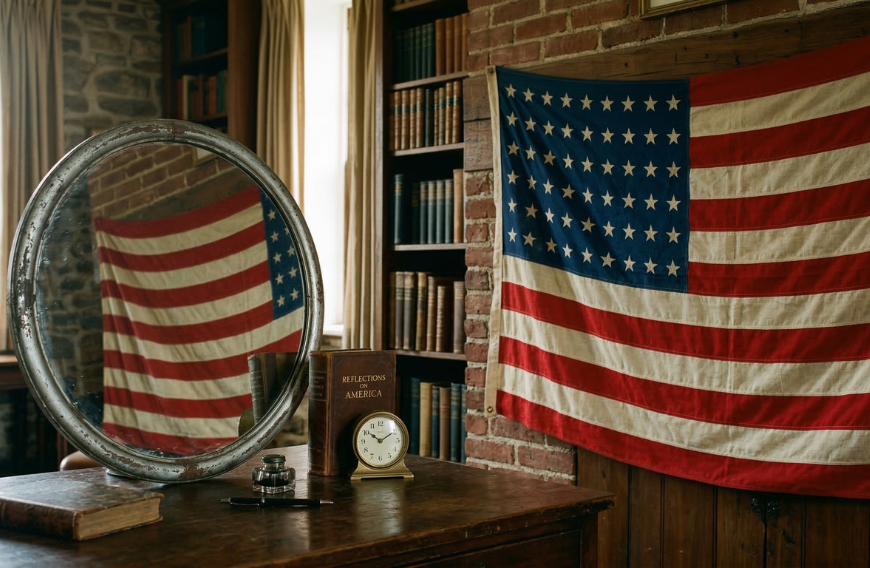
There are moments when a nation looks at its leader and sees not a man but a mirror. The reflection is rarely flattering—and rarely, in the history of republics, has it been this precise. For more than a decade, the United States has stared into that mirror through the career of Donald Trump and discovered something it did not expect: not a monster at the margins, but a recognizable face, distorted just enough to be deniable.
Trump did not invent America’s appetite for spectacle. He revealed it—and then he fed it, and then he became inseparable from it. That is the harder truth that polite political analysis has consistently struggled to absorb.
The pattern by now is familiar. A crisis erupts. The language is maximalist—enemies will be crushed, allies punished, tariffs unleashed, wars ended by a single phone call from a very powerful man. Days later the threat dissolves into ambiguity or reversal, while the spectacle moves on. What looks like incoherence is actually a kind of discipline: the chaos is the message. Uncertainty, it turns out, can be wielded as a weapon. Financial markets, foreign ministries, and domestic opponents must perpetually recalibrate. The cost of that recalibration falls on everyone but him.
This is Trump Time—a political style built not on ideology but on tempo. He controls the clock. He decides when urgency spikes and when it drains away. In doing so, he has pioneered something genuinely new in American presidential history: a governance of permanent imminence, in which the perpetual threat of catastrophe substitutes for the actual work of policy.
Long before politics, Trump understood the economics of notoriety. In the 1980s and 1990s he built a persona calibrated for the tabloid age—the developer whose name gleamed in gold across Manhattan, the impresario whose divorces and bankruptcies generated headlines as reliably as his buildings. Corporate failure never dimmed the image; it expanded it. In the media economy he inhabited, scandal was capital, and Trump was running a surplus.
Reality television then did something subtler than make him famous. It trained an audience to receive him. On The Apprentice, authority was not earned but performed—judged, ritualized, and delivered with the finality of a gavel. You’re fired. Contestants did not merely lose; they were found wanting before millions. Week after week, viewers absorbed a stylized portrait of executive power that bore almost no resemblance to how organizations actually function, but bore a great deal of resemblance to how many people wish they did. Trump did not rehearse for politics on that show. He pre-sold its aesthetics to the electorate.
When he descended the Trump Tower escalator in June 2015, the political establishment dismissed it as stunt. The stunt never ended. What they called performance, his supporters called authenticity—and the distinction, while philosophically interesting, proved electorally irrelevant.
Trump’s political genius—if “genius” is the word for an operation so instinctive —was to treat democratic politics as participatory entertainment. Rivals became nicknames worn like scarlet letters. Policy disputes became personality feuds. Rallies became episodes in a serialized drama whose protagonist was perpetually embattled and perpetually triumphant. Critics read the insults as cruelty. Supporters read them as the first honest speech they had heard from a politician in years. Both were, in their way, correct.
READ: Satish Jha | India beyond the telescope (February 28, 2026)
The victory was not merely electoral but epistemological. Trump reshaped what counted as evidence, what counted as credibility, and who counted as legitimate. Expertise became a form of condescension. Institutions became fronts for the corrupt. Losing became proof of a rigged game. In this closed system, every accusation confirmed the narrative, and every exoneration was suspect. Scandal that might have destroyed another politician often served to fortify him—each charge adding another stone to the rampart of persecution from which he governed.
To see Trump only as aberration is to indulge a comfortable myth. He is not an interruption of American democratic tradition but a pressure test of it—and the test is revealing structural weaknesses that predate him by decades. The polarization he exploited had been building since the 1990s. The media economy that amplified him had been atomizing public discourse since the early internet. The distrust of institutions he channeled had been accumulating through Iraq, through 2008, through a generation of promises made and unmade.
The founders feared demagogues. They built institutions—separation of powers, federalism, an independent judiciary—designed to dilute charisma with procedure. What they could not build was the civic culture those institutions depend on: the habits of restraint, the acceptance of legitimate defeat, the willingness to distinguish between losing an election and suffering an injustice. Those habits are not law. They cannot be enforced. They can only be honored or abandoned, and Trump made abundantly clear that he regarded their abandonment as a competitive advantage.
The deeper question is not who Trump is. After decades in public life, that answer is, if not plain, at least legible. The question is why the performance continues to resonate—and what it demands of those who consume it. An audience is never merely passive. It is a co-author. Trump’s supporters do not simply receive the performance; they ratify it, extend it, defend it, and in doing so make themselves partly responsible for what it produces. This is uncomfortable for everyone, which is perhaps why it is so rarely said directly.
The media economy shares responsibility of a different kind. Attention is the most valuable commodity in the information age, and Trump has been its most reliable generator. Every outrage covered is a lesson taught: that outrage produces coverage. Every normalization of the abnormal is a ratchet turned. The press that warned most loudly about Trump also, in its coverage decisions, most efficiently expanded his reach. There is no clean exit from this dynamic. There is only the recognition that it exists.
READ: Who decides who leads Iran? (
One day the rallies will end. The cameras will move on to the next spectacular figure this media landscape is already producing. The era of Trump will close, as all eras do, though perhaps not as cleanly as we might wish—movements outlast their founders, and the conditions that created him remain.
What remains, after the performance, will be the harder task: not simply deciding what kind of democracy Americans want, but acknowledging what kind of democracy they have already revealed themselves to want. The mirror does not flatter. But it does not lie, either.
The real story of Trump Time has never been about a single man in a gold tower. It is about a society that discovered how easily democratic politics could become a spectacle—and then discovered, to its greater alarm, that a great many of its citizens preferred the spectacle. That preference did not begin with Trump. It will not end with him.
The lights are still blazing. The question is what we will see, when we finally let them dim, in the room that remains.