



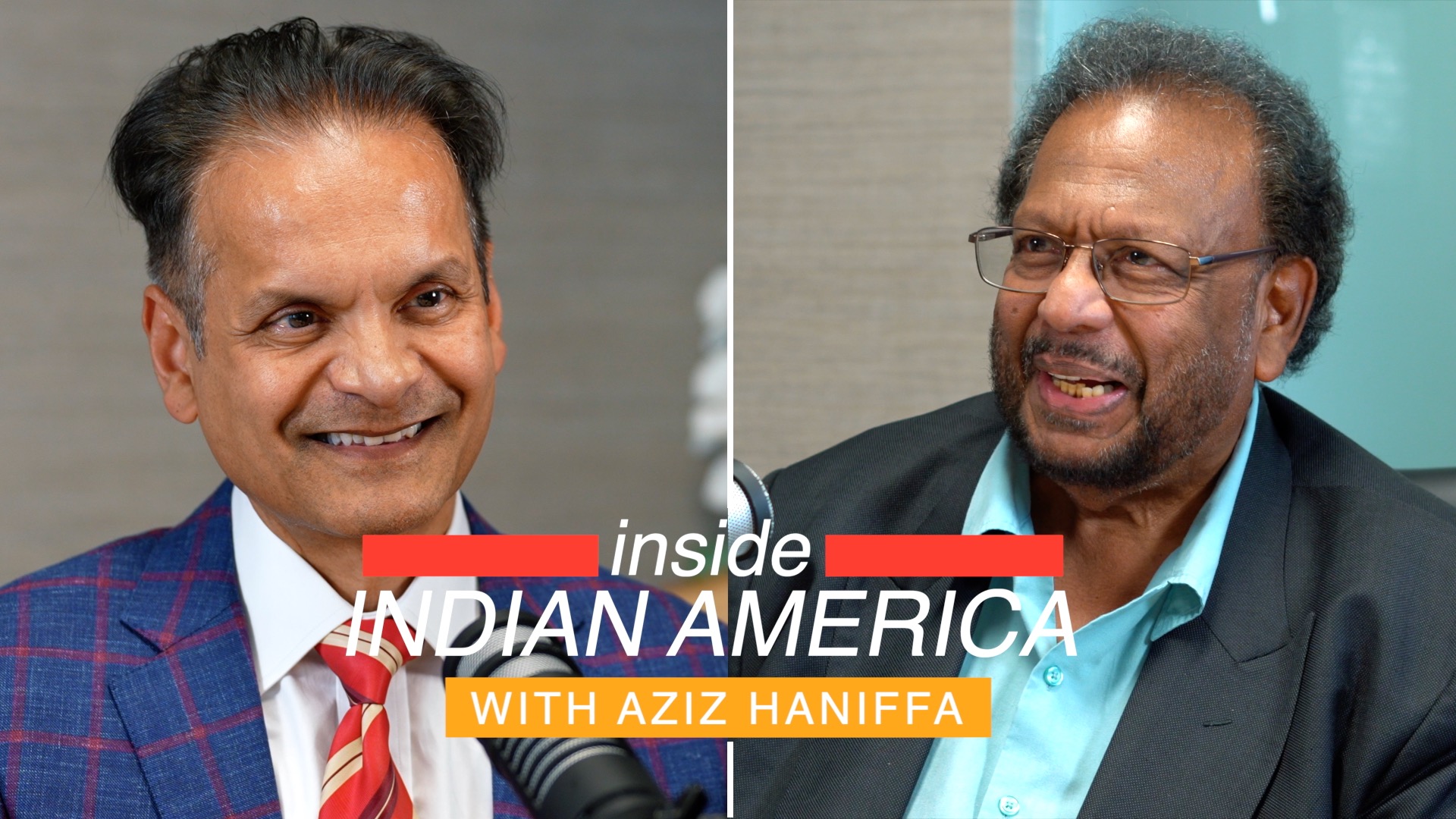
Himanshu Shah’s fifth-floor office near the Crabtree area in Raleigh, N.C., reflects the quiet discipline that has defined his career. There are no flamboyant displays of Wall Street bravado, no signs of the swagger often associated with hedge funds. Everything is orderly, understated, and measured.
The founder of Shah Capital, appearing on the latest episode of the podcast Inside Indian America, speaks with the same calm precision about markets, geopolitics, and the philosophy that has guided his investment decisions for more than three decades.
The results speak loudly enough. Over the past decade, Shah’s hedge fund has delivered annual compounded net return of nearly 22 percent, with cumulative returns approaching 1,000 percent since fund’s inception in 2006 and roughly $1 billion in portfolio gains from small pool of money.
Yet Shah insists the principles behind that performance are neither mystical nor complicated.
“The core philosophy is still the same,” he says. “When I started Shah Capital 20-some years ago, it was really looking at a 360-degree view of the company or the investment that we’re looking at. So, really understanding: what am I getting into?”
That deceptively simple question — what exactly you are buying — has been the anchor of Shah’s investment worldview.
In the podcast, Shah offers a wide-ranging look at the ideas that have shaped his investing career and worldview. Reflecting on his journey from India to founding a successful hedge fund in the United States, he emphasizes the importance of deeply understanding the companies and industries in which one invests, maintaining a disciplined and often contrarian approach to markets, and paying close attention to the influence of geopolitics and global economic trends.
Shah also shares his perspectives on emerging forces such as artificial intelligence, the role of shareholder activism, lessons learned from investing in China, and the need for stronger technical education to create jobs in India. Together, his remarks provide a candid glimpse into how an experienced global investor navigates risk, opportunity, and long-term value in an increasingly complex economic landscape.
Himanshu Shah’s journey to the world of global finance began in Ahmedabad, in India.
“I grew up in a yarn merchant family,” he recalls. “My dad was running family business with tremendous integrity, and he was a man of principles and discipline, so that was a good takeaway.”
Shah’s curiosity about finance emerged early. “As a teenager, I dabbled with stocks in my teens of the Mumbai Stock Exchange before I came here,” he says.
Still, the path to becoming a hedge fund manager was not predetermined. Shah immigrated to the United States in 1988 to pursue graduate studies at the University of Akron.
“Really understanding the global equities and currencies and hedging and whatnot, that really came from some of the coursework,” he says.
In those years, Indian Americans were only beginning to establish a visible presence in American professional life. The first wave of immigrants had made their mark largely as physicians, engineers, or entrepreneurs in industries such as hospitality and technology.
Finance was a different frontier. “Actually, my dad never liked stocks,” Shah says with a laugh. “He never invested in the market. So, for him, it is paper money — that’s what he used to call.”
Over time, however, Shah’s fascination with markets evolved into a professional calling.
“[It] has been an evolution,” he explains. “If you really understand whatever you are doing — whether you own a hotel or whether you own a clinic or what not — if you really understand what you are doing, you are going to end up being a better professional.”
Building Shah Capital
Shah founded Shah Capital more than two decades ago with a philosophy rooted in deep research and concentrated conviction.
In the early days, his portfolio was broadly diversified. “In 2005, when I started, I had 40 companies in my portfolio,” he says. Today, the approach is dramatically different. “Today, I have 13. And ideally, I want that number to be less than that.”
The shift reflects a lesson learned over time: focus often produces better returns than diversification. “I’ve just seen that in the last 10 years, or five years especially, the more focused I’ve become, it has given me better returns.”
That focus requires looking beyond traditional financial metrics. Shah studies industries, geopolitical dynamics, and economic trends before committing capital.
“Geopolitics and geoeconomics do play a role,” he says. “We have swam against the current — if you want to call that contrarian thinking.”
The strategy frequently leads him toward companies overlooked or misunderstood by the broader market.
Betting on the overlooked
Shah’s portfolio includes companies with global exposure, including VEON, Emeren, Yuchai, and Novavax.
What attracts him to these investments is not hype but mispricing. Take VEON, a digital telecom operator primarily in emerging markets.
“Here you have a company that is dominant in its five markets,” Shah explains. “first of all, it is well managed.” Yet the company’s stock trades at a fraction of the valuation commanded by large multinational corporations.
“VEON, I see growing — and it has grown — double digits for the last number of years,” he says. “But then I look at the underlying valuation of that business. It is like one-third of some of those multinationals.”
For Shah, that disparity creates opportunity. “I gravitated towards those companies because, again, your risk-return profile is a lot better in your favor.”
Novavax play
One of Shah’s most significant investments is Novavax, a vaccine company.
The company rode a massive surge during the COVID-19 pandemic before its stock collapsed amid regulatory delays and marketing missteps. Shah entered the investment after the decline.
“I would not call it a no-brainer,” he says. “I do like capabilities of their Matrix-M adjuvant.”
Adjuvants, compounds that enhance vaccine effectiveness, are difficult to get approved by regulators. “It is very difficult to get, by the way, an adjuvant approved by FDA,” Shah explains.
Despite the scientific promise, Novavax struggled commercially. “They really mocked up in terms of how they marketed it,” Shah says.
The experience highlights a broader theme in Shah’s investment philosophy: markets often misjudge companies during moments of crisis or volatility.
“We got involved in late 2022 after the stock’s collapse from mid-2020.” Shah Capital later pushed for changes within the company through shareholder activism.
The activist investor
Shah has frequently been described as an “activist investor” — someone who pushes companies to adopt strategic or governance changes. For him, activism is both an investment strategy and a responsibility.
“Activism can generate tremendous return on your investment, if you do it right,” he says. His experience serving on corporate boards gives him insight into how companies actually operate.
“A lot of companies that I’ve seen in 30 years of my investment career — they just basically are rubber-stamp boards,” he says.
In such cases, shareholder engagement can unlock value. “So the way I look at activism is like I’m also helping the other shareholders of that company, not just Shah Capital.”
One example involved a company whose market value increased by nearly $2 billion after Shah launched an activist campaign.
Investing requires balancing conviction with risk. Shah returns again to his central principle: knowledge reduces risk. “If you know what you are getting involved, the risk goes down dramatically,” he says.
Markets can still collapse due to events beyond any investor’s control — wars, pandemics, political shocks, recessions. “You are definitely taking a market risk,” Shah says.
But if an investor buys a fundamentally strong company at a reasonable price, the probability of loss decreases. “If you really understand that asset and if you haven’t overpaid for it, your probability of losing money goes down dramatically.”
AI and the future of work
Today, investors across the globe are pouring billions into artificial intelligence, fueling fears of technological disruption and job displacement.
Shah takes a more measured view. “AI and agentic AI are here to stay and will play far larger role in our daily lives,” he says.
But he rejects the idea that automation will wipe out large portions of the workforce. “I am not in a camp that AI is going to eliminate 50, 60, 70 percent of white-collar jobs.”
Instead, he believes AI will function primarily as a productivity tool. “I look at AI as a productivity enhancer, not a massive job killer.”
Yet technological revolutions historically create new opportunities. “The building of the data centers has almost contributed two-thirds of the U.S. economic growth in 2025,” Shah notes.
“Though there is a little madness going on right now in terms of the CapEx outlay,” he says, referring to massive investments in data centers and computing infrastructure.
As a result, Shah Capital has largely stayed away from direct AI or datacenter investments. “We are not allocating capital directly into AI today,” he says. Instead, he prefers companies that will benefit indirectly from AI adoption.
Passive and Algo investing and human judgement
In an era increasingly dominated by algorithmic trading and passive investing, Shah also makes a compelling case for human judgment. He believes human insight will regain importance.
Over the past decade, massive inflows into index funds have concentrated capital in a handful of mega-cap companies such as Apple, Nvidia, and Walmart.
But that trend may be reversing. “The bottom 90 percent of the companies — they really have not participated in this massive equity upswing from 2015,” Shah says.
As valuations normalize, opportunities may emerge among overlooked companies. “That’s where the human judgment will play a role.”
Looking ahead, Shah remains intrigued by new technologies. Hydrogen energy, in particular, could become transformative. “I just feel like in five, six, seven years or so we are going to see some tremendous development on that front,” he says.
But he cautions that technological revolutions rarely generate profits for most early investors. “Most of the time, if history is correct, very few people end up making lot of money.”
Despite the uncertainties of global markets, Shah remains optimistic. Experience, he believes, has sharpened his perspective. “I’m a better investor because of some of those mistakes I made,” he says.
In a world defined by volatility — from pandemics to geopolitical rivalries — the ability to understand risk remains the ultimate advantage.
For Shah, that understanding begins with a simple question. “What am I getting into?”
Lessons from China
Few investors can claim as much firsthand exposure to China as Shah. “I’ve been there around 50 times,” he says.
His early visits left him impressed with the country’s rapid growth, culture and infrastructure development. Yet investing there proved more complicated than expected.
“Just because you have a 10 percent GDP growth doesn’t mean the equity market goes through the roof,” he says.
Cultural differences also shaped investment outcomes. “The investing culture is very different than the American culture,” Shah explains.
Today, geopolitical tensions between Washington and Beijing complicate the investment landscape. “If there was no tension between U.S. and China, then I would own a lot more Chinese equities today,” he says.
Still, he believes the two economies remain deeply interconnected. “The probability of these two countries going separate is low because there’s just so much interdependency.”
A vision for India
Shah also has strong views on India’s economic future. With millions of young people entering the workforce every year, job creation remains a pressing challenge.
“There are around one million Indian students that graduate every month,” he says.
His solution: expand technical education dramatically. “If I was [Prime Minister Narendra] Modi, I would actually turn half the colleges into technical colleges,” Shah says.
Traditional four-year academic degrees may no longer be sufficient. “I don’t think four-year college education is important as it used to be.”
Instead, Shah believes India should massively emphasize practical and manufacturing skills. “India needs manufacturing jobs,” he says.
Colossal Industrial clusters, similar to the textile hubs that once powered Gujarat’s economy, could play a key role in absorbing its growing young workforce.
Giving back
Outside the world of finance, Shah devotes growing attention to philanthropy. His efforts focus primarily on education and rural development in India, along with cultural initiatives in the United States.
“We have only focused on education and uplifting rural communities in India,” he says. In time, he expects philanthropy to become an even larger part of his life.
“Anything I do should be my hobby, not a responsibility,” Shah says. “For me, work is my hobby.”