



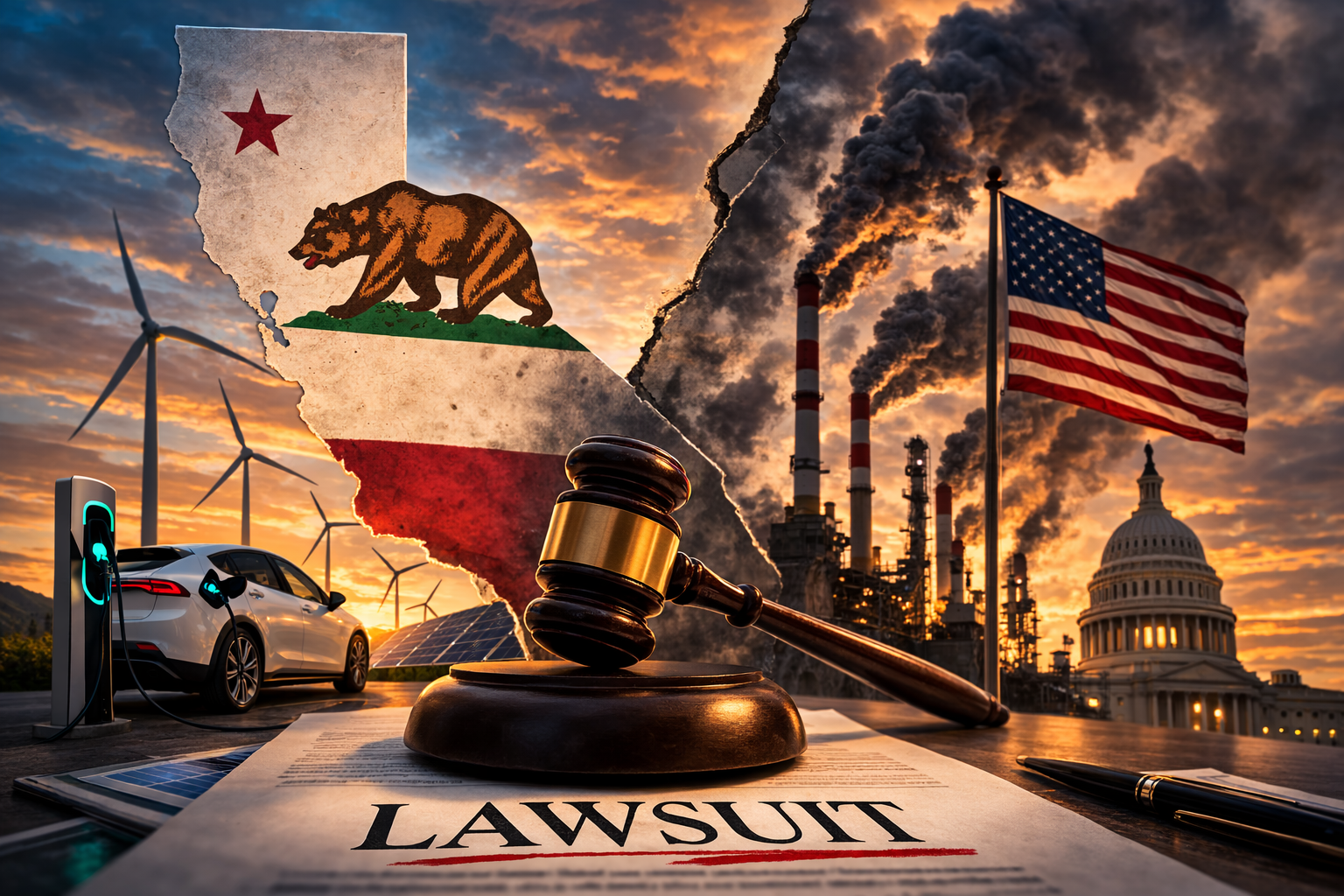
U.S. President Donald Trump and his administration have launched a legal challenge against California’s vehicle emissions standards. Reportedly, the Trump administration on Thursday sued California, arguing that the state’s zero-emission vehicle and tailpipe greenhouse gas emissions rules are illegal and preempted by federal law.
“This litigation will help automakers design and produce cars and trucks to meet one federal fuel economy regulation,” said Jonathan Morrison, who heads the National Highway Traffic Safety Administration.
The U.S. Transportation Department filed the lawsuit against the California Air Resources Board in U.S. District Court in California over vehicle rules that remain in place after Trump signed legislation last year overturning California’s Advanced Clean Cars II program, which aims to phase out the sale of new gasoline-powered cars by 2035.
READ: Tesla escapes California suspension by removing ‘autopilot’ term (
California’s zero-emission vehicle (ZEV) and tailpipe greenhouse gas emissions rules are central to the state’s broader efforts to combat climate change and improve air quality. Under the Advanced Clean Cars II program, the California Air Resources Board (CARB) requires automakers to gradually increase the sale of zero-emission vehicles—including battery-electric, hydrogen fuel cell, and certain plug-in hybrid models.
For decades, California has positioned itself as a leader in climate policy, using state-level standards to encourage innovation in cleaner transportation technologies. Federal authorities, however, often emphasize the benefits of a single national regulatory framework, arguing that uniform standards provide greater certainty for automakers and manufacturers operating across multiple states.
Decisions about vehicle emissions standards and fuel efficiency carry wide-ranging implications, affecting automakers, consumers, local economies, and potentially global energy markets. They also shape the pace at which electric and alternative-fuel vehicles are adopted nationwide, which in turn could influence long-term environmental outcomes depending on how regulations are implemented and challenged in court.
Reportedly, a spokesperson for California Governor Gavin Newsom said that as Americans face higher gasoline prices following the start of the Iran war, “the Trump administration sued California for advancing cleaner, cheaper cars that free drivers from the grip of foreign oil markets and the bad actors who stand to profit from global instability.”
The dispute highlights how political, legal, and economic considerations often intersect in environmental governance. Legal challenges over emissions rules can create uncertainty for industries attempting to plan production and investment strategies, while also shaping public perception of leadership on climate policy.
At the same time, the case illustrates the broader challenges involved in transitioning to a low-emission future. Balancing sustainability goals with consumer affordability, technological innovation, and regulatory consistency requires coordination across multiple levels of government.
READ: Tesla invests $2 billion in Elon Musk’s xAI (
The conflict also underscores the broader dynamics of policymaking in a federal system. State-led initiatives, such as California’s emissions rules, frequently act as testing grounds for new approaches to reducing greenhouse gases and advancing clean technologies. These disputes can also reflect differing political priorities, as administrations may place varying emphasis on economic growth, energy independence, or climate mitigation.
Vehicle emissions standards ultimately affect not only automakers but also consumers, energy markets, and local communities by shaping costs, access to emerging technologies, and economic opportunities. The situation demonstrates that meaningful reductions in transportation emissions depend not only on technological progress and consumer adoption but also on clear legal frameworks and cooperative governance among state and federal authorities.