



Although the 2028 presidential election is still years away, the early contours of the next Republican primary are already beginning to take shape. In Washington, the invisible primary—the period when donors, party leaders, media voices, and activists begin quietly aligning themselves with potential candidates—has effectively begun.
The buzz within Republican circles is increasingly focused on a single question: who will eventually carry the Trump movement forward once President Donald Trump leaves the political stage?
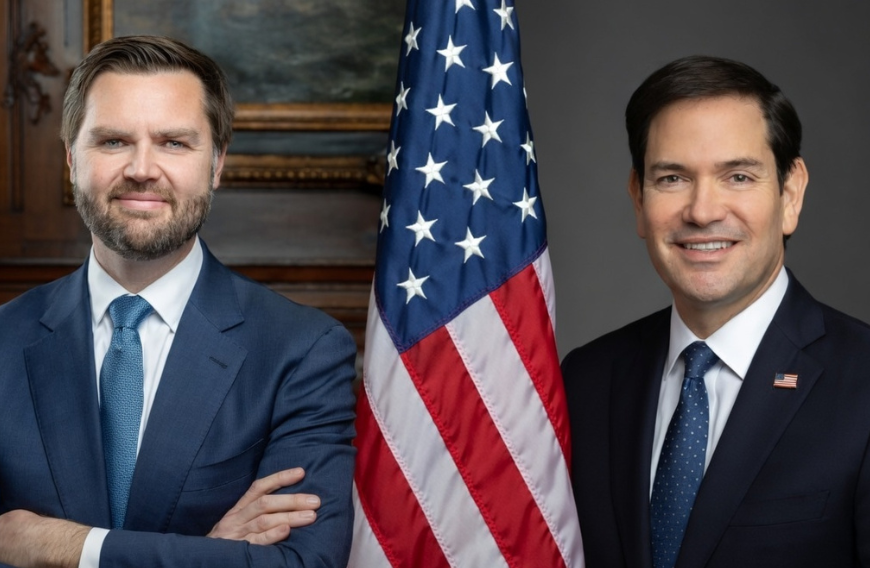
Conversations in donor gatherings, conservative media, and party strategy sessions are steadily converging around the obvious names —Vice President JD Vance and Secretary of State Marco Rubio—setting the stage for what could become the defining rivalry of the post-Trump Republican Party.
A recent report noted that Trump himself has repeatedly raised the question with advisers and donors: who should carry the torch after him—Vice President JD Vance or Secretary of State Marco Rubio?
One way to gauge the early momentum in the race is through prediction markets, which increasingly function as real-time barometers of political expectations. On platforms such as Polymarket and Kalshi—where traders wager real money on future political outcomes—the race between JD Vance and Marco Rubio is already being priced by the market.
On Polymarket, one of the largest political prediction platforms with hundreds of millions of dollars in trading volume on the 2028 Republican nomination market, Vance currently holds roughly a 39% probability of becoming the GOP nominee, compared with about 26% for Rubio, making him the market favorite but not an overwhelming one.
On the U.S.-regulated exchange Kalshi, the gap is narrower, with Vance trading around 38% and Rubio roughly 32%, suggesting traders see a far more competitive race than conventional political commentary might imply. What is notable is not just the spread but the trend: Rubio’s probability has risen sharply in recent months as his visibility in foreign policy has grown, while Vance’s odds have softened slightly as the market absorbs new information about the administration and the evolving Republican field.
At the moment, Vance enters the conversation with structural advantages that historically matter in presidential politics. As vice president, he occupies the traditional launching pad for a future presidential bid, and within the MAGA coalition he is widely seen as the ideological heir to Trump’s populist realignment. Vance’s appeal rests heavily with the party’s populist wing and the conservative media ecosystem that helped fuel Trump’s rise.
Influential figures within the movement—including Donald Trump Jr., media voices like Tucker Carlson, and organizations such as Turning Point USA—have been associated with the faction that views Vance as the natural continuation of Trump’s political project. His role within the administration and his close alignment with the “America First” worldview have allowed him to consolidate support among activists and grassroots conservatives who believe the party’s future lies in deepening that populist coalition.
Rubio, however, has quietly assembled his own set of advantages that make the contest far more competitive than many initially expected. As secretary of state, Rubio has become the administration’s principal diplomatic figure at a moment when international tensions and geopolitical shifts are once again defining American leadership.
His speech at the Munich Security Conference earlier this year drew significant attention across diplomatic circles, presenting a more conciliatory but strategically assertive vision of American leadership and reinforcing his credibility as a statesman on the global stage. Rubio’s stewardship of foreign policy and his expanding diplomatic portfolio have strengthened his reputation among donors and establishment Republicans who value experience in international affairs. At the same time, Rubio’s identity as the first Hispanic secretary of state and his long-standing ties to Hispanic communities—particularly in Florida and across the broader conservative Latino electorate—give him a political constituency that could become increasingly influential in future Republican primaries.
READ: Sreedhar Potarazu | India’s AI content crackdown: Why it matters to Big Tech and the US (February 10, 2026)
Recent events surrounding the conflict with Iran have also created moments of vulnerability for both men. Secretary of State Marco Rubio faced criticism after comments explaining the administration’s rationale for striking Iran appeared to conflict with President Donald Trump during a press exchange, forcing clarification from the administration and highlighting the political risks that come with serving as the public face of U.S. diplomacy during wartime. At the same time, Vice President JD Vance has been forced to navigate resurfacing clips and statements from earlier in his career expressing skepticism about military action against Iran and warning that the United States should avoid another prolonged Middle East conflict. In past interviews he argued that America’s interest was “very much in not going to war with Iran,” a position that critics now juxtapose with the administration’s current military posture.
Together, these episodes illustrate the delicate balancing act both potential 2028 contenders face: defending the administration’s actions while managing past statements and the unpredictable consequences of foreign policy crises.
For now, the early stages of the contest reveal a balance rather than a clear front-runner. Vance holds the institutional advantage that comes with the vice presidency and strong support within the populist base that defines Trump’s political movement. Rubio, by contrast, has strengthened his position through foreign-policy visibility, a widely noted Munich address, and growing appeal among Republican donors and Hispanic voters. Taken together, those competing strengths leave the race for the 2028 Republican nomination in an unusual position this early in the cycle.
Round one: Vance: 1 Rubio: 1