


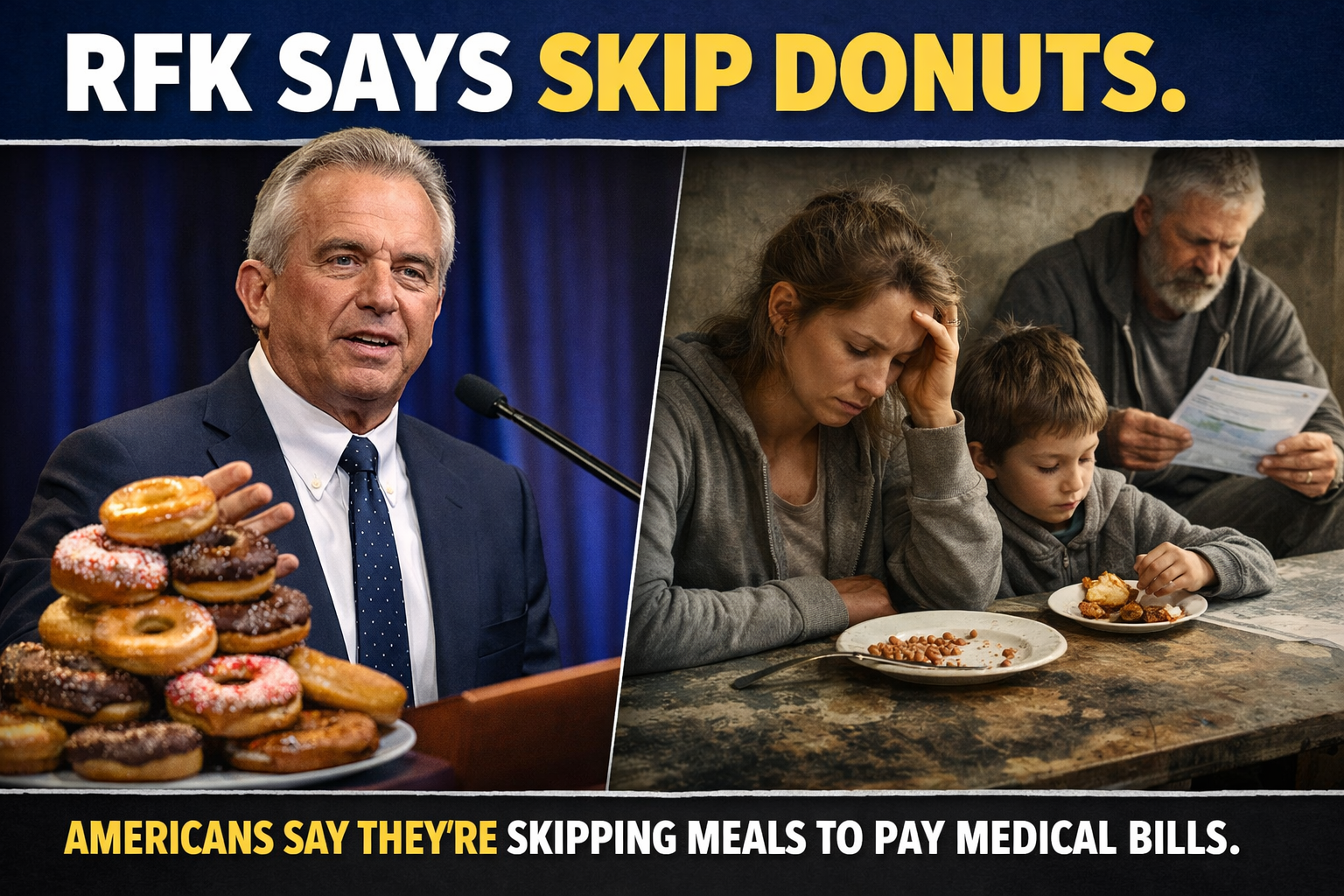
Calls to improve the American diet have gained renewed momentum. Advocates such as Robert F. Kennedy Jr. have argued that the country must confront the health consequences of ultra-processed foods, suggesting that Americans should move away from products like donuts and other highly processed snacks while physicians receive more training in nutrition.
The premise behind these proposals is understandable: if Americans eat healthier foods and doctors are better educated about nutrition, the nation may begin to reverse rising rates of obesity, diabetes, and other chronic diseases.
Yet at the very moment this conversation is gaining traction, new data reveals a troubling contradiction.
For millions of Americans, the problem is not whether they are eating donuts or kale. It is whether they are eating at all.
Recent national surveys conducted by the West Health Institute in partnership with Gallup paint a stark picture of how deeply healthcare costs are affecting everyday life. Approximately one-third of Americans report cutting back on essential household spending—including food, utilities, or transportation—in order to pay medical bills. Even more alarming, about 11 percent of Americans say they have skipped meals in the past year because they could not afford healthcare expenses, a figure that represents nearly 28 million people nationwide.
The contradiction is difficult to ignore. Policymakers are urging Americans to improve their diets while the economic pressures created by the healthcare system itself are forcing many households to reduce spending on food altogether. When families must choose between paying a medical bill and buying groceries, nutritional advice—no matter how scientifically sound—becomes disconnected from economic reality.
The proposal to expand nutrition education in medical training highlights this disconnect particularly clearly. There is broad agreement that physicians should understand the role diet plays in preventing chronic disease.
Yet one must ask a fundamental question: what is the practical value of teaching doctors more about nutrition if the patients they treat cannot afford either the recommended foods or the medical care required to guide those decisions?
Knowledge inside the clinic has limited impact if the economic conditions outside the clinic make healthy choices unattainable.
Consider the typical clinical encounter. A physician may counsel a patient to adopt a diet rich in fresh vegetables, lean proteins, and minimally processed foods in order to control blood pressure or prevent diabetes. From a medical standpoint, this advice is sound. But if that same patient is struggling to pay insurance premiums, deductibles, and medical bills—and is already skipping meals to cover those costs—the advice quickly becomes abstract. The challenge facing the patient is not dietary awareness; it is economic survival.
This tension reflects the broader economics of healthy eating in the United States. Nutrient-dense foods such as fresh fruits, vegetables, and unprocessed proteins are widely recognized as healthier dietary options, yet they often cost significantly more than highly processed alternatives.
Ultra-processed foods dominate supermarket shelves not only because they are convenient but also because they are inexpensive to produce, shelf-stable, and optimized for large-scale distribution. For families already managing rising housing costs, childcare expenses, and transportation costs, the price difference between fresh foods and processed alternatives can be decisive.
Healthcare costs intensify these pressures. Employer-sponsored health insurance—long considered the foundation of American healthcare coverage—has become an increasingly expensive benefit. The average annual cost of employer-sponsored family coverage now approaches $27,000, a figure that has grown far faster than wages and overall inflation. Employers absorb a portion of these increases, but a substantial share is shifted to workers through higher premiums, larger deductibles, and increased out-of-pocket expenses.
The economic effects extend well beyond household budgets. Businesses facing higher healthcare costs frequently incorporate those expenses into the price of goods and services. With profit margins in many industries measured in single digits, even moderate increases in benefit costs can ripple throughout the economy in the form of higher prices. In this sense, healthcare inflation functions as a hidden tax embedded in everyday economic activity—one that consumers ultimately pay whether or not they are currently receiving medical care.
As healthcare expenditures continue to grow—now approaching one-fifth of the U.S. economy—the financial strain on households is becoming increasingly evident. Americans report delaying medical appointments, rationing prescriptions, borrowing money to pay medical bills, and postponing major life decisions such as buying homes or starting families. The finding that millions are skipping meals to afford healthcare costs is perhaps the clearest signal that the system is placing unsustainable pressure on household finances.
This is where the policy contradiction becomes most apparent. Public health advocates emphasize prevention through better nutrition. Healthcare policymakers focus on expanding insurance coverage and managing medical expenditures. Agricultural policies shape the economics of food production. Meanwhile, private insurers operate within reimbursement systems that often allow costs to be shifted rather than reduced. Each policy area operates with its own objectives, yet the combined effect produces outcomes that undermine the broader goal of improving national health.
Private markets play a critical role in healthcare innovation and delivery, but markets respond to incentives. In the current system, insurers, providers, and other intermediaries frequently operate within structures that reward higher utilization rather than long-term prevention. Employers pass rising costs to workers, workers reduce spending elsewhere, and families adapt in ways that may ultimately worsen their long-term health outcomes. Ironically, a system designed to finance healthcare may be contributing to the financial stress and nutritional compromises that increase the burden of chronic disease.
If policymakers are serious about improving health outcomes, they must begin treating healthcare affordability and food affordability as interconnected challenges. Encouraging healthier diets while healthcare costs consume a growing share of household income is unlikely to produce meaningful improvements in public health.
Reducing healthcare inflation must therefore be viewed not only as an economic priority but also as a public health necessity. Greater price transparency, stronger competition in healthcare markets, payment models that reward prevention rather than procedure volume, and reforms that address how value is captured across the healthcare supply chain could all play important roles in containing costs. At the same time, policies that improve access to affordable nutritious foods—particularly for lower-income households—should be recognized as integral to any serious national health strategy.
Ultimately, the effectiveness of health policy should be judged by a simple measure: whether it improves both the health and the financial security of the population it serves. By that standard, the current system raises troubling questions.
When millions of Americans report skipping meals in order to pay medical bills, the issue extends far beyond dietary habits or physician education. Encouraging doctors to learn more about nutrition is a worthwhile goal. But if patients cannot afford the care physicians provide—or the food those physicians recommend—then that knowledge will have little opportunity to translate into better health outcomes.
Until the United States confronts the underlying economics of healthcare affordability, efforts to improve the nation’s diet will remain constrained by a far more basic problem: too many Americans are struggling simply to afford both healthcare and food.