



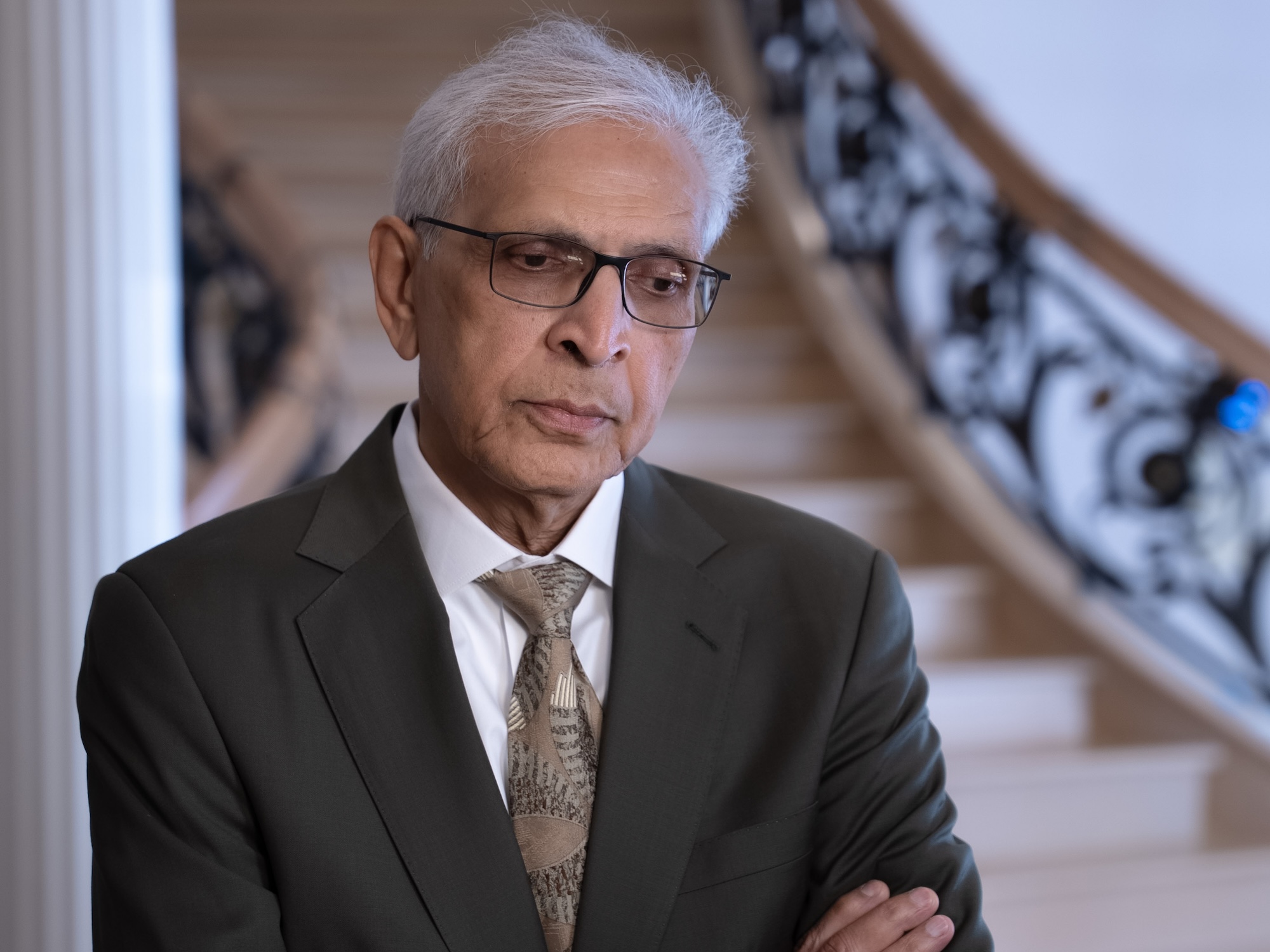
A new documentary in The American Journey series traces the rise of Gujarat-born physician Dr. Jasvant Modi, who built a career in Los Angeles and donated more than $30 million to philanthropy across the U.S., India and Europe.
Dr. Jasvant Nagindas Modi’s life traces a remarkable arc from a modest upbringing in Godhra, a small town in the western Indian state of Gujarat, to a career of success and service in the United States. The son of a schoolteacher and raised in a large Jain family rooted in discipline and faith, Modi studied medicine at B.J. Medical College in Ahmedabad before immigrating to the United States in the mid-1970s. He eventually established himself as a respected gastroenterologist in Los Angeles and later expanded beyond clinical practice into healthcare management and investments, acquiring and operating long-term care facilities across Southern California.
The wealth he built as a physician and entrepreneur would later become the foundation for an extraordinary philanthropic mission. Together with his wife, Dr. Meera Modi, he has contributed more than $30 million to philanthropic initiatives across the United States, Europe, and India. That journey is the subject of the latest installment in The American Journey documentary series produced by The American Bazaar.
“Dr. Jasvant Modi’s Legacy of Healing, Faith, and Giving” is now streaming on YouTube. At its core, the film is a portrait of a first-generation immigrant who never forgot how many hands lifted him on the way up.
The documentary presents the physician, entrepreneur, and philanthropist as a man shaped by discipline, faith, family, sacrifice, and a deep sense of obligation to give back. It traces the major chapters of his life: his childhood in Godhra, his rise through India’s educational system, his uncertain early years in America, his eventual success as a doctor and healthcare entrepreneur in Los Angeles, and finally his emergence as one of the most significant benefactors of Jain institutions and education in the United States, Europe, and India.
READ: Capturing an inspiring journey: Documentary released on Indian American entrepreneur Dinesh C. Patel (February 4, 2024)
A childhood shaped by discipline and faith
Modi’s father, who later became an inspector in the school system, was his first role model. “He was a very hardworking person,” Modi recalls.
His mother anchored the household. “My mother came from a large family. She was a homemaker. We were six kids and she was busy raising us,” he says.
Religion was woven into daily life. Both parents were deeply religious, and a nearby Jain center became an important part of Modi’s spiritual upbringing. These two forces — discipline from his father and devotion from his religious environment — would become the twin pillars of his life.
Modi began his education in the local public school system before moving to private institutions, eventually excelling enough to pursue higher studies in Ahmedabad. The film highlights the support he received from his older brothers, who provided both encouragement and financial assistance.
After finishing high school in Godhra, he followed his eldest brother to Ahmedabad and enrolled at St. Xavier’s College, one of Gujarat’s premier science institutions. The documentary lingers on a formative chapter in his life: his years at the Mahavir Jain Vidyalaya hostel.
Friends and family say the hostel gave him exactly what he needed — structure, affordability, and community. Modi himself emphasizes its importance.
Watch the documentary
“I had lifelong friends there,” he says. “They helped me economically. My hostel cost was much less. Without that help, I probably would not have been able to finish my study because I just couldn’t afford it.”
Those years in Ahmedabad culminated in admission to B.J. Medical College, one of the region’s most respected institutions. After completing medical school and he trained in ophthalmology at Ahmedabad Civil Hospital.
Dr. Modi arrived in the United States in June 1975.
America, however, did not immediately open its doors. “At the time, the academic year for the internship and residency training had already started on July 1st,” he explains. “So I didn’t have much opportunity to get into a program.”
Inside Indian America with Aziz Haniffa | The contrarian investor: Himanshu Shah’s global playbook for risk, returns, and the future of markets (March 13, 2026)
The documentary broadens this personal moment of doubt into a universal immigrant question. As his son, Rushabh, reflects: Why leave “an assured comfortable existence for something that is unpromised to you?”
The answer becomes one of the film’s central messages.
“You have to really believe in yourself,” Rushabh says. “You have to believe that you can rise through different circumstances. There is an element of betting on the future.”
That bet first paid off in Hinton, West Virginia — a town of just 4,500 people — where Modi secured his first American medical job in October 1975. Under the guidance of older physicians at a small hospital, he practiced medicine, learned to drive, bought his first car, and began building financial stability.
The salary — $33,000 a year — was significant. So was what he did with it.
“I borrowed $20,000 from the bank,” he recalls, “and I sent all my debt to people over here in India.”
But Hinton was only the beginning. Dr. Modi still wanted to enter the mainstream American medical system and pursue specialization. After two years, he took a 70 percent pay cut to begin an internship near Pittsburgh before moving to Chicago for back-to-back residencies in internal medicine and gastroenterology.
A marriage and a partnership
Chicago also brought a life-defining moment: meeting Meera, the woman who would become his wife and lifelong partner. She, too, had come from India to pursue medicine in the United States — an unusual step for a woman of her generation.
The two became engaged in the United States and traveled to India the following year to marry. Soon afterward, they began building a life together in Chicago while both pursued demanding medical careers.
In 1983, the Modis moved to Los Angeles with their young son. The city would become the place where Dr. Modi truly flourished.
He secured privileges at several leading hospitals, including St. Vincent’s, Good Samaritan, Queen of Angels, Hollywood Presbyterian, and Temple Hospital.
When he arrived at Temple Hospital, there was no gastroenterology division. “So right from the ground up I started a gastroenterology laboratory,” he says.
The film presents this as quintessential Modi: when an opportunity did not exist, he created one.
Rushabh captures the family philosophy succinctly: “We may not be invited to the party, so we will have to create our own party. If I can’t go through this door, there has to be a side door.”
From medicine to entrepreneurship
That same mindset later shaped Dr. Modi’s entrepreneurial journey.
During the 1990s, while building a successful medical practice, he began exploring investments — first in stocks and bonds, then in real estate, and eventually through investment clubs and funds.
The strategy proved transformative. With significant cash reserves during the 2008-09 financial crisis, he invested heavily and benefited from the market rebound.
Earlier, in 2004, he had purchased his first long-term care facility, Westlake Convalescent Hospital, drawing on his medical experience and management instincts.
He turned the struggling facility around and went on to acquire additional centers in the Los Angeles area, including Newport Subacute Healthcare Center, Barlow Rehabilitation and Skilled Nursing Center, and Vista Veranda Assisted Living.
By 2014, after three decades in medicine, Modi retired from clinical practice to focus entirely on managing his healthcare enterprises.
Wealth as a means, not an end
The documentary’s most powerful section comes in its final act, when the narrative shifts from success to purpose.
“The reason I do philanthropy is I believe that humanity and many people need help,” Modi says. “If nobody helped me, I wouldn’t be where I am today. So I feel an obligation to help other people, especially when I have more than what I need.”
His philanthropy began close to home — supporting extended family, contributing to the Jain community in Southern California, and helping build the Jain temple in Buena Park.
Inside Indian America with Aziz Haniffa | Vinai Thummalapally: From Obama’s roommate to the first Indian American U.S. ambassador (February 14, 2026)
But it soon expanded far beyond that.
Over the years, the Modis have contributed more than $30 million to philanthropic causes. Roughly half has gone toward establishing Jain academic chairs, professorships, postdoctoral fellowships, and doctoral research programs at more than three dozen universities across the United States, Europe, and India.
“Practically most people have never heard what Jainism is,” Modi says. “So to change that narrative, I felt I should take the lead and do something about it.”
Those initiatives have helped introduce Jain philosophy and ethics into mainstream academic discourse.
The documentary also highlights Modi’s philanthropic work in India — including rest houses for Jain monks, hostels for students, school construction, and educational infrastructure projects in cities such as Surat, Godhra, Ahmedabad, and Vadodara.
The themes remain consistent: Education, shelter, faith, and dignity — the same foundations that sustained him as a young student.
For all the institutions and accolades featured in the film, the documentary ultimately returns to what matters most to Modi: Family.
The Modi family has grown to include children, in-laws, and grandchildren. Annual family trips have become a cherished tradition, strengthening bonds across generations. One particularly meaningful journey brought the entire family to India, allowing younger members to see firsthand the schools, hostels, and community projects the Modis have supported.
In its closing moments, the film frames Modi’s life as a quintessentially American success story — not because he left his roots behind, but because he carried them forward.
“My American journey,” Modi says, “I would say is a satisfying journey. I was able to help my family, my wife’s family, and do a lot of philanthropic work to help many other people. I came here with $8 to $10 in my pocket. I have done well financially, and I think this is a land of opportunity.”
That may be the documentary’s simplest and most enduring lesson: opportunity gains its true meaning only when it is shared.
In Dr. Jasvant Modi’s story — and in The American Journey’s portrait of his life — success is not merely what one builds for oneself, but what one leaves behind for others.