


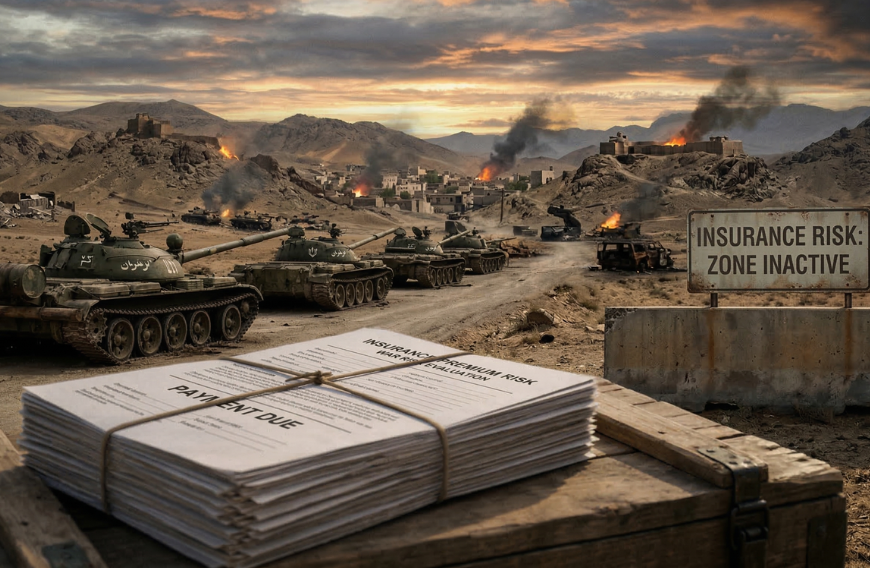
There is a room in the City of London, not far from the cobblestoned alleys where Edward Lloyd once served coffee to mariners and merchants in the late seventeenth century, where the fate of the global oil economy is decided not by generals or parliaments, but by underwriters studying actuarial tables. The room belongs to the Joint War Committee, a quiet, architecturally invisible, and catastrophically powerful body that most of us wouldn’t know.
 While the media coverage on the Iran war has focused on the weapons deployed in the Middle East this week, missiles, drones, and the accumulated grievances of decades, a different kind of weapon may prove most decisive. This weapon arrived, as the most devastating instruments of modern power often do, in a spreadsheet. It has no Pentagon codename and no congressional appropriation. Let’s call it warfare by insurance premium.
Chokepoints
The Strait of Hormuz is only twenty-one nautical miles wide at its narrowest point. A man with good eyesight standing on the Iranian shore could see Oman. Yet through this narrow aperture passes approximately twenty million barrels of oil per day, roughly one-fifth of global petroleum liquids consumption, along with twenty percent of the world’s traded liquefied natural gas. In the first half of 2025, the U.S. Energy Information Administration calculated that 20.9 million barrels per day transited the strait, representing twenty-five percent of the world’s entire seaborne oil trade. Saudi Arabia alone accounts for thirty-eight percent of those Hormuz crude flows. Iraq contributes another twenty-three percent. The UAE, Iran, and Kuwait round out the principal suppliers.
Where does that oil go? Eighty-nine percent of the crude and condensate moving through the Strait of Hormuz, nearly nine of every ten barrels, flows to Asian markets. China alone receives thirty-eight percent of all Hormuz flows. India receives nearly fifteen. South Korea and Japan receive twelve percent and eleven percent respectively. The United States, insulated by its domestic shale renaissance, receives a comparatively modest two and half percent. The geography of Hormuz dependence is, in other words, a geography of Asian vulnerability. Any disruption to this passage is not primarily a Western crisis. It is a civilizational emergency for the economies of East and South Asia.
Of course, this is not a new observation. What is new, what the events of late February and early March 2026 have made viscerally, expensively apparent, is that closing the strait no longer requires laying naval mines across its shipping lanes, though Iran has long maintained an estimated five thousand of them ready for deployment. Closing the strait requires only the appearance of intolerable risk. And for that, Tehran needs no fleet.
The Invisible Committee
The Joint War Committee was established to do what markets always eventually do: to price danger. Its members are underwriters drawn from the Lloyd’s Market Association syndicates and the broader London company market. Together, they maintain what is called the Listed Areas, a formal catalogue of the world’s maritime danger zones, and they advise the global shipping industry on where war risk premiums apply and at what magnitude.
READ: The Review by Ajay Raju |The coming Civil War inside law firms (February 23, 2026)
The JWC’s instrument is elegant in its simplicity. When a region is designated a Listed Area, standard hull insurance policies effectively go dark. Shipowners who wish to continue sailing must purchase Additional War Risk Premium, a supplemental coverage calculated as a percentage of the vessel’s insured value. In peacetime, transiting the Persian Gulf costs a carrier roughly 0.125 to 0.4 percent of hull value per voyage. For a modern Very Large Crude Carrier valued at two hundred million dollars, that translates to a manageable surcharge.
Then Operation Epic Fury began on February 28, 2026, and the math changed overnight.
By March 3, the JWC had convened an emergency session, announcing that the committee had moved to expand the Listed Areas to encompass Bahrain, Djibouti, Kuwait, Oman, and Qatar, effectively designating the entirety of the Persian Gulf region as a zone of war-related peril. War risk premiums for Strait of Hormuz transits surged four to five times within days of the U.S. and Israeli airstrikes. Ships with perceived American, British, or Israeli nexus are now paying three times more than unaffiliated tonnage. For a transit through the Strait itself, rates have reached between 1.5 and 3 percent of hull value, levels not seen since the Iran-Iraq Tanker War of the 1980s, when hundreds of vessels were struck and premiums reached 5 percent for an extended period.
But the premium itself is not the most consequential instrument. The most consequential instrument is the cancellation clause.
The 48-Hour Kill Switch
Marine war risk policies contain a provision that receives almost no attention in geopolitical coverage and deserves far more: the notice of cancellation. Under standard market practice, insurers can withdraw war risk coverage with as little as forty-eight hours notice. By March 5, war-risk insurers had issued notices of cancellation on protection and indemnity coverage across Gulf waters. The JWC’s guidance, which is not binding but which every major underwriter treats as authoritative, had effectively rendered the strait commercially unnavigable.
No shipping executive will sail a two-hundred-million-dollar vessel carrying crude oil into a combat zone without insurance. The exposure is not abstract. It is existential. A single total loss, one vessel struck, one cargo destroyed, one crew killed, without coverage would be a catastrophe sufficient to destroy a mid-sized shipping company outright. The calculus is not courage versus cowardice. It is math.
And so the ships stopped.
Maersk, the world’s second-largest container carrier, announced the suspension of all Strait of Hormuz transits. Hapag-Lloyd followed, citing the official closure of the waterway by the IRGC and the irreducible safety risk to its crews. CMA CGM instructed all vessels inside the Gulf and bound for the region to proceed to shelter pending reassessment. MSC followed suit. Few companies invoked maritime law to begin offloading stranded containers at available safe ports, charging customers eight hundred dollars per box plus retrieval costs. By March 4, Maersk, COSCO, MSC, and Hapag-Lloyd had all suspended new cargo bookings to and from UAE and Gulf ports. Freight rates on some lanes surged as much as nine hundred percent.
By early March, tanker transits through the Strait had fallen from a historical average of 138 per twenty-four hours to as few as 28 per day, and then to near zero. At least 150 tankers anchored in open Gulf waters, their masters waiting, their insurers watching, their cargo going nowhere. QatarEnergy declared force majeure on all LNG shipments on March 4, after Iranian attacks on its Ras Laffan facilities, removing, in a single announcement, approximately twenty percent of global LNG supply from the market. For Pakistan, Bangladesh, and India, which source sixty-three to ninety-nine percent of their LNG from Qatar and the UAE, the implications are harsh. Bangladesh was already running a structural gas deficit exceeding 1,300 million cubic feet per day before this crisis began.
READ: The Review by Ajay Raju | All roads lead to Beijing
The Iranian Strategy
Iran’s doctrine here is not new. It has been developing for decades, tested and refined through the tanker harassment campaigns of 2019, the seizure of MSC Aries in April 2024, and the persistent shadow war against merchant shipping. What Tehran grasped, that its adversaries were slow to appreciate, is that the Western financial architecture built to manage risk can be turned into a weapon by anyone willing to manufacture sufficient uncertainty.
Iran does not need to sink every tanker. It needs only needs to, credibly threaten to, or sink enough ships, to terrify the actuaries in London. The IRGC’s announcement on March 2 that the Strait of Hormuz was closed and that any vessel attempting passage would be “targeted” was not primarily a military statement. It was a communication addressed to underwriters. The audience was not in Tehran or Washington. It was in the City of London.
The logic exploits a structural vulnerability in how the West has organized its relationship with risk. Modern maritime commerce depends on an unbroken chain of insurability. Remove insurance from any point in that chain and the chain breaks, not by force, but by the withdrawal of willingness to accept exposure. The genius, if it can be called that, of Iran’s asymmetric position is that it need not defeat the United States Navy. It need only make the Joint War Committee uncomfortable enough to price the strait out of commercial reach.
There is historical precedent to consider. In the 1980s Tanker War, Iraq and Iran together managed to strike more than four hundred vessels before the international community responded with naval escorts. Even then, premiums reached five percent and remained elevated for years. Today, with the additional threat layer of unmanned surface vehicles, GPS jamming, ballistic missiles, and drone swarms, all of which have appeared in the current conflict, the risk calculus has shifted further. Risk Intelligence has assessed the Strait as “effectively closed by behavior and enforcement,” noting that even limited mine deployment would achieve closure primarily through the psychology of uncertainty rather than the physical barrier of steel.
Disruption
What makes this moment singular is not the closure of one corridor but the simultaneous degradation of both. The Red Sea route, already operating at forty-nine percent of pre-crisis capacity following the Houthi campaign that began in late 2023, has been closed again. Houthi forces threatened attacks on commercial vessels on February 28, the same day Operation Epic Fury began, reversing the limited progress made after the October 2025 Gaza ceasefire. For the first time in modern history, both of the Middle East’s major maritime corridors are simultaneously commercially unnavigable.
The alternative, the Cape of Good Hope route around the southern tip of Africa, adds ten to fourteen days to Asia-to-Europe transit times and removes vessel capacity from global shipping systems simply by consuming more of it. Saudi Arabia is rerouting some crude exports through its East-West pipeline to Yanbu on the Red Sea coast. The Saudi and UAE bypass pipelines together offer perhaps 2.6 to 5.5 million barrels per day of bypass capacity. Against the twenty million barrels per day that normally transit Hormuz, that is a tourniquet, not a cure.
The Norwegian Maritime Authority has raised its security level to MARSEC Level 3 for Norwegian-flagged vessels in the Persian Gulf, Strait of Hormuz, and Gulf of Oman, the highest level, signifying a probable or imminent security incident. The U.S. MARAD Maritime Alert 2026-001A advises vessels to avoid the region where possible and maintain at least thirty nautical miles of separation from U.S. naval units. Jebel Ali, the largest container port in the Middle East and one of the world’s premier transshipment hubs, is experiencing cascading congestion from vessels that diverted after the closure. Hapag-Lloyd alone has cited 50,000 TEUs as being impacted, with analysts estimating as many as 250,000 or more total TEUs stranded across the region.
The Lesson
There is a profound irony embedded in this crisis that deserves more reflection than it is likely to receive. The architecture of maritime insurance, Lloyd’s of London, the Institute of London Underwriters clauses, the concept of war risk exclusions, was built by Western capitalism to protect Western commercial interests. It was designed to be an instrument of stability, a mechanism for distributing the costs of adversity so that no single actor bore catastrophic exposure alone.
What Iran has discovered, what the Houthis demonstrated in the Red Sea before it, is that this architecture of distributed risk can be inverted. The very sophistication of the system, the very precision with which it calibrates danger into price, becomes a vector of coercion. You do not need to outfight the system. You need only to make the system price itself out of your adversary’s reach. The underwriters are not your enemies. They are your instrument.
This is, in the truest sense, a financial blockade administered by institutions that have no interest in geopolitics and every interest in not paying claims. When the Joint War Committee expands its Listed Areas, it is not taking sides. It is merely reading its actuarial models. And in reading those models accurately, it enforces, with perfect commercial neutrality, the strategic outcome that Tehran desires.
The West built the global financial system to manage risk. The adversaries who have studied it most carefully have learned that managing risk and weaponizing it are, in the right hands, the same operation.
Last Word
The Persian Gulf crisis of 2026 will be remembered in naval histories for the missiles and drones. But it should be studied in business schools for the underwriters.
The most devastating weapon in the Middle East is not hypersonic. It is actuarial. And it was built, at considerable sophistication and expense, by the civilization it is now being used against.