



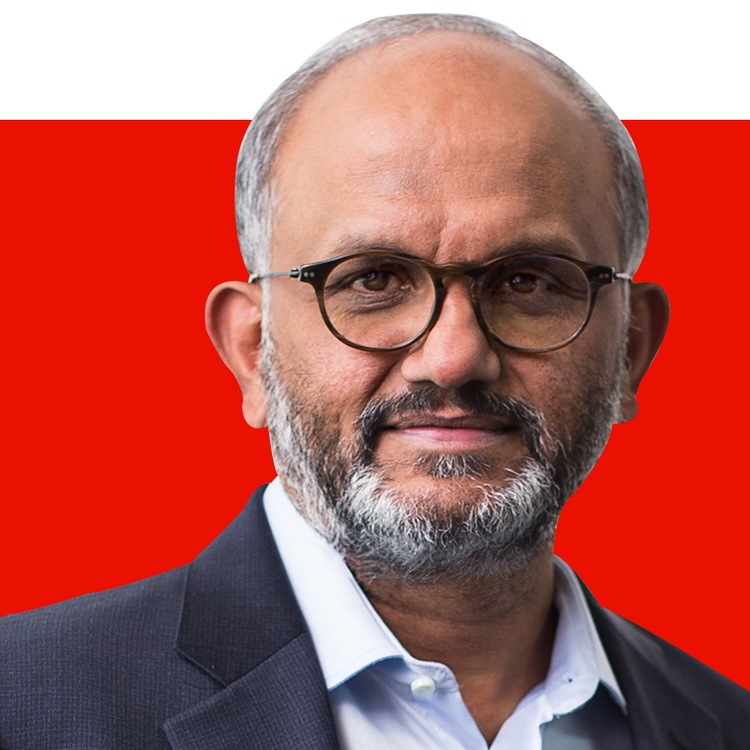
When Shantanu Narayen announced last week that he would step down as CEO of Adobe after 18 years at the helm — once his successor is named — it marked more than the transition of a corporate leader. It also highlighted the end of an era that helped define one of the most remarkable developments in modern corporate America: the rise of Indian American CEOs.

Narayen belongs to what might be called the pioneering generation of Indian American corporate leaders. That early cohort included figures such as Raj Gupta, who led Rohm and Haas, and Indra Nooyi, who famously transformed PepsiCo during her tenure as its CEO.
They were among the first Indian Americans to reach the very top of corporate leadership in the United States. Their success helped normalize the idea that immigrant professionals could not only participate in American business but lead some of its most powerful institutions.
Over the following decade, that trend accelerated dramatically.
Today, there are 11 Indian American CEOs leading Fortune 500 companies, an extraordinary statistic for a community that represents barely one percent of the U.S. population.
The list includes some of the most influential companies in the world. Satya Nadella at Microsoft and Sundar Pichai at Google lead companies at the forefront of the technological revolution.
Together, Microsoft and Google command a combined market valuation of roughly $7 trillion. For comparison, the total market capitalization of India’s stock markets — Bombay Stock Exchange and
National Stock Exchange of India combined — is about $5.3 trillion.
That comparison illustrates the sheer scale of the institutions now led by Indian American executives.
READ: Shantanu Narayen quitting as Adobe CEO after 18 years (March 13, 2026)
It is difficult to think of another immigrant community that has achieved such a concentration of leadership in global corporations.
But every success story has a pipeline behind it.
The current generation of Indian American CEOs did not appear overnight. Most came to the United States decades ago as students, engineers, or early-career professionals. Many arrived through the H-1B visa program, studied at American universities, built careers within major corporations, and slowly climbed through the ranks.
In other words, today’s C-suite leaders are the result of a long talent pipeline built over 30 or 40 years.
And that pipeline may now be facing a new kind of pressure.
In recent months, a noticeable backlash against Indians and Indian Americans has emerged within segments of the MAGA movement. Much of this hostility has focused on the H-1B visa program, which has long been controversial in American politics.
The program allows U.S. companies to hire highly skilled foreign professionals in fields such as engineering, technology, and finance. Critics argue that it depresses wages or displaces American workers. Supporters say it fills critical talent shortages and fuels innovation.
But the tone of the debate has changed.
In many online forums and right-wing social media platforms, H-1B workers are increasingly portrayed as “job stealers,” corporate replacements, or symbols of globalization run amok. Because Indian nationals receive the majority of H-1B visas — often more than 70 percent — the criticism frequently spills over into resentment toward Indians themselves.
Places like Frisco, Texas — once celebrated as thriving hubs of Indian American success — have recently become flashpoints for these debates. Online campaigns and local controversies have amplified a narrative that casts Indian professionals not as contributors to American prosperity but as competitors or outsiders.
Most of this rhetoric remains confined to social media and political commentary. But the question it raises is nonetheless important.
Could such hostility eventually affect the pipeline that produced so many Indian American CEOs?
Corporate boards do not typically choose CEOs based on ethnicity or politics. Leadership appointments are driven primarily by track record, competence, and the confidence of investors.
But corporations today operate in a far more polarized environment than they did even a decade ago.
Executive appointments are scrutinized not only by shareholders but also by political activists, media commentators, and social media campaigns. Decisions that once attracted little public attention can suddenly become lightning rods for ideological debates.
We have already seen early signs of this dynamic.
When Microsoft named Asha Sharma to lead its gaming division earlier this year, online reaction in some corners of the internet quickly turned hostile. Critics framed the appointment not as a professional advancement but as evidence of supposed “Indian nepotism” or an alleged takeover of American companies by immigrant executives.
The claims were largely baseless. Yet their virality illustrates how quickly leadership decisions can become entangled in political narratives.
The question, therefore, is not whether corporate boards will suddenly stop appointing Indian American leaders. That seems unlikely.
The more subtle question is whether companies might become more cautious in politically sensitive environments.
Could executives from immigrant backgrounds face additional scrutiny? Could boards weigh reputational risks more heavily when making leadership decisions?
These shifts, if they occur, would likely be gradual and difficult to measure. But leadership pipelines are shaped by subtle signals as much as by formal policies.
The larger concern may not be current executives but future ones.
The generation that produced Nadella, Pichai, Narayen, and others arrived in the United States during the great waves of global talent migration in the 1980s and 1990s. American universities and technology companies served as magnets for the world’s best engineers and scientists.
READ: Adobe sees backlash as it shuts down Adobe Animate (February 3, 2026)
That system has been one of the United States’ greatest competitive advantages.
If talented students from India or elsewhere begin to perceive the United States as less welcoming — or if immigration pathways become more uncertain — they have other options. Countries such as Canada, the United Kingdom, Singapore, and Australia are actively competing for global talent.
The world’s brightest engineers will not simply disappear. They will go where opportunity is greatest and where they feel most welcome.
Over time, that could affect the leadership pipeline that has produced so many influential CEOs.
The rise of Indian American CEOs is not just a story about immigration. It is also a story about the openness of American institutions.
For decades, the United States has rewarded talent regardless of origin. Immigrants arrived, worked their way through companies, and eventually reached the highest levels of leadership.
That system has benefited not just immigrant communities but American corporations themselves.
The success of executives like Nadella and Pichai is not simply a reflection of Indian achievement. It is a reflection of the American ability to attract and elevate global talent.
As Shantanu Narayen prepares to step down after nearly two decades at Adobe, his career offers a reminder of what that system can produce: a leader who helped transform a company into one of the world’s most valuable software firms. During his tenure, Adobe became a $25 billion cloud behemoth and the company grew from 3,000 employees to more than 30,000.
The question now is whether the next generation of leaders will have the same opportunity.
Political cycles come and go. But leadership pipelines take decades to build.
If hostility toward skilled immigrants continues to grow, the effects may not appear immediately. They will emerge gradually, as fewer talented professionals enter the system that once produced so many of corporate America’s most influential CEOs.
The golden era of Indian American CEOs did not happen by accident.
It was built on openness, meritocracy, and the belief that talent — wherever it comes from — should be allowed to rise.
The real question now is whether the United States intends to preserve that tradition.