



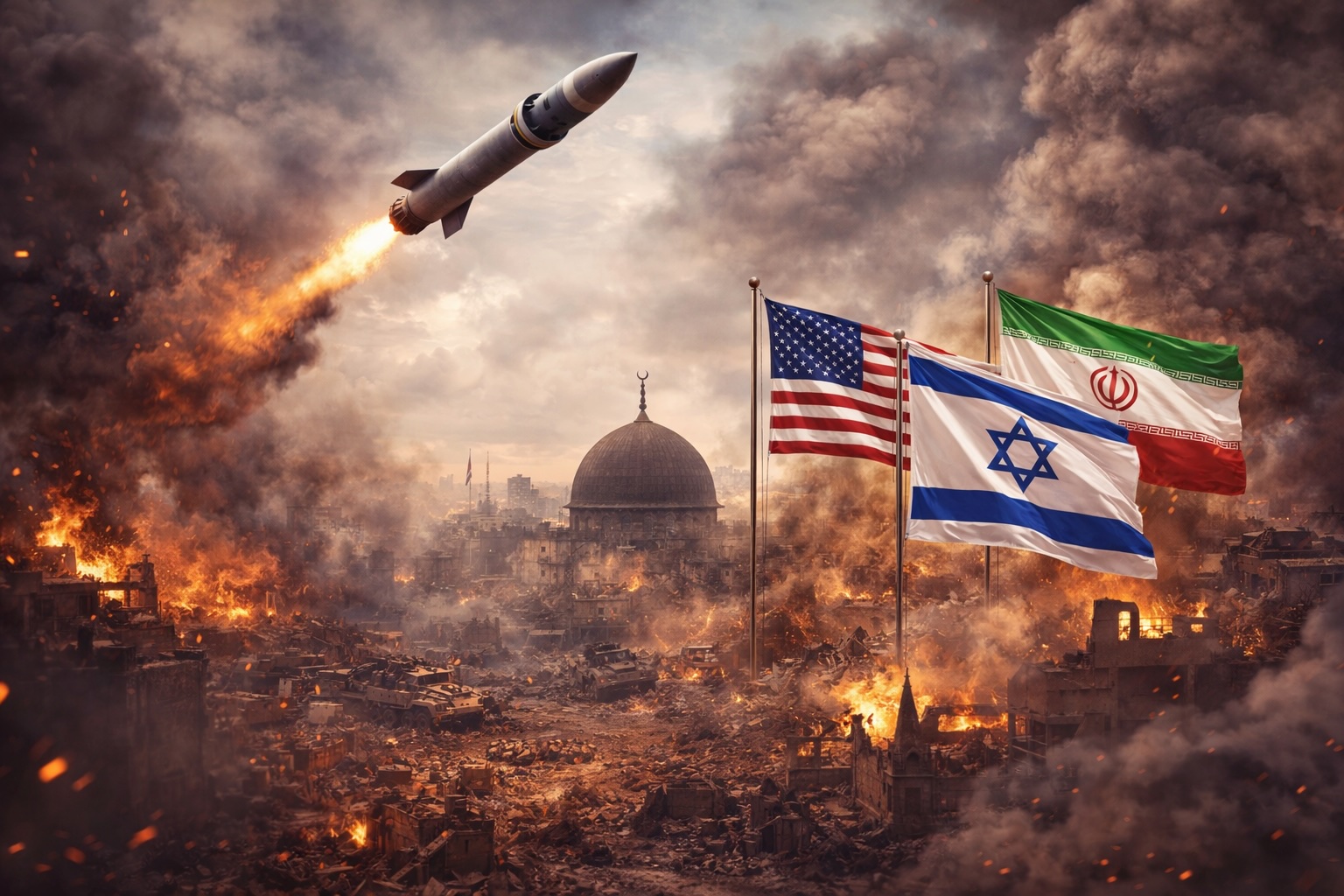
A man golfing while schools collapse under falling bombs is not simply an image of indifference; it is a declaration of impunity. It tells us that the systems built to restrain power have lost both their authority and their moral force.
Three weeks into a war that most of the world neither sanctioned nor supported, the international order finds itself confronting a crisis not only of violence but of meaning. The question is no longer whether the United States and Israel violated international law in initiating the current military campaign.
That question has been answered in The Hague, where Israel faces active proceedings at the International Court of Justice; in the African Union, which has rejected the legal rationale for the strikes; and across the Global South, where governments have dismissed the doctrines of anticipatory self‑defense invoked to justify the assault.
The legal debate is settled. What remains unsettled is whether the world has the political will to enforce the law when the violators sit atop the very architecture designed to restrain them.
The United Nations Security Council was built on a bargain: the great powers would police themselves and each other, and the world would accept the asymmetry in exchange for stability. That bargain depended on at least the appearance of principled behavior. It has now collapsed.
In the same week that the Council tabled a resolution condemning Iran—despite Iran not initiating the present conflict—it failed to pass even a single sentence censuring the states responsible for the strikes now devastating civilian infrastructure. The United States vetoed a resolution condemning its own military actions.
READ: Satish Jha | Who decides when the world burns? (
This was not a procedural failure. It was a structural confession. The veto was never a mechanism of collective security; it was a license for impunity dressed in the language of order. The Council did not merely fail. It revealed itself. And in revealing itself, it handed the world both a crisis and an obligation.
Into this vacuum stepped—or rather, conspicuously failed to step—India. On January 1, 2026, India assumed the BRICS chairmanship, taking over from Brazil and becoming responsible for convening the 18th BRICS Summit. With the expanded bloc now representing more than 40 percent of the world’s population and a rising share of global GDP, India held a rare instrument of genuine multipolar leverage. Brazil was prepared to support a unified condemnation of the strikes. South Africa signaled the same. China and Russia, for their own strategic reasons, were willing. Iran, Egypt, Ethiopia—the new members—were aligned. The only holdout was India.
New Delhi’s calculation was transparent: its deepening defense and technology partnerships with Washington, and its loud strategic alignment with Tel Aviv, outweighed its obligations to the bloc it was chairing. In a moment that demanded moral courage, India chose transactional comfort. The result was paralysis.
BRICS, the institution most capable of filling the void left by a compromised Security Council, issued no joint statement. Its chair became, functionally, a shield for the aggressor. History will record this not because India is uniquely blameworthy, but because India was uniquely positioned to act and chose not to. The door to global leadership was open. India walked past it.
Certain facts are no longer contested. Israel is under active proceedings at the International Court of Justice for violations of the Genocide Convention. The International Criminal Court has issued arrest warrants for senior Israeli officials, including the prime minister, and multiple European states—bound by the Rome Statute—have affirmed their legal obligation to enforce those warrants should the individuals enter their territory.
READ: Satish Jha | The arithmetic of impunity (
A growing number of nations have restricted airspace or downgraded diplomatic ties in response to the ongoing strikes. The legal doctrines invoked to justify the current campaign have been rejected by the African Union, the Arab League, and leading international law scholars across continents.
Civilian casualties continue to mount. Schools, hospitals, and aid convoys have been repeatedly struck. The humanitarian crisis is not a matter of interpretation; it is a matter of record. This is not a conflict in which the law is ambiguous. The law is clear. What is absent is not legal authority but political will.
The deeper danger is not this war alone. It is the precedent being written in real time. If a state under active ICJ proceedings can continue military operations with American air cover and face no meaningful consequence, the message to every would‑be aggressor is unmistakable: international law applies to the weak and protects the strong.
The norms painstakingly constructed over eight decades—the prohibition on aggressive war, the protection of civilians, the accountability of leaders—can be dismantled not through a single dramatic rupture but through sustained, unpunished violation. We are not in a pre‑war moment. We are in the war. The question is whether the rules‑based order will survive it as a functioning reality or merely as a phrase invoked selectively by those with the power to ignore it.
READ: Satish Jha | Who decides who leads Iran? (
The formal multilateral system cannot save itself from within. The P5 veto makes the Security Council structurally incapable of acting against its own permanent members. BRICS consensus rules make it hostage to its most reluctant chair. The tools of the old order are not merely insufficient—they are obstructive.
A new path must be forged through alternative channels. BRICS members willing to act—Brazil, South Africa, China, Russia, Iran, Egypt, Ethiopia—should convene an emergency session within days, issuing a joint statement explicitly without India. The absence must be visible and politically costly.
The G77+China and the Non‑Aligned Movement should table a Uniting for Peace resolution in the UN General Assembly. This mechanism, used during Korea, Suez, and Afghanistan, bypasses Security Council paralysis and requires only a two‑thirds majority—one the Global South can assemble.
Coordinated economic measures should follow: reduced purchases of U.S. Treasury instruments by sovereign wealth funds, accelerated bilateral trade in non‑dollar currencies, and selective divestment from Israeli bonds and U.S. defense contractors.
The scale matters, but the signal matters more: the world will not finance impunity. Every nation that enforces ICC warrants, restricts airspace, or files amicus briefs at The Hague contributes to an emerging architecture of accountability. Individually symbolic, collectively foundational. Above all, a humanitarian ceasefire must be demanded through every available channel—UNGA, regional bodies, civil society, and direct pressure on Washington from its own uneasy allies.
The answer to this crisis will not come from Washington or Tel Aviv. It will come from Brasília, Johannesburg, Jakarta, Lagos, Cairo, and Ankara. It will come from the 80 percent of humanity that has watched this spectacle with a mixture of outrage and exhaustion and has not yet decided whether the cost of standing up exceeds the cost of staying silent.
READ: Satish Jha | India beyond the telescope (February 28, 2026)
That calculation is shifting. The Global South is not a monolith. It contains contradictions, rivalries, and competing interests. But it also contains a majority of the world’s population, a growing share of its economic power, and—crucially—a moral case rooted in lived experience. For the first time in decades, it possesses an alternative institutional architecture through which to act. What it has lacked is coordination and courage arriving in the same moment. This is that moment.
A man golfs. Bombs fall on schools. A Council vetoes its own conscience. A chair betrays its bloc. And the world watches, and waits, and asks: If not now, when? If not this, what? If not us—those who still believe that law exists to protect people, not states—then who?
The answer will not be delivered by the powerful. It will be built, painstakingly, by those who refuse to accept that impunity is the natural order of the world. The institutions of the twentieth century are failing. The responsibility for the twenty‑first falls to those willing to act when the old guardians look away.
The world is waiting. The question is whether the Global South will step forward as the custodian of the international system’s original promise: that the law protects all people, everywhere, or it protects no one at all.