


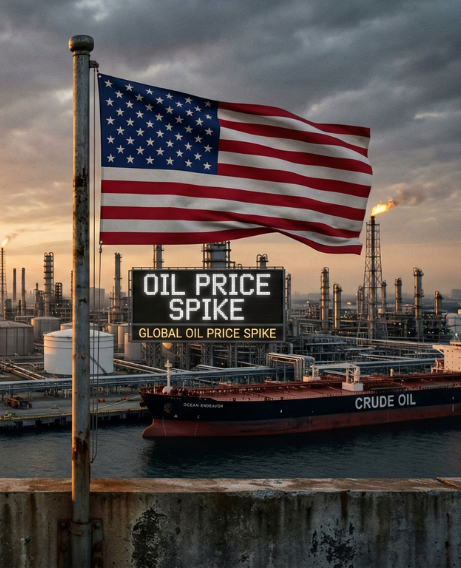
Amid escalating tensions in the Middle East, petroleum executives in Saudi Arabia are desperate to determine the upper limit of oil prices. Prices might reach a level that triggers a recession or a change in consumer behavior, whichever the situation demands.
According to reports from the NY Posts, the oil officials in the Gulf region are not in much pleasure with what they are seeing in matters related to energy supplies that are not ending soon. The oil officials in Saudi Arabia predict that the prices could soar past $180 a barrel following the continued disruptions that might persist until late April.
Such a hike would be a massive profit for oil-exporting countries, and increasing oil revenues would give a boost to such countries’ economies. However, such devastating disparity could also lead global consumers to reduce the use of oil and trigger a recession. Officials told the Wall Street Journal that they predict that Saudi Arabia will be the profiteer of the war it didn’t start.
Brent crude reached $111 on March 19 due to the continuation of Iran’s blockade of the Strait of Hormuz. The blockage disrupted the supply of millions of barrels. Pursued attacks on major energy infrastructures in the Middle East are threatening to keep prices soaring for a longer period of time, possibly even if the conflict ends soon.
READ: How a distant war is raising India’s cooking gas bills (March 7, 2026)
Although the US is termed to be the largest oil producer worldwide, it is at risk of a global energy shock. Goldman Sachs analysts warned the prolonged attacks on the Middle East oil fields could push the Atlantic basic benchmark, Brent Crude, above its benchmark of $147 set in 2008.
“The persistence of several prior large supply shocks underscores the risk that oil prices may stay above $100 for longer in risk scenarios with lengthier disruptions and large persistent supply losses,” the analysts highlighted.
After the strike at Iran’s South Pars gas field on March 18, Israeli Prime Minister Benjamin Netanyahu accepted President Trump’s idea of not repeating attacks. However, Tehran retaliated with air strikes on key energy facilities of Qatar and Saudi Arabia, including attacks on ships in the Gulf.
READ: Middle East conflict fears send oil prices up, could hit US gas prices (March 20, 2026)
Energy Secretary Chris Wright has said there is “a very good chance” that gasoline prices will be back below $3 by the summer, and oil experts suggest oil prices will quickly revert to previous levels after temporary supply interruptions. Nevertheless, Wright also warned there are “no guarantees in wars at all,” as analysts have proposed on extended supply disruptions, citing the longer conflict and severe damage from attacks on energy hubs.
As it stands, there is no clear sight of the end to the war. The Strait of Hormuz has been completely closed for 20 days, marking the largest-ever energy supply disruption. The International Energy Agency has requested households, businesses and governments to shift to working from home, vehicle sharing and flying less often to restrain soaring prices.
According to the Financial Times, the head of the International Energy Agency highlighted that it could take six months or longer to fully restore oil and gas flows through the Gulf. “The market isn’t acting like this is an end-of-March thing anymore,” Rebecca Babin, senior energy trader for CIBC Private Wealth, said.
“I don’t think $150 is out of the question in another month…You start talking about June, I’ll give you $180.” An Iranian military spokesperson reportedly warned that the price of oil could reach up to $200 a barrel. Wright has clarified that Americans need not “pay no attention to what Iran says.”
US Federal Reserve Chairman Jerome Powell warned that rising energy costs could result in higher inflation. “The net of the oil shock will still be some downward pressure on spending and employment and upward pressure on inflation,” Powell said. The Federal Reserve on Wednesday kept interest rates unchanged at 3.5% to 3.75%, citing uncertainty on the ongoing war.