



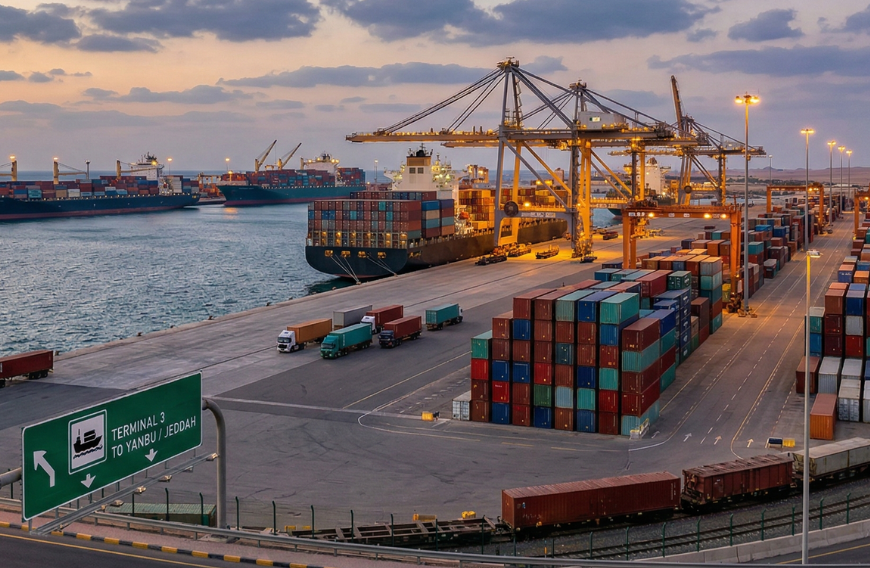
As Iran continues to exert its influence over the Strait of Hormuz, countries may be turning to an alternative. Saudi Arabia’s Red Sea port of Jeddah is bracing for an increase in business over the next two weeks.
As per MarineTraffic data shared with CNN, when the war began, over 60 ships en route to ports in the gulf had to divert, some back to their home bases in China and India, others headed to ports on the Arabian Peninsula along the Arabian and Red seas, while others chose regional ports farther afield.
“There is no industry standard for this crisis. Your cargo’s arrival date now depends entirely on which carrier’s strategy you’re tied to,” wrote Ronan Boudet, head of container intelligence at Kpler, which specializes in global trade analytics.
“The region is extremely import-driven, which means that from all the containers that are coming into the region, every single commodity that you could think of would be within those containers,” said Charles van der Steene, regional managing director of shipping giant Maersk.
READ: Oil prices climb amid Iran war, Hormuz disruption sparks fears of worst crisis since 1970s (March 23, 2026)
“Food and medicine are the priority … Whether it is for the UAE, whether it’s for Saudi, whether it’s for Bahrain or Kuwait, and any other country within the gulf, these are the prime priority to make sure that the population can receive what they need as part of their daily life,” he explained.
Officials at the Jeddah port, the biggest in Saudi Arabia, told CNN during a visit Sunday that an increase in demand will be reflected in a 50% surge in arrivals in two weeks.
What is the Port of Jeddah?
The Port of Jeddah, officially known as King Abdulaziz Port, is the largest and one of the busiest seaports in Saudi Arabia and the Red Sea region. Located on the western coast of the country near the city of Jeddah, it serves as a key gateway for both imports and exports, connecting Saudi Arabia to global trade routes through the Red Sea and beyond. Established in 1975, the port has grown to handle millions of tons of cargo annually, including containerized goods, bulk shipments, and general cargo.
The port plays a critical role in supporting Saudi Arabia’s economy, particularly for the import of essential goods, food, and industrial materials. It is equipped with modern container terminals, cranes, and logistics facilities to manage large-scale shipments efficiently. Strategically, the Port of Jeddah is supposedly vital for trade in the Middle East, offering an alternative route to the Gulf region during times of regional maritime disruption, making it a crucial hub for both commercial and humanitarian supply chains.
READ: Iran war disrupts Hormuz shipping; LA port chief flags safety risks, fuel surge (March 17, 2026)
The disruption of shipping routes in the Gulf has forced companies and nations to explore alternative ports and logistical solutions, underscoring the critical dependence of regional economies on uninterrupted maritime commerce. This shift not only affects shipping schedules but also has broader economic implications, as rerouted vessels and adjusted supply chains can increase costs, strain infrastructure, and delay the delivery of essential goods.
The growing reliance on alternative ports, such as those along the Red Sea, reflects the flexibility and adaptability of global trade networks in times of crisis. However, this adaptability is not without limits. Ports must handle sudden surges in traffic, requiring rapid adjustments in workforce, storage capacity, and customs processing. Operational efficiency may be challenged, and bottlenecks could lead to delays and heightened logistical risks.
Prioritization of critical goods like food and medicine demonstrates the importance of strategic planning in mitigating humanitarian and economic consequences during disruptions. At the same time, such crises reveal the broader interdependence of nations, carriers, and supply chains, where even minor shifts in shipping patterns could have ripple effects on global markets.