



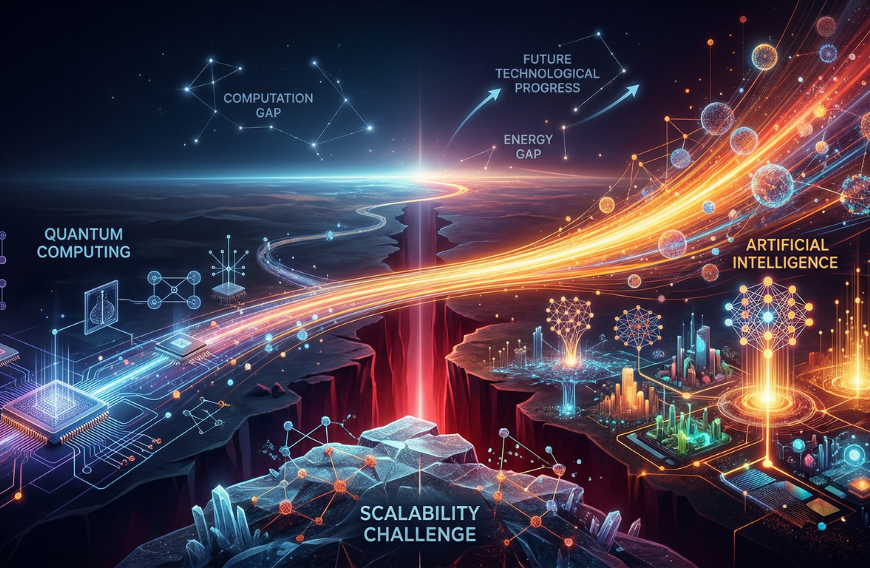
Quantum computing begins with a simple but departure from the way today’s computers work. Classical systems process information in bits that exist as either 0 or 1. Quantum computers use qubits, which draw on the principles of superposition and entanglement to exist in multiple states at once.
Instead of evaluating possibilities one step at a time, a quantum system can explore many paths simultaneously, dramatically expanding the range and speed of computation. This is not an incremental improvement in processing power; it is a fundamentally different model of computation.
That distinction is precisely why quantum computing is so critical to the future of artificial intelligence. Modern AI systems, from large language models to advanced vision architectures, are built on optimization—finding the best solution within an enormous and complex landscape of possibilities. As models grow in size and sophistication, the computational burden required to train and operate them increases exponentially.
The irony is that a quantum state, by definition, allows multiple possibilities to coexist simultaneously, yet in the evolution of quantum computing and AI, that convergence remains unrealized.
READ: Sreedhar Potarazu | Artificial intelligence or artificial temptation? Risks of training AI on human instincts (March 17, 2026)
Classical computing has managed to keep pace through better chips, distributed systems, and algorithmic refinements, but those gains are beginning to show signs of strain at scale.
Quantum computing offers a pathway to accelerate these optimization processes, reduce the computational load, and enable entirely new forms of modeling, particularly in areas such as molecular structures and genetic mapping that can happen in minutes instead of years with quantum. But there is a problem.
While AI is advancing at extraordinary speed, quantum computing remains roughly a decade behind in terms of practical, scalable deployment.
This divergence has created a widening gap between what AI demands and what current computing infrastructure can support. The result is a technological imbalance: one field is scaling rapidly, while the other, which may ultimately be necessary to sustain that growth, is still in its formative stages.
Artificial intelligence today is beginning to encounter the limits of classical computation. Training state-of-the-art models already requires immense computation power, vast energy consumption, and increasingly specialized hardware.
Each successive improvement comes at a higher cost, both financially and energetically. The pattern resembles a system under stress like adding more layers of software onto an old PC that was never designed to handle such complexity. Over time, performance gains slow, inefficiencies accumulate, and the system becomes harder to scale. Without a new computational paradigm, AI risks reaching a plateau where further progress becomes prohibitively expensive and operationally inefficient.
Quantum computing has the theoretical potential to break through this ceiling, but its development has not kept pace with the urgency of AI’s needs. One of the primary reasons is the disparity in investment.
READ: Sreedhar Potarazu | Drone vision and AI warfare: How intelligent drones are changing the battlefield (March 10, 2026)
Artificial intelligence has attracted hundreds of billions of dollars globally, fueled by immediate commercial applications and competitive pressure across industries. Quantum computing, by contrast, has received only a fraction of that funding. While governments and research institutions have made significant commitments, and private capital has begun to flow into quantum startups, the total investment remains modest relative to AI. This imbalance has slowed the transition of quantum computing from experimental systems to scalable, reliable platforms.
The consequences of this funding gap are becoming more visible as AI systems push against the boundaries of classical infrastructure. Without a breakthrough in computational capability, the efficiency gains that have driven AI’s rapid progress may begin to diminish. At that point, the limiting factor will not be innovation in algorithms or access to data, but the physical constraints of the hardware itself. The industry could find itself in a position where increasing performance requires disproportionately larger investments in energy and infrastructure, undermining both scalability and economic sustainability.
The global race to close this gap adds another layer of complexity. The United States continues to lead in innovation, supported by a dynamic ecosystem of universities, startups, and private investment. However, its efforts are often decentralized, which can slow the translation of research into large-scale deployment.
Quantum computing is increasingly being framed as the next “Manhattan Project,” with both the United States and the United Kingdom treating it as a strategic national priority requiring coordinated government, academic, and private-sector investment. Much like the original wartime effort, the urgency is driven not only by scientific ambition but by the recognition that leadership in quantum could determine economic and security dominance for decades to come.
China has taken a more coordinated approach, investing heavily in quantum research as a matter of national strategy. Its ability to align funding, policy, and infrastructure gives it a potential advantage in accelerating development, particularly in areas such as quantum communication and cryptography.
India is emerging as a participant with growing ambition, leveraging its strengths in engineering talent and manufacturing capability. However, quantum computing introduces challenges that extend beyond fabrication and design.
READ: Sreedhar Potarazu | Happy Ugadi, Usha Vance (March 19, 2026)
One of the most underappreciated constraints in scaling quantum systems is energy. Quantum computers require highly controlled environments, often involving extreme cooling and continuous power stability. As systems scale, so too will their energy demands. This raises important questions for countries like India, where energy infrastructure is already under pressure from rapid economic growth and climate-related constraints.
Manufacturing quantum components is one challenge; sustaining the energy-intensive environments required for large-scale quantum operations is another. In a future where both AI and quantum computing demand enormous power resources, energy availability may become a decisive factor in determining technological leadership.
The intersection of these trends points to a critical inflection point. Artificial intelligence is advancing rapidly, but its long-term trajectory depends on a computational foundation that is approaching its limits. Quantum computing offers a potential solution, yet it remains years away from delivering at scale. This misalignment creates a period of uncertainty in which the pace of AI innovation may begin to slow before the next generation of computing is ready to take over.
The implications are both technological and strategic. If quantum computing development accelerates through increased investment and coordinated effort, it could unlock a new phase of AI growth, enabling capabilities that are currently out of reach. If it does not, the industry may face a period of stagnation, constrained by the very infrastructure that enabled its rise. The gap between AI and quantum computing is not just a matter of timing; it is a defining challenge that will shape the next era of technological progress.