



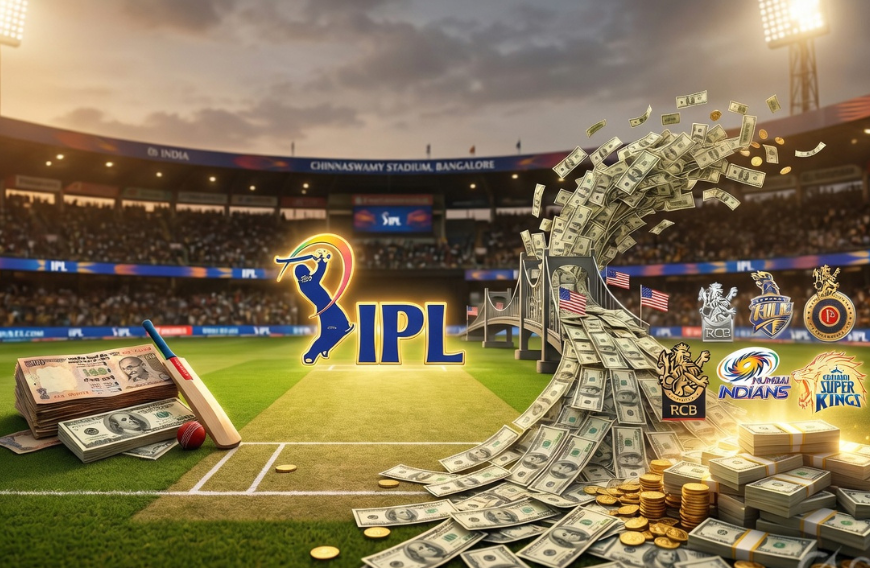
The deals may read like cricket headlines at first glance, but together they signal something far bigger. American capital is no longer circling the Indian Premier League. It is stepping in with conviction.
In the span of days, two IPL franchises have been valued at levels that would feel familiar in the United States. Royal Challengers Bengaluru (RCB) has been acquired at about $1.78 billion by a consortium that includes Blackstone and U.S. sports investor David Blitzer. Rajasthan Royals has changed hands at roughly $1.63 billion, backed by Walmart heir Rob Walton.
For American audiences, the headline numbers are striking. But the real story lies in what those numbers unlock next.
From cricket league to capital magnet
When the IPL launched in 2008, it looked more like a bold experiment than a mature investment platform. RCB was bought for about $111 million. Rajasthan Royals came in at $67 million, the lowest entry point in the league.
Today, both sit comfortably above $1.5 billion.
That kind of growth mirrors the trajectory of franchises in the National Football League and National Basketball Association. The difference is speed. What took decades in the US has happened in under 20 years in India.
READ: Kal Somani buys Rajasthan Royals for $1.63 billion (March 25, 2026)
For investors, that compression of value creation is hard to ignore.
Two blueprints, one outcome
What makes these deals particularly compelling is that they validate two very different investment strategies.
RCB is the classic premium asset. Its brand equity, powered by players like Virat Kohli, has translated into one of the most commercially dominant teams in the league. Even without consistent titles, it has remained a sponsorship and media powerhouse.
Rajasthan Royals offers a contrasting model. It built its identity on data, efficiency, and smart scouting. Over time, it expanded into a multi-team ecosystem with franchises in other T20 leagues. That structure is instantly recognizable to American investors accustomed to multi-club ownership models.
One is driven by brand. The other by systems. Both now command billion-dollar valuations.
That dual validation matters. It tells investors there is more than one way to win in the IPL.
Why U.S. money is moving now
The entry of firms like Blackstone and capital linked to Walmart reflects a broader shift in how sports are being valued globally.
The IPL today offers what American investors look for:
- Centralized media revenues that create predictable cash flows
- A closed league structure with limited teams, ensuring scarcity
- A massive, digital-first fan base that extends far beyond India
This is the same architecture that underpins franchise valuations in US sports. The unfamiliarity around cricket is no longer a barrier because the business model feels deeply familiar.
Closing the gap with American sports
READ: Indian American Sanjay Govil looks to buy IPL’s Royal Challengers Bangalore (
At valuations between $1.6 billion and $1.8 billion, RCB and Rajasthan Royals are now comparable to mid-tier teams in the NBA or lower-tier franchises in Major League Baseball (MLB).
That shift is significant. It places the IPL firmly within the global sports investment conversation.
Cricket may still be finding its cultural footing in the U.S., but economically, the gap is narrowing fast.
This is just the beginning
More important than the deals themselves is what they signal to the next wave of investors.
The IPL now looks like a market that has moved past its proof-of-concept phase. For U.S. investors, that changes the calculus.
Familiar playbook, new geography. The league offers a structure they already understand, but with higher growth potential.
Scarcity is creating urgency. With a limited number of franchises and most already locked in, the window to enter at scale is narrowing. That creates the kind of competitive pressure that has historically driven up valuations in U.S. leagues.
The multi-team ownership model is another draw. Investors like David Blitzer already operate across continents. The IPL fits naturally into portfolios that span basketball, soccer, and now cricket, unlocking synergies in analytics, talent pipelines, and fan monetization.
Then there is the digital upside. The IPL’s streaming and global audience story is still evolving. For American investors, that represents untapped headroom in areas like direct-to-consumer content, global sponsorships, and diaspora engagement.
READ: Who owns Royal Challengers Bengaluru Now? Inside David Blitzer and Blackstone’s big move (March 25, 2026)
In many ways, the IPL is where U.S. sports were a decade ago in terms of digital monetization. That gap is an opportunity.
What comes next
These valuations are likely to trigger a second wave of American participation.
Expect more private equity firms to explore stakes in existing franchises. Minority investments could become more common as entry prices rise. If new teams are introduced, competition for ownership could intensify quickly.
There is also a growing possibility that IPL franchises evolve into more structured financial entities, with institutional co-investment and even partial listings becoming part of the conversation.
The inflection point
What RCB and Rajasthan Royals ultimately represent is an inflection point.
The IPL is no longer just a successful cricket league. It is becoming a closed, high-growth sports economy with characteristics that American investors trust. Revenues are centralized, costs are relatively controlled, and asset values are compounding.
For years, cricket sat outside the global sports capital market. That is changing.
And if these deals are any indication, the next phase of IPL growth will not just be driven from India. It will be shaped as much in New York boardrooms as it is on the field.