



By Girish Kumar
The India International Centre has long been one of those Delhi institutions where the country’s anxieties and ambitions are discussed with a seriousness that borders on ritual. It is a place where policy veterans still believe in the power of conversation, where academics arrive armed with footnotes, and where the coffee, though unremarkable, is consumed with the intensity of a civic duty.
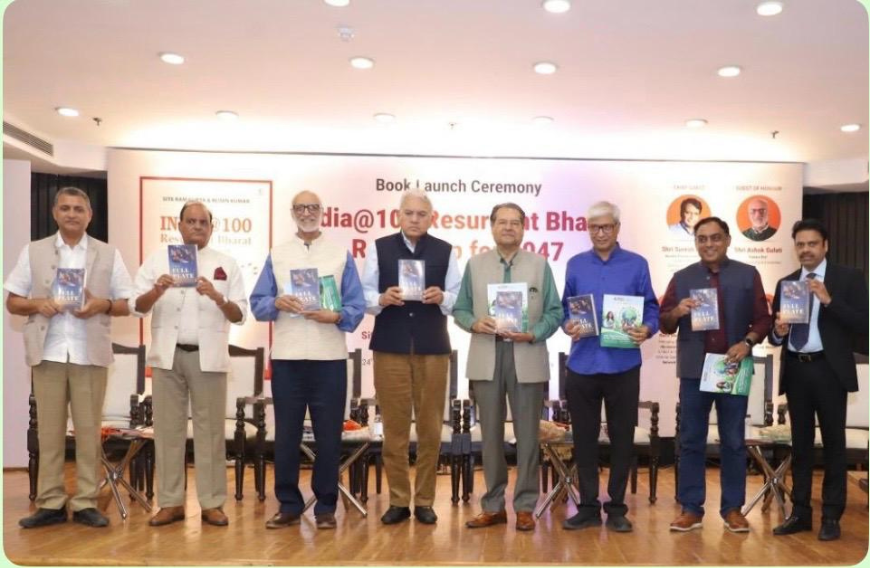
On the evening The Full Plate: India’s Education Revolution and the Race for Human Capital was launched, the Centre was in familiar form. The room filled with people who have spent years thinking about India’s education system—some professionally, others as a lifelong habit—and who understand that the subject is too important to be left to slogans.
Satish Jha, the author, has spent decades moving across journalism, technology, governance, and education, a career trajectory that in India is less a résumé than a survival strategy.
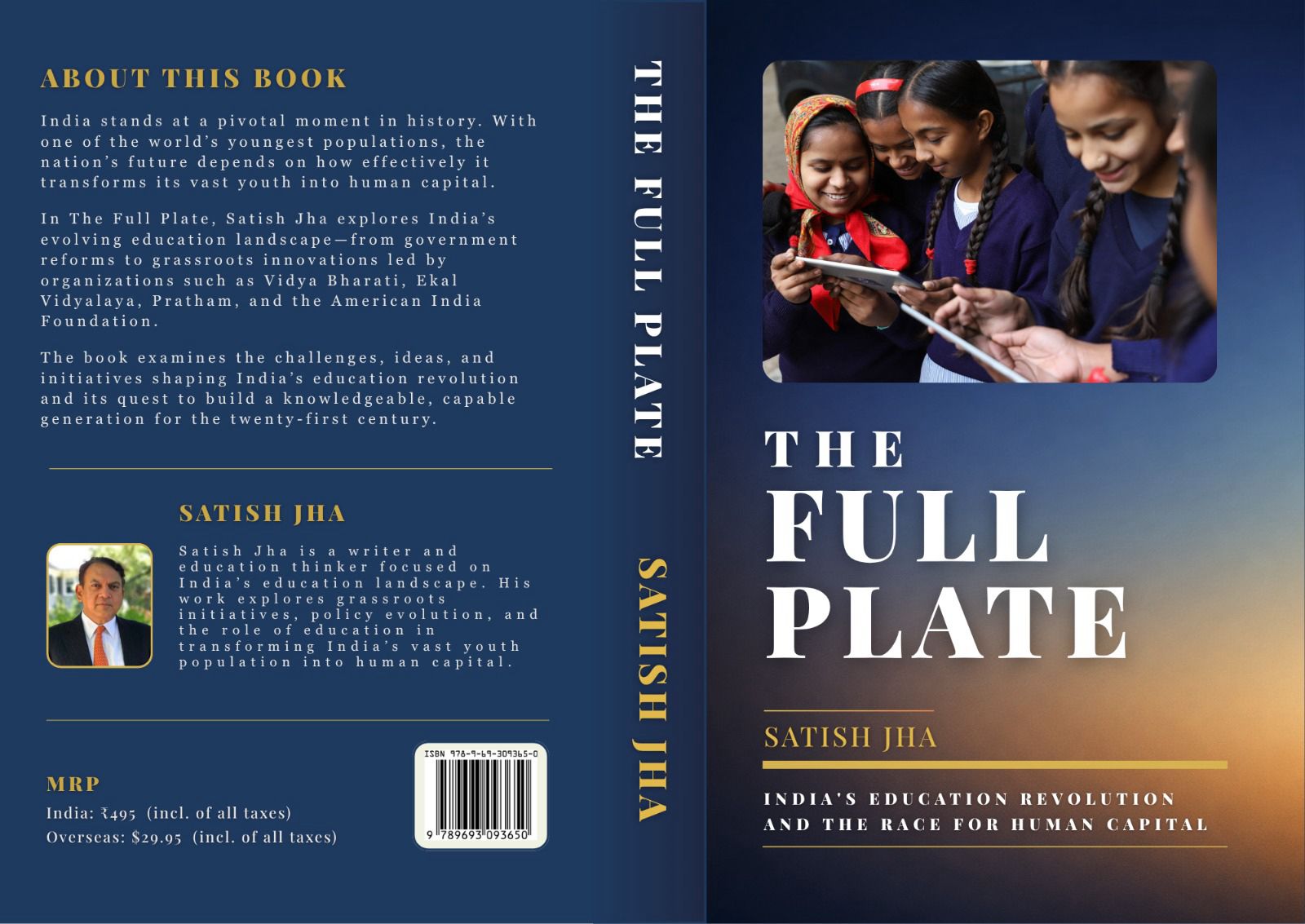
His new book attempts something deceptively modest: to understand how four organizations—Vidyabharati, Ekal, Pratham, and the America India Foundation—have managed to improve learning outcomes in places where resources are scarce, distances are long, and optimism is often the only reliable infrastructure.
In a country where education debates often oscillate between despair and grandiosity, Jha’s premise is refreshingly grounded. He is not offering a new policy framework, a new dashboard, or a new acronym. He is offering something rarer: a close look at what actually works.
The launch panel reflected the breadth of the challenge. Former Union Minister Suresh Prabhu, agricultural economist Ashok Gulati, former Government of India Secretary Bhaskar Chatterji, educationist Jawahar Surisetti, Member of Parliament Sudhakar, social activist Sitaram Gupta, and journalist‑scholar Nalin Mehta shared the stage.
The event was curated by Rusen Kumar, a CSR evangelist who has spent years persuading corporations that social responsibility is not merely a decorative flourish. The group differed in ideology and temperament, but they converged on one point: India’s education challenge is no longer a matter of diagnosing failure. It is a matter of learning from success—however scattered, however imperfect.
Jha’s examination of the four organizations is neither celebratory nor cynical. Instead, it is a study of institutional craft: how teachers are supported, how communities are engaged, how systems learn from their own mistakes. These organizations differ in scale, philosophy, and geography, but they share a commitment to the learner that is both stubborn and unfashionable.
READ: ‘Heartlines’ launch in Kolkata: Chandrani Ghosh brings Indian American love story home (March 20, 2026)
In an era when education reform is often reduced to apps, dashboards, and “scalable solutions,” Jha’s attention to the everyday feels almost subversive. He writes about classrooms where the electricity flickers but the teaching does not; about volunteers who walk miles to conduct assessments; about parents who insist, against all odds, on the dignity of aspiration. The book’s argument is clear: India’s education revolution will not be engineered from above. It will be built from below, through the slow accumulation of human capital.
Among the book’s early admirers is Sam Pitroda, the architect of India’s telecom revolution, who understands better than most the limits of technology. “Technology without human capital is meaningless,” he writes, a sentence that should be printed on the login screen of every education app in the country. Pitroda’s endorsement places the book in a lineage of Indian reform literature that treats technology not as a savior but as an amplifier—one that can widen inequity as easily as it can expand opportunity. It is a reminder that India’s digital public goods, however impressive, cannot compensate for the absence of capable teachers or functioning classrooms.
If Pitroda represents India’s technological imagination, Amitabh Kant represents its administrative one. His foreword reads like a meditation on the ethics of reform. Kant praises Jha’s “clarity, integrity, and impact,” and his ability to “hold complexity without losing sight of the human being at the center.”
His central insight—that India must reject the false choice between scale and humanity—echoes throughout the book. The Full Plate is not a policy manual, nor a memoir, nor a theoretical treatise. It is, as Kant puts it, “a narrative of possibility,” a phrase that captures both the urgency and the optimism that run through the work.
Since its online release on March 12, reviewers have placed The Full Plate in the intellectual company of Amartya Sen’s Development as Freedom and Banerjee and Duflo’s Poor Economics. The comparison is not hyperbole. Like those works, Jha’s book is grounded in the granular realities that shape human capability.
READ: There is an autobiographical element to my storytelling: ‘Heartlines’ author Chandrani Ghosh on her debut novel (February 27, 2026)
But what distinguishes The Full Plate is its refusal to indulge in despair. India’s education system is vast, uneven, and often exasperating. Yet Jha insists that transformation is possible—not through sweeping reforms, but through the cumulative effect of small, persistent acts of competence. In a country where cynicism is often mistaken for sophistication, this is a quietly radical stance.
At the close of the launch, Jha announced that he is developing The Full Plate Framework, a structured approach to help policymakers, educators, and philanthropists translate the book’s insights into practice. If the book is the conversation starter, the framework aims to be the blueprint. It is an ambitious undertaking, but then again, so is the idea that a billion‑person nation can educate itself into a different future.
What makes The Full Plate significant is not its diagnosis—India’s education challenges are well known—but its method. Jha listens. He observes. He resists the temptation to romanticize or condemn. He studies what works, and more importantly, why it works. The book’s deeper message is that India’s future will be determined not by its GDP but by its classrooms; not by its infrastructure but by its imagination. And imagination, Jha suggests, is a public good that must be cultivated with care.
In a country racing toward economic ambition, The Full Plate is a reminder that the race that matters most is the one taking place quietly, every day, in its schools.
(Girish Kumar is a technology graduate with passion for education and has been supporting education quality improvement programs with non-state actors.)