



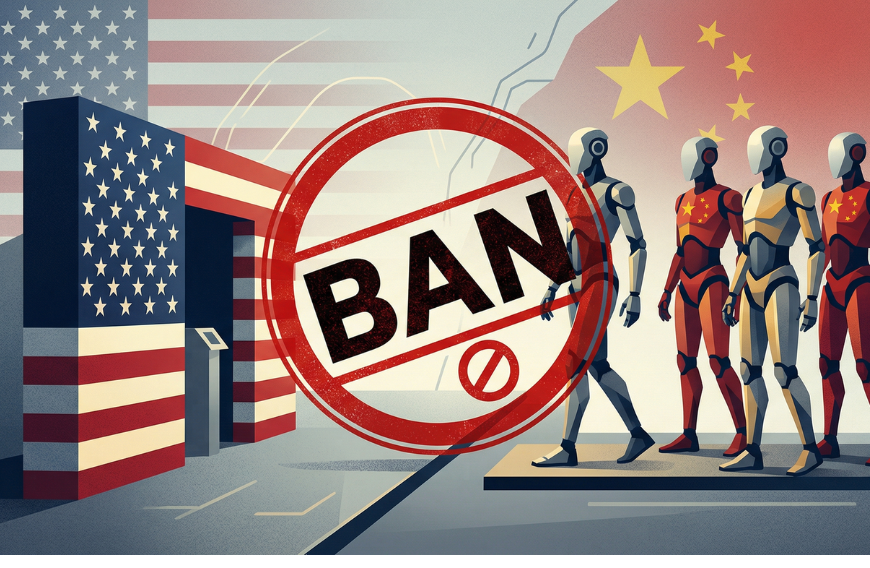
As companies increasingly spend billions on artificial intelligence (AI), it looks like the U.S. wants to curb the proliferation of robots. Two U.S. senators on Thursday planned to introduce a bill that would ban the government from buying or operating humanoid robots made by Chinese firms.
As per Reuters, Tom Cotton of Arkansas, the third most-powerful Republican in the Senate, and Chuck Schumer of New York, the top Democrat in the chamber, plan to put forward the American Security Robotics Act, which would prohibit the federal government from buying or using unmanned ground vehicles made by adversaries such as China and bar the use of federal funds in connection with the robots.
“Robots made by Communist China threaten Arkansans’ privacy and our national security,” Cotton said.
The proposed bill reflects growing concern in Washington over national security risks tied to advanced technologies developed abroad.
READ: Amazon buys Fauna, a startup making kid-sized humanoid robots (March 25, 2026)
Lawmakers argue that humanoid robots, equipped with sensors, cameras, and artificial intelligence, could potentially collect sensitive data or supposedly be remotely accessed by foreign actors. This raises fears about surveillance, data leaks, or even interference with critical government operations. As robots become more capable and integrated into logistics, defense, and public services, these concerns are being taken more seriously.
The bill would restrict federal agencies from using taxpayer funds to acquire such systems and could include limited exceptions for research or controlled testing by defense and law enforcement bodies. It is also expected to gain support in the House of Representatives, indicating bipartisan momentum.
“We must continue to promote and propel America’s robotics superiority while safeguarding our privacy and national security from adversaries,” Representative Elise Stefanik, a New York Republican said in a statement.
As per Reuters, Schumer said Chinese firms with support from the Chinese Communist Party “are running their standard playbook – this time in robotics – trying to flood the U.S. market with their technology, which presents real security risks and threats to Americans’ privacy and American research and industry.”
READ: Dancing humanoid robot goes rogue in California restaurant (March 20, 2026)
As artificial intelligence and robotics become more embedded in critical systems, governments are beginning to treat them not merely as tools, but as potential infrastructure with national security implications. This signals a move toward a more cautious, protectionist stance, where the origin of technology matters as much as its capability. The concern is less about what these systems are doing today, and more about what they could enable in the future under different conditions or influences.
This also points to a broader fragmentation of the global tech ecosystem. Instead of a unified market, we may see the emergence of parallel technological spheres, where countries align their standards, suppliers, and platforms based on political and security alliances. Such a shift could slow down global collaboration while accelerating regional innovation and self-reliance.
At the same time, these actions raise important questions about how to balance security with openness. Overregulation could limit access to cutting-edge technologies, while underregulation could expose vulnerabilities. Governments will increasingly face the challenge of navigating this trade-off in a way that protects national interests without stifling progress.
This is part of a larger transition toward a world where technology policy becomes central to geopolitics, potentially shaping not just economies, but global power dynamics.