



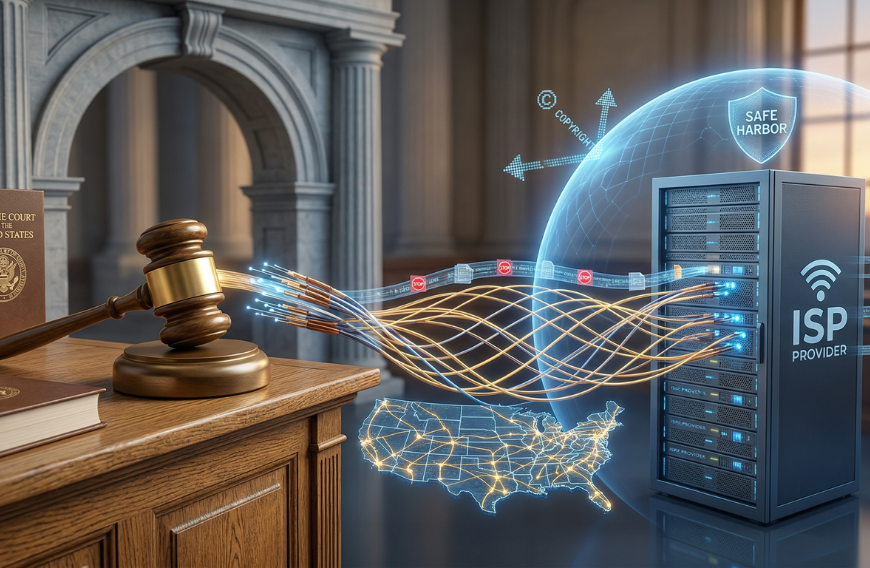
The U.S. Supreme Court ruled unanimously on Wednesday that internet providers are not liable for copyright infringement by their users.
“Under our precedents, a company is not liable as a copyright infringer for merely providing a service to the public with knowledge that it will be used by some to infringe copyrights,” Justice Clarence Thomas wrote in opinion in the Cox v. Sony lawsuit. “Accordingly, we reverse.”
Justice Sonia Sotomayor, joined by Justice Ketanji Brown Jackson, agreed Cox should prevail in this case but rejected the majority’s broader reasoning. Sotomayor wrote that “the majority, without any meaningful explanation, unnecessarily limits secondary liability” and warned that the decision “also upends the statutory incentive structure that Congress created.”
READ: US to stop collecting tariffs deemed illegal by Supreme Court from Tuesday (February 23, 2026)
The ruling is a significant win for broadband providers facing pressure from copyright owners to police subscriber activity. It states that Cox Communications cannot be held liable for piracy by its internet service subscribers of songs owned by Sony Music, Warner Music Group, Universal Music Group and other labels. This ends their copyright lawsuit, worth over a billion dollars.
Earlier, a jury had awarded Sony Music Entertainment and other record companies a $1 billion verdict against Cox Communications for the infringement of more than 10,000 copyrighted works. While a federal appeals court threw out the award, it nevertheless upheld the judgement that Cox could be held indirectly liable for contributing to infringement on a massive scale.
Cox said that a victory by Sony could have rather adverse consequences for internet users. It said that for instance, institutional customers like universities and hospitals could be entirely cut off from the internet if only a few users on their campuses were downloading pirated music. That argument seemed to resonate with both liberal and conservative justices during oral arguments in early December 2025.
READ: US trade deficit in 2025 ended similar to 2024 despite Trump tariffs (
More than 50 labels had joined together to sue Cox in 2018. Internet service providers like Cox are not usually considered liable under U.S. law for infringement by their users if they take reasonable measures to address it. However, the labels accused Cox, the largest unit of privately-owned Cox Enterprises, of failing to respond to thousands of infringement notices, cut off internet access for repeat infringers or take other piracy-deterrence steps.
“Today’s 9-0 decision in Cox v. Sony reaffirms a bedrock principle in American copyright law: liability for copyright infringement should fall on infringers and those who intentionally enable them, not on neutral technologies and platforms essential to our internet infrastructure,” Re:Create Executive Director Brandon Butler wrote in a statement. Butler claimed that a different ruling would have “inevitably led to mass surveillance, censorship, and a chilling effect on both innovation and creativity.”