



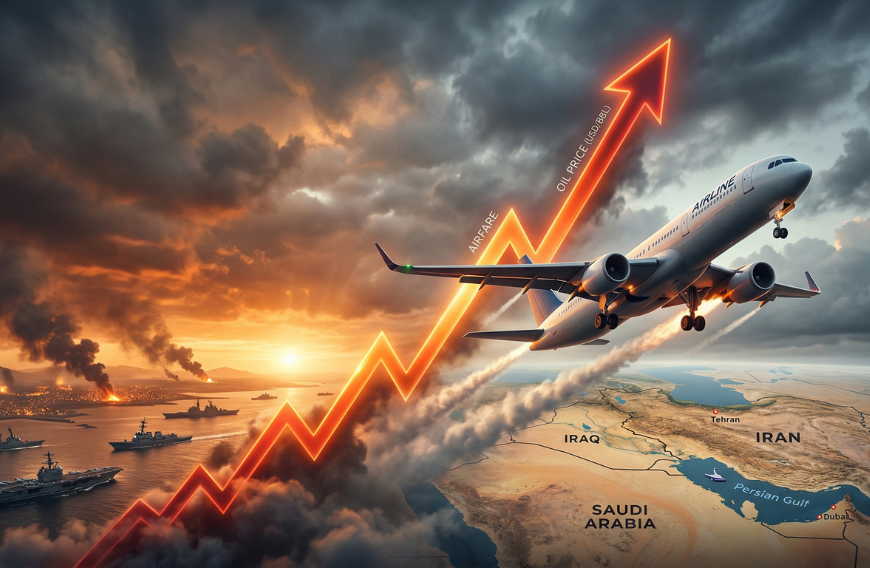
Global airlines have begun to hike fares and cut capacity to cope with the sudden surge in the oil price due the U.S.-Iran conflict, but the industry’s ability to remain profitable may depend on whether consumers pull back on flying as gasoline costs threaten household budgets.
“Airlines face an existential challenge,” said Rigas Doganis, who once headed Greece’s former national carrier, Olympic Airways and served as a director of Britain’s easyJet.
“They will need to cut fares to stimulate weakening demand while higher fuel costs will be pushing them to increase fares. A perfect storm,” said Doganis, who now chairs London-based consultancy firm Airline Management Group.
As per Reuters, before the U.S.-Israeli conflict with Iran began last month, the airline industry had forecast record profits of $41 billion in 2026, but a doubling in jet fuel prices has placed that at risk and forced carriers to rethink their networks and strategies.
READ: Middle East conflict fears send oil prices up, could hit US gas prices (March 20, 2026)
“The only way to get prices up is to reduce capacity,” said Barclays’ head of European transport equity research Andrew Lobbenberg. “That is what I would expect to see happen this time, and it’s what we saw in the previous occasions when we had other crises; people just have to start trimming capacity.”
Aviation is particularly vulnerable because it relies heavily on fuel while also depending on discretionary spending. When both costs and consumer caution rise at the same time, the industry is squeezed from both sides, making stability difficult to maintain.
As per Reuters, low-cost carriers could struggle the most given their passengers are more price-sensitive than the corporate customers and wealthy consumers who have been increasingly targeted by premium rivals like Delta Air Lines and United Airlines, analysts say.
“I think for the more price-sensitive travellers, even the short-haul flying trip gets downgraded, potentially to rail or to bus or other alternatives,” said Nathan Gee, Bank of America’s head of Asia-Pacific transport research.
READ: India faces energy risks as Hormuz closure disrupts global oil flows (
This situation reflects a supposed recurring pattern in the global economy: external shocks, whether geopolitical, environmental, or financial, tend to expose structural weaknesses. Airlines operate on relatively thin margins even in favorable conditions, so sudden disruptions force rapid adjustments. These adjustments don’t just affect airline balance sheets; they ripple outward to tourism, trade, and regional economies that depend on air connectivity.
Another important implication is the shift in consumer priorities. When travel becomes more expensive, people reassess what is essential versus optional. This could accelerate longer-term behavioral changes, such as fewer short trips, increased use of alternative transport, or a stronger preference for value over convenience. Businesses tied to travel demand may also need to rethink their strategies in response to more cautious spending patterns.
This moment underscores the importance of adaptability. Industries that can quickly realign capacity, manage costs, and respond to changing demand will be better positioned to navigate uncertainty. At the same time, it serves as a reminder that global crises rarely remain isolated—they tend to cascade across sectors, shaping both economic outcomes and everyday decisions for consumers worldwide.